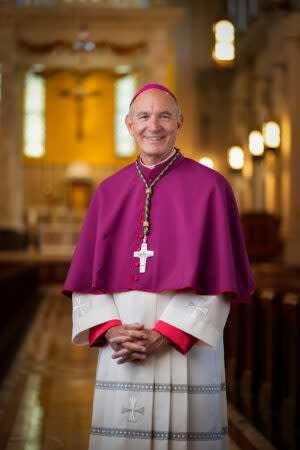
Bishop Mark Beckman
On Friday, July 26, James Mark Beckman became the fourth bishop of the Diocese of Knoxville. He goes by his middle name so, while we will call him “Bishop Beckman,” in the prayers of the Mass, he will be called, “our bishop, Mark.”
I’ve not had the pleasure of meeting Bishop Beckman yet. I was hoping to attend the Vespers service for him on Thursday evening but was prevented from doing so because of a family matter. I never planned on attending his ordination and installation ceremony on Friday because Fridays are a dialysis day, and I am often weak after dialysis. I didn’t think I could make it through a three-plus hour service, and I think that was a good call. I do hope to meet him at one of the deanery Masses he’ll be celebrating soon.
As for now, allow me to share the information on Bishop Beckman on the diocesan website. It’s sparse, but he’s new at being a bishop. My prayers, and those of Catholics all over east Tennessee, are for his success in his role as chief shepherd of the Diocese of Knoxville and in his duties to sanctify, teach, and govern.
From the Diocese of Knoxville website:
Bishop Mark Beckman was born on October 19, 1962, in Lawrenceburg, Tenn., which is located within the Diocese of Nashville. He attended Sacred Heart School and Lawrence County High School and received a bachelor’s degree in history from St. Ambrose College in Davenport, Iowa in 1984. He also earned a master’s degree in religious studies from the Catholic University in Louvain, Belgium in 1988.
He was ordained a priest of the Diocese of Nashville by Bishop James D. Niedergeses on July 13, 1990. He served as associate pastor of Holy Rosary Parish, Nashville (1990-91); teacher and associate principal of Father Ryan High School, Nashville (1990-96); pastor of Our Lady of Lourdes Parish, Springfield, Tenn. and St. Michael Mission, Cedar Hill, Tenn. (1996-2002); pastor of St. Matthew Parish, Franklin, Tenn. (2002-15); and pastor of St. Henry Parish, Nashville (2015-2024). He also served as director of priest personnel for the Diocese of Nashville 2018-2024.
Bishop Beckman is an avid hiker and plans to continue his passion for the outdoors while serving in the Diocese of Knoxville.
Pope Francis appointed Bishop Beckman as the fourth Bishop of the Diocese of Knoxville on May 7, 2024. He was ordained and installed as the Bishop of Knoxville on July 26, 2024.
And, also from the diocesan website, regarding Bishop Beckman’s coat of arms (which is always fun!):
- Ecclesiastical heraldry developed in the Church as a way of identifying people and dioceses and to offically mark documents. Every bishop and diocese has a coat of arms that is unique to that person/diocese. In designing his shield—the central element in what is formally called the heraldic achievement—a bishop has an opportunity to depict symbolically various aspects of his own life and heritage and to highlight particular aspects of Catholic faith and devotion that are important to him. Every coat of arms includes external elements that identify the rank of the bearer: the low crowned, wide brimmed ecclesiastical hat, commonly the Roman galero, indicates rank based on its ornamentation and color (bishop is green, cardinal is red, etc.). With the internal elements, the bishop has the opportunity to depict symbollically various aspects of his own life and/or highlight particular aspects of the faith that are important to him. A blazon, derived from medieval French and English terms, is an official description, allowing the appearance and position of each element to be recorded precisely.
 Bishop-elect Beckman is an avid hiker and has a deep appreciation for the beauty of God’s creation. His coat of arms reflects this part of his life, in which he has found much solace and communion with God in prayer. His personal arms display a symbolic natural setting on a field of green (vert), which also has ties to the bishop’s heritage, and to Sacred Scripture.The bishop’s surname is German, and derives from the word beck, which means a stream or brook. This is depicted by the wavy vertical lines (pale wavy) painted white and blue (argent and azure) in the center of the shield. This also recalls the prophecy related by St. John the Evangelist about the City of God, the New Jerusalem, which he sees in a vision near the end of the Book of Revelation: “Then the angel showed me, the river of the water of life, bright as crystal, flowing from the throne of God and of the Lamb through the middle of the street of the city” (Rev 22:1). John also saw, “on either side of the river, the tree of life with its twelve kinds of fruit, yielding its fruit each month. The leaves of the tree were for the healing of the nations” (Rev 22:2). The tree of life and its fruit are alluded to here by twelve leaves of the tulip poplar (Liriodendron tulipifera). This was chosen as the state tree of Tennessee in 1947, because, as the Tennessee Assembly wrote at the time, “it grows from one end of the state to the other,” and “was extensively used by the pioneers of the state to construct houses, barns, and other necessary farm buildings.” It is an appropriate symbol for the state that comprises both the Diocese of Nashville, where Bishop-elect Beckman was born and served as a priest, and the Diocese of Knoxville, which he will serve as its bishop.The scroll below the shield is inscribed with the bishop’s motto. It is taken from the Letter to the Hebrews: “Jesus Christ is the same, yesterday, today, and forever” (Heb 13:8).
  A diocesan bishop shows his commitment to the flock he shepherds by combining his personal coat of arms with that of the diocese, in a technique known as impaling.The central feature of the coat of arms of the Diocese of Knoxville, designed by Deacon Paul Sullivan in 1988, is a cross in gold (Or), taken from the arms of Pope John Paul II, who established the diocese. Three small red (Gules) crosses on this large gold cross represent the three dioceses in the state of Tennessee.The background of the shield that shows behind the cross is divided quarterly into areas of red and blue (Azure). Charges in these quarters allude to natural features that dominate the landscape of East Tennessee: mountains, a dogwood blossom, and the Tennessee River. A railroad trestle in the bottom right quarter honors the Irish immigrants who brought the Catholic faith to the area, many of whom worked constructing railroads, especially trestles. A diocesan bishop shows his commitment to the flock he shepherds by combining his personal coat of arms with that of the diocese, in a technique known as impaling. The shield is divided in half along the pale or central vertical line. The arms of the diocese appear on the dexter side—that is, on the side of the shield to the viewer’s left, which would cover the right side (in Latin, dextera) of the person carrying the shield. The arms of the bishop are on the sinister side—the bearer’s left, the viewer’s right.
Be Christ for all. Bring Christ to all. See Christ in all.
 Thoughts and Prayers for the Faithful