
First Reading: Joshua 24:1-2a, 15-17, 18b
Joshua gathered together all the tribes of Israel at Shechem, summoning their elders, their leaders, their judges, and their officers. When they stood in the ranks before God, Joshua addressed all the people: “If it does not please you to serve the LORD, decide today whom you will serve, the gods your fathers served beyond the River or the gods of the Amorites in whose country you are now dwelling. As for me and my household, we will serve the LORD.” But the people answered, “Far be it for us to forsake the LORD for the service of other gods. For it was the LORD, our God, who brought us and out fathers up out of the land of Egypt, out of a state of slavery. He performed those great miracles before our very eyes and protected us along our entire journey and among the peoples through whom we passed. Therefore we also will serve the LORD, for he is our God.”
Second Reading: Ephesians 5:21-32
Brothers and sisters: Be subordinate to one another out of reverence for Christ. Wives should be subordinate to their husbands as to the Lord. For the husband is head of his wife just as Christ is head of the church, he himself the savior of the body. As the church is subordinate to Christ, so wives should be subordinate to their husbands in everything. Husbands, love your wives, even as Christ loved the church and handed himself over for her to sanctify her, cleansing her by the bath of water with the word, that he might present himself the church in splendor, without spot or wrinkle or any such thing, that she might be holy and without blemish. So also husbands should love their wives as their own bodies. He who loves his wife loves himself. For no one hates his own flesh but rather nourishes and cherishes it, even as Christ does the church, because we are members of his body. For this reason a man shall leave his father and his mother and be joined to his wife, and the two shall become one flesh. This is a great mystery, but I speak in reference to Christ and the church.
Gospel: John 6:60-69
Many of Jesus’ disciples who were listening said, “This saying is hard; who can accept it?” Since Jesus knew that his disciples were murmuring about this, he said to them, “Does this shock you? What if you were to see the Son of Man ascending to where he was before? It is the spirit that gives life, while the flesh is of no avail. The words I have spoken to you are Spirit and life. But there are some of you who do not believe.” Jesus knew from the beginning the ones who would not believe and the one who would betray him. And he said, “For this reason I have told you that no one can come to me unless it is granted him by my Father.” As a result of this, many of his disciples returned to their former way of life and no longer accompanied him. Jesus then said to the Twelves, “Do you also want to leave?” Simon Peter answered him, “Master, to whom shall we go? You have the words of eternal life. We have come to believe and are convinced that you are the Holy One of God.”
I want to begin with the reading from Paul’s Letter to the Ephesians. I think the key to understanding this reading is the first and last verses: “Be subordinate to each other out of reverence for Christ” … and “This is a great mystery, but I speak in reference to Christ and the church.” What is Paul’s concern here? Is it the proper order of the family? Yes, but to a purpose. And that purpose is the salvation of souls. This is always Paul’s purpose when he writes his letters.
The point is, as Paul says, to be subordinate to each other out of reverence for Christ. It is out of reverence for Christ that the husband and wife are to be subordinate to each other, as each, in a way, attempts to out-do the other in their service to each other out of reverence for Christ, because they are now one flesh in Christ, and the purpose of their union, ultimately, is their salvation. The wife is to work toward the salvation of her husband, and the husband toward the salvation of his wife. They are one flesh in Christ, just as Christ and the Church are one in His body. This is a great mystery.
But, every Church needs a head. Just as the diocesan Church has a bishop and a parochial, or parish, Church has a pastor, so too the domestic Church, the Church in the home, has a head, and that is the husband/father. A Church without a head, as St. Ignatius of Antioch wrote, is not a Church.
Paul tells the wife to be subordinate to her husband as the Church is to Christ. As the diocese is to the bishop. As the parish is to the pastor. Without order in the Church, there is confusion, and there must be no confusion in the Body of Christ.
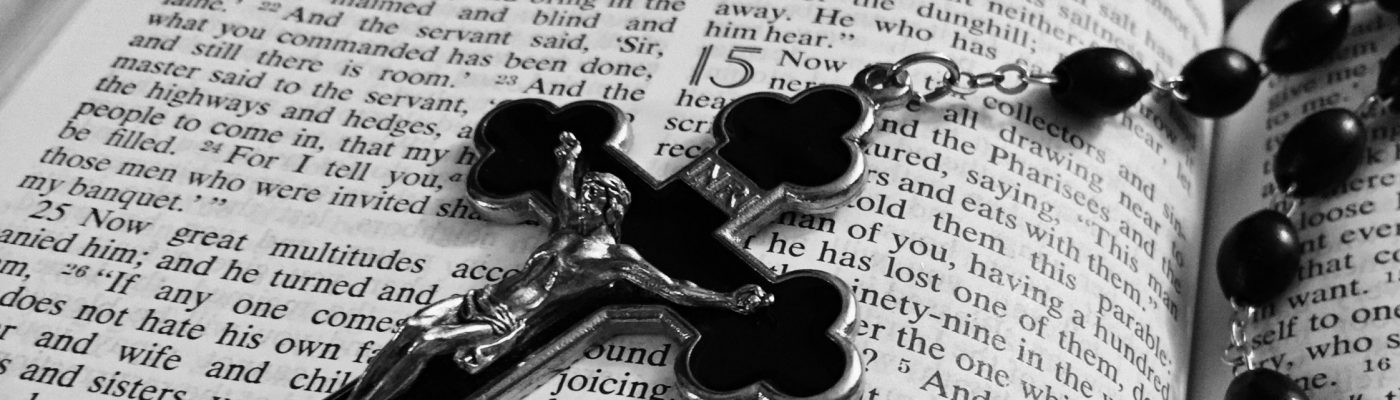
Then Paul tells the husband to love his wife even as Christ loved the Church. And how did Christ love the Church? There it is, right up there (pointing to the crucifix). This is how Christ loved His Church. He gave His life for His Church.
St. Augustine of Hippo said that the responsibility of the Catholic husband is the same toward his domestic Church as is that of the bishop toward his diocesan Church. As the spiritual head of the household, then, the husband is the one who will be held accountable before God for his domestic Church. It is the responsibility of the husband to ensure that his domestic Church, his family, is participating in the sacramental life of the Church, is praying at home, that his children are taught the faith and morals of the Church, and that his family is involved in some service to the Church and the community.
Some of our Evangelical brothers like to look to the image of Christ the King as their model for their role as spiritual head of the household. I would like to suggest the image of Christ as servant leader as a more appropriate model. Christ is King, of course, but recall that Christ did not assume His throne until He was finished with His cross. Christ did not begin His throne time until He was done with His cross time. And when Christ was done with His cross time, He was dead. I would like to recommend to the husbands and fathers that, if you ain’t dead, you ain’t done with your cross time. This is not the time, then, to be claiming your crown. This is the time to claim your cross, and to work for the salvation of your wife and children. When you get to the kingdom, you can ask the Lord, “Lord, where is my crown?” And the Lord will point to your wife and children, there in the midst of the kingdom, and say, “There is your crown. The salvation of your family, your wife and children – their salvation will be your crown.”
When Joshua gathered Israel around him at Shechem, he instructed them – choose today whom you will serve. As for me and my house, we will serve the Lord. That is servant leadership. That choice must be made for each of us – choose today whom you will serve. Your presence at this Mass recommends that you have chosen to serve the Lord. Good. Now, make that choice every day. When someone cuts you off in traffic, and you are tempted to curse them, choose today whom you will serve. When you’re tempted to watch that movie or TV program you know you have no business watching, choose today whom you will serve. When your child disobeys you and you are tempted to scream at them, choose today whom you will serve. When your job demands that you act in a way that is contrary to your Catholic faith or morals – choose today whom you will serve.
Our Gospel today begins rather cryptically: “Many of Jesus’ disciples who were listening said, ‘This saying is hard; who can accept it?’” Well, what saying? What has Jesus been talking about? He has proclaimed Himself the bread come down from heaven; the bread of life. Whoever eats this bread will never die. Eat my body. Drink my blood.”
This is a hard saying. How can we eat His body and drink His blood. They don’t understand. So they have to make a choice. Do they trust Jesus, or do they not? Many walked away, returning to their former lives.
Jesus, in likely the most plaintive words He ever spoke, turned to the Twelve and asked them, “Do you also want to leave?” Did the Apostles understand what Jesus meant? Do you think they imagined His coming institution of the Blessed Sacrament at the Last Supper? No, of course not. They had no idea what all of this fully meant, but they trusted in Jesus, and that was the key. That’s why they didn’t leave Him. Because they trusted Him.
We are called to do the same. Your presence here at this Mass recommends that you have put your trust in Jesus. Good. Now make that choice every day. When the day has been long and getting to Mass is a chore, will you also leave Him? When you are ridiculed for the fervent practice of your Catholic faith, will you also leave Him? When others question how you can believe that Jesus wants you to eat His body and drink His blood, will you also leave Him? When your family or friends insist that you choose between Jesus and your relationship with them, will you also leave Him?
Put your trust in Jesus! This is the Body and Blood of our Lord! We believe because we trust in Jesus. When you come up to receive this gift, then, the greatest gift God could give you, and the priest or deacon says, “The Body of Christ,” say “Amen!” Say it with gusto and life, say it like you mean it! It is the greatest gift you have ever received: “The Body of Christ,” – “Amen!” It is the life of Christ for your salvation: “The Body of Christ,” – “Amen!” It is the body, blood, soul, and divinity of your Lord that you receive: “The Body of Christ,” – “Amen!” “Amen!”
Put your trust in Jesus. Do not return to your former life. Never leave Jesus for anything or anyone. He has the words of everlasting life. We believe and are convinced that He is the Holy One of God. Amen!
Be Christ for all. Bring Christ to all. See Christ in all.
 Thoughts and Prayers for the Faithful