Mark 10:46-52
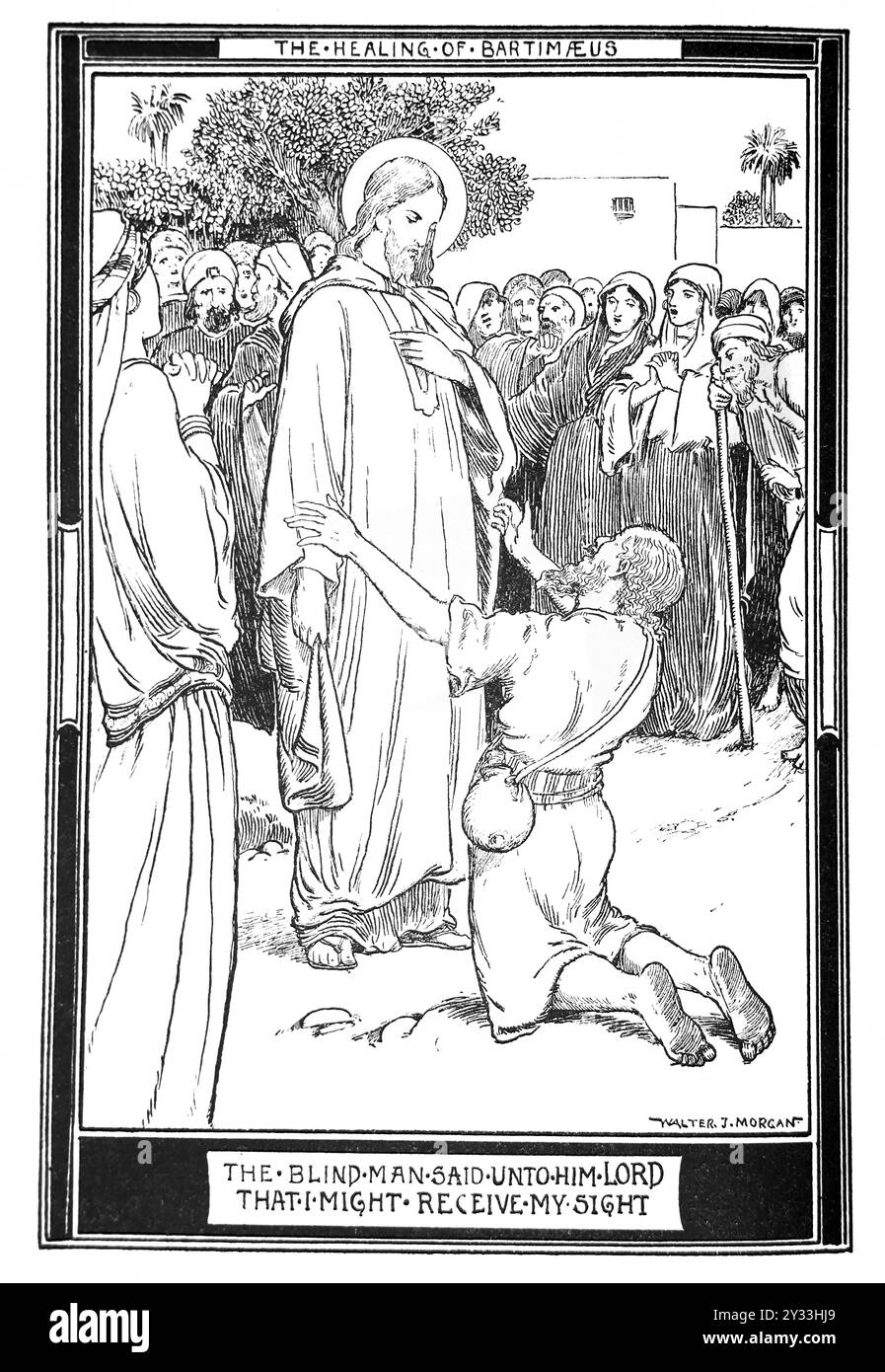
As Jesus was leaving Jericho with his disciples and a sizeable crowd, Bartimaeus, a blind man, the son of Timaeus, sat by the roadside begging. On hearing that it was Jesus of Nazareth, he began to cry out and say, “Jesus, son of David, have pity on me.” And many rebuked him, telling him to be silent. but he kept calling out all the more, “Son of David, have pity on me.” Jesus stopped and said, “Call him.” So they called the blind man, saying to him, Take courage; get up, Jesus is calling you.” He threw aside his cloak, sprang up, and came to Jesus. Jesus said to him in reply, “What do you want me to do for you?” The blind man replied to him, “Master, I want to see.” Jesus told him, “Go your way; your faith has saved you.” Immediately he received his sight and followed him on the way.
Jesus’ healing of the blind Bartimaeus includes features from earlier healings. Bartimaeus’ “crying out,” for instance, takes us back to Jesus’ healing of the demoniac in the territory of the Gerasenes, when the demons who possessed a strong man cried out to Jesus. But when the demons cried out, they wanted Jesus to leave. When Bartimaeus cries out, he wants Jesus to come close to him.
When the disciples tell Bartimaeus to “Get up,” the word is the same word Jesus uses to tell the young girl, Jairus’ daughter, to “Rise up” when He brought her back from the dead. Finally, when Jesus tells Bartimaeus, “Your faith has saved you,” these are the same words He told the woman healed of her bleeding. Each of these persons – the demoniac, the dead girl, the woman with the flow of blood – would have been considered unclean in the community in which they resided. The name “Bartimaeus” means “son of the unclean.” Throughout the Gospel, Jesus makes His presence known, especially to the so-called “unclean”: demoniacs, lepers, tax collectors, sinners, a woman with flow of blood, a dead girl. Now His healing of the one who is the “son of the unclean,” along with those He healed earlier, makes clear that Jesus has come to restore the lives of all the unclean, all those who are sick, all those who are possessed, all those who are dead, all those who are blind, all those who are sinners. That means us. Jesus came to restore us.
Bartimaeus is sitting and begging at the roadside on the road from Jericho to Jerusalem, while Jesus and His disciples are on their journey to Jerusalem, along with many others traveling to the holy city to celebrate the Passover. Jesus, as we know, is traveling to Jerusalem to fulfill His own Passover, the new covenant in His Body and Blood.
Seeing Jesus on the road must have caused a commotion of some sort, and Bartimaeus sensed this, asking what it was about. He’s told that it is Jesus of Nazareth passing by. Bartimaeus has obviously heard of Jesus and His healings, because he cries out to Jesus, calling Him, “Son of David,” the first to call Jesus such, and a recognition of Jesus’ Messianic mission. Bartimaeus already has a measure of faith that Jesus the healer must be one sent by God. He’s rebuked by the people, but his faith is sure, and he presses on, calling out louder, “Son of David, have pity on me.”
Jesus hears him, and tells the people, rather than rebuking him, to call Bartimaeus to Him. The disciples tell Bartimaeus, “Take courage, rise up; Jesus is calling you.” Bartimaeus immediately throws down the only possession he has – his cloak, and goes to Jesus. Recall here the rich young man we read about only two weeks ago. The rich young man desired to be saved, but when Jesus instructed him to go and sell all he had, give it to the poor, and follow Him, the rich young man went away sad. In his mind, all that he had was not worth sacrificing to follow Jesus. Yet Bartimaeus, the blind beggar, gave up all that he had – the only thing he had, his cloak – in order to come to Jesus. In Bartimaeus’ mind, following Jesus is worth giving up everything.
Jesus asks Bartimaeus, “What do you want me to do for you?” Jesus asked the same question of James and John in last week’s Gospel when they came to Him asking, “Teacher, we want you to do for us whatever we ask of you.” James and John desired power and glory. Bartimaeus desires sight. “Master,” he says, “I want to see.” Some translations, based on the Greek, translate Bartimaeus’ answer as, “That I may see again,” implying a restoration of what had been lost. Of course, what was Jesus’ mission, but to restore our relationship with God, which had been lost at the Fall of Adam? So, here we have Bartimaeus referring to Jesus with a Messianic title, “Son of David,” and then asking Him to fulfill the Messianic mission in him by restoring his sight, both physical and spiritual.
Jesus restores Bartimaeus’ sight, declaring that it was his faith that saved him. He tells Bartimaeus to “Go your way.” Does Bartimaeus go his way? Yes! The Gospel says that Bartimaeus “followed him on the way.” “The Way” was how the earliest Christians referred to the life of faith in Jesus (Acts 9:1-2; 19:8-9; Acts 24:14). So, now that Bartimaeus can see – not only physically, but spiritually – he follows Jesus. Jesus’ way is now Bartimaeus’ way.
And what is that way? The Gospel According to Mark will reveal to us in the coming weeks that the way of Jesus is the way to Jerusalem, and in Jerusalem, Jesus will suffer and die for us. So, the way of Jesus is suffering, crucifixion, and even death. This is what it means to be a disciple of Jesus: to follow Jesus, even when that means suffering and death. But if we do so, the promise is that we will share in Jesus’ glory.
Take courage! Rise up! Jesus is calling you! Jesus is calling us to Him. He is asking us, “What do you want me to do for you?” How will we answer that question? What do you want Jesus to do for you? If you desire to be His disciple, the right answer is: “Lord, I want to see!” I want to see the truth of God that you reveal. I want to believe. I want to follow you. I am willing to follow you as your disciple, even though I know that that will mean suffering and death. But I believe in your promise that, if I share in your suffering and death, then I will also share in your glory.
To share in the glory of Jesus is our hope. It is our destiny. It is the promise of Jesus for those who remain faithful to Him, for those who take up their cross and follow Him, for those who unite their sufferings with His, for those who put their faith in the joy of the resurrection. It is our hope. It is our destiny. It is the promise if Jesus. And Jesus keeps His promises.
Be Christ for all. Bring Christ to all. See Christ in all.
 Thoughts and Prayers for the Faithful