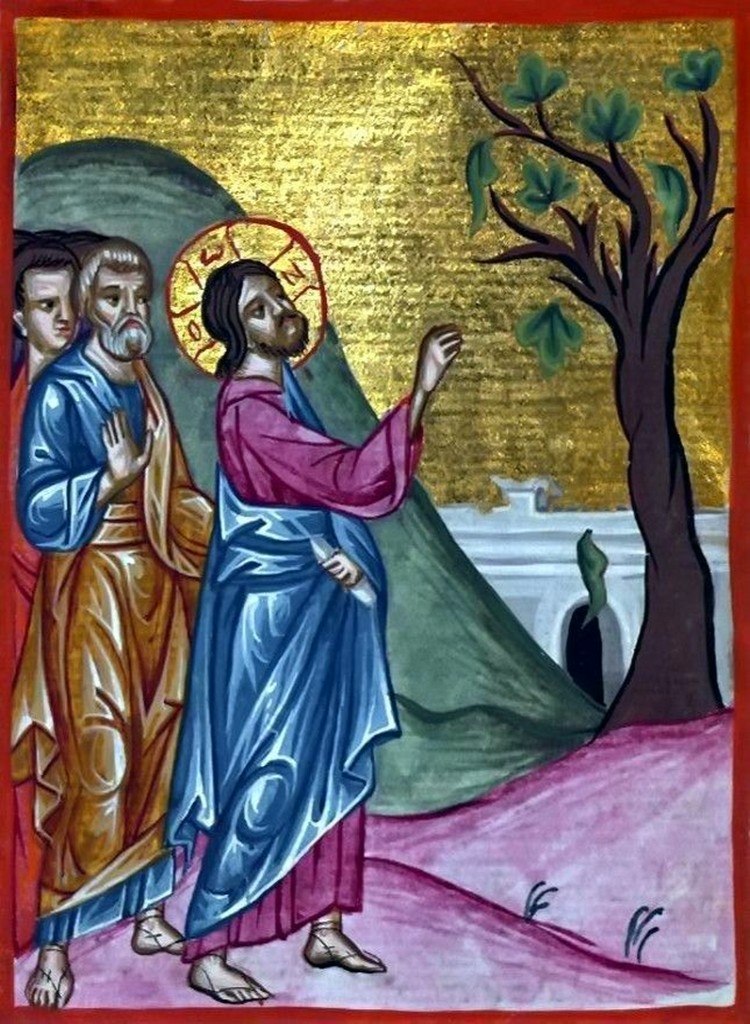
Jesus and the fig tree
Luke 13:1-9
“Some people told Jesus about the Galileans whose blood Pilate had mingled with the blood of their sacrifices. Jesus said to them in reply, “Do you think that because these Galileans suffered in this way they were greater sinners than all other Galileans? By no means! But I tell you, if you do not repent, you will all perish as they did! Or those eighteen people who were killed when the tower at Siloam fell on them – do you think they were more guilty than everyone else who lived in Jerusalem? By no means! But I tell you, if you do not repent, you will all perish a they did!” And he told them this parable: “There once was a person who had a fig tree planted in his orchard, and when he came in search of fruit on it but found none, he said to the gardener, ‘For three years now I have come in search of fruit on this fig tree but have found none. So cut it down. Why should it exhaust the soil?’ He said to him in reply, ‘Sir, leave it for this year also, and I shall cultivate the ground around it and fertalize it; it may bear fruit in the future. If not you can cut it down.'”
Popular piety at the time of Jesus, and well before Jesus (read the Book of Job), attributed disasters to sin. Jesus doesn’t necessarily counter this popular piety, but He does make the point that those who died suddenly and under horrible condidtions were no worse sinners than others. The point is to repent, because none of us has any idea of when we will die. After we die, it will be too late. That Jesus says, “if you do not repent, you will all perish as they did!” could suggest that these people, though no worse sinners than others, had the misfortune of dying in their sins because they failed to repent. Pope St. Clement of Rome wrote to the Church in Corinth at the end of the first century: “Going over all the stages of history again, we will see that in each era the Lord has given a chance to repent to anyone who wanted to convert to him.” We do not trip into hell. No one in hell is there by accident, or even neglect. No one in hell is surprised to be there. The damned are those who made the conscious choice to reject God. Sometimes, out of pride, it was a matter of choosing to refuse Him the praise and adoration that is His due. Sometimes, out of a desire to live the life of pleasure, it is a matter of ignoring Him, or even pretending that He doesn’t exist. Sometimes, out of conviction that we know better, it is a matter of outright rejection of His revelation. No matter the cause, when we stand before Him in judgment, we will recall the opportunities we had to embrace His grace, His mercy, and His love. And we will realize, “Had I just given it some thought, it would have made so much sense to give to the living God of the universe my repentance.”
The parable of the fig tree is another call to repentance. Jesus is on His way to Jerusalem, so there is still time to repent. The fig tree may be a symbol of the temple that outwardly served God but inwardly failed to do so, or of Israel who was called as God’s people but were ultimately unfaithful, or of the individual sinner who has wasted God’s gifts (the soil) and produced nothing. Regardless, it represents one who has failed in his duty to God to live the life of faith expressed in good works (fruit). The owner of the orchard (God) is not unjust in His condemnation of the fig tree. He has tolerated it for three years and received nothing in return. He wants it cut down rather than exhaust the soil. In other words, God does not want one who claims to belong to Him but produces no good works to cause others to be just as fruitless, especially by poor example. The gardener is Jesus. As our Savior, He begs God to extend His mercy to the fruitless one for yet more time. Jesus Himself will cultivate the believer, giving Him more grace still that he or she may bear the fruit of good works for the kingdom (the orchard). Then if, in spite of this, the believer still bears no fruit, God can cut him or her off. The parable is a message both merciful and terrifying. Merciful because Jesus gives us still more grace and more time to repent and bear fruit for the kingdom. Terrifying because, if we do not, we know our fate will not be a happy one. Even still, no one will be caught off guard. God is not a trickster, eager to find us damned and laughing at our misfortune. No! God is merciful, eager to forgive and generous with His grace. Do not receive the grace of God in vain (2 Cor 6:1).
Be Christ for all. Bring Christ to all. See Christ in all.
 Thoughts and Prayers for the Faithful