John 13:1-15
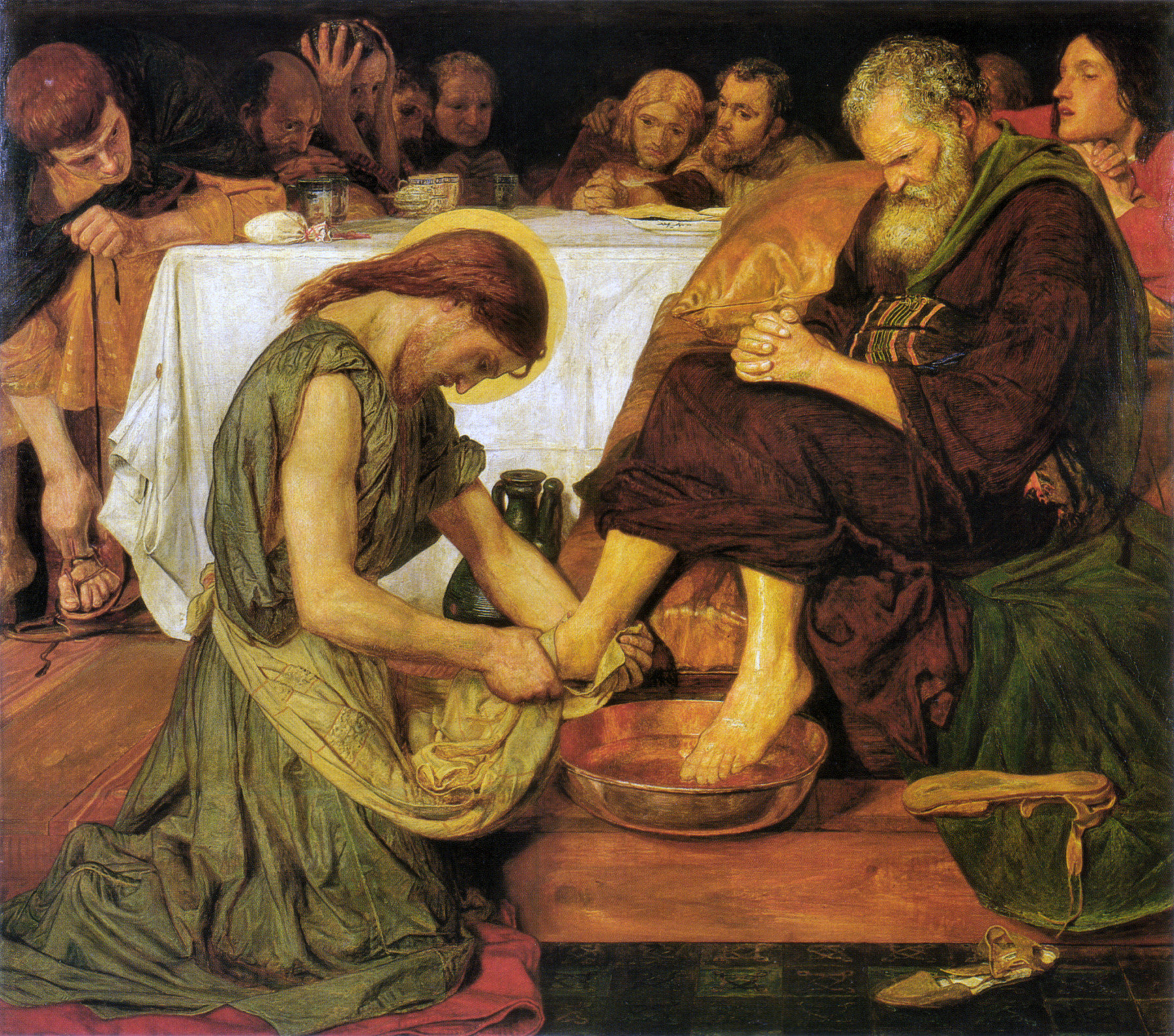
Before the feast of Passover, Jesus knew that his hour had come to pass from this world to the Father. He loved his own in the world and he loved them to the end. The devil had already induced Judas, son of Simon the Iscariot, to hand him over. So, during supper, fully aware that the Father had put everything into his power and that he had come from God and was returning to God, he rose from supper and took off his outer garments. He took a towel and tied it around his waist. Then he poured water into a basin and began to wash the disciples’ feet and dry them with the towel around his waist. He came to Simon Peter, who said to him, “Master, are you going to wash my feet?” Jesus answered and said to him, “What I am doing, you do not understand now, but you will understand later.” Peter said to him, “You will never wash my feet.” Jesus answered him, “Unless I wash you, you will have no inheritance with me.” Simon Peter said to him, “Master, then not only my feet, but my hands and head as well.” Jesus said to him, “Whoevere has bathed has no need except to have his feet washed, for he is clean all over; so you are clearn, but not all.” For he knew who would betray him; for this reason, he said, “Not all of you are clean.” So when he had washed their feet and put his garments back on and reclined at table again, he said to them,. “Do you realize what I have done for you?” You call me ‘teacher’ and ‘master,’ and rightly so, for indeed I am. If I, therefore, the master and teacher, have washed your feet, you ought to wash one another’s feet. I have given you a model to follow, so that as I have done for you, you should also do.”
Today, April 17, is Maundy Thursday, also known as Holy Thursday.
“Maundy” comes from the Latin mandatum, from which we get “mandate,” and is associated with Jesus’ words to His disciples, “I give you a new commandment: love one another. As I loved you, so you also should love one another. This is how all will know that you are my disciples, if you have love for one another” (Jn 13:34-35).
Jesus’ giving of this new commandment comes shortly after His washing the disciples’ feet. This, I think, gives us some glimpse of what Jesus meant by the new commandment to love one another. Certainly, He saw love as service to those in need. In washing the disciples’ feet, Jesus was performing a service to them. When travelers walked the roads of Rome, their feet became dirty, and it was a hospitable custom to provide them with water to wash their feet. In households that had slaves, this service was performed by slaves, because the bottoms of one’s feet was considered a dishonorable part of the body. In washing His disciples’ feet, Jesus is identifying Himself as a slave, though not to the disciples, but to the will of the Father. The washing of the feet, then, becomes a action parable of the cross. And just as Jesus emptied Himself and took the form of a slave to be hung on a cross for the sake of our salvation, so His disciples (us included) are to take up our crosses and follow Him in service to the will of the Father, even to the point of sacrificing everything for the salvation of the world.
Jesus gives the new commandment to love one another immediately after He announces that one of the disciples would betray Him. This, too, is signficant, because it becomes an action parable signifying the importance of faithfulness and obedience to the will of the Father. Satan is everywhere attempting to steal us away from the mission Christ came to fulfill. He succeeded with Judas. He must not succeed with us, for Christ’s mission is not yet completely fulfilled. There are still persons to be saved from the clutches of sin, and we participate in that mission by, again, taking up our crosses and following Jesus, even if it means giving up everything for the salvation of the world. Loving one another means serving those in need, of course. But, even more profoundly, it means uniting all we have to Jesus on the cross for the sake of the world’s salvation.
Holy Thursday is also the day the Church celebrates the institution of the Eucharist, the Blessed Sacrament, the Body, Blood, Soul, and Divinity of Christ present under the guise of bread and wine. No longer bread and wine, the elements of the Eucharist become the Body and Blood of Christ. Why? So that we might be nourished by the manna from heaven that is our Savior, and so that we might participate in the saving action of Christ for the sake of the world’s salvation.
From the Liturgy of the Hours for Holy Thursday:
Father, for your glory and our salvation you appointed Jesus Christ eternal High Priest. May the people he gained for you by his blood come to share in the power of his cross and resurrection by celebrating his memorial in this eucharist, for he lives and reigns with you and the Holy Spirit, God for ever and ever.
Be Christ for all. Bring Christ to all. See Christ in all.
 Thoughts and Prayers for the Faithful