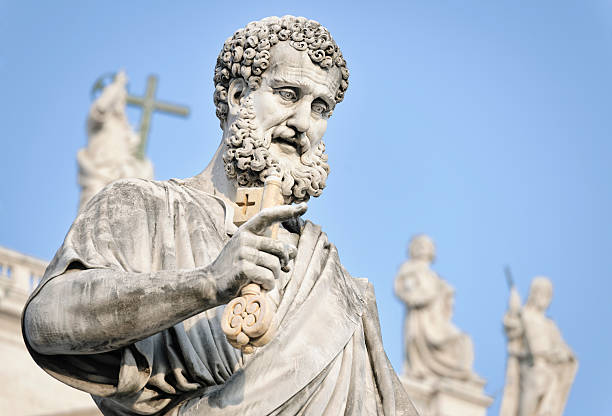
Statue of St. Peter at the Vatican
Today, the 133 cardinal electors processed into the Sistine Chapel, took their individual oaths to perform their duties as best they could, including a promise of silence on how the conclave plays out, and were locked into the Chapel, with (supposedly) no communication with the outside world until they announce the election of the next pope, the 266th successor of St. Peter.
I have written that the only thing predictable about the papacy is that the papacy is unpredictable. The so-called papabile, an Italian word that roughly translates “pope-able,” put forth by the press is often an exercise in futility. In the 1958 conclave, no one saw Cardinal Angelo Roncalli of Venice as a likely pope. He was finally elected as what many observers regarded as a compromise candidate who would serve as a transition pope with a brief papacy of no particular historical import. Yeah, that sure worked out … NOT! In the 1963 conclave, Cardinal Giovanni Battista of Milan, regarded as a protege of Pope John XXIII (or, some say, John was a protege of Montini), was the front runner from the beginning, so his election was no surprise.
1978 was famously “the year of three popes.” Pope Paul VI died in August and the conclave assembled in Rome and elected Cardinal Albino Luciani, another Patriarch of Venice. This was a complete surprise. Luciani was on no one’s list as a papabili. He became Pope John Paul I, the first new name for a pope in many centuries and the first double name ever. He insisted that the ordinal number be attached to his name, contrary to historical practice, so even before John Paul II was elected, he was known as John Paul I. Sadly, he would go down in history as “the September pope” because he died only 33 days after his election. In that one-month papacy, however, he managed to make an impact, refusing to be crowned pope. Popes following him have also rejected coronation, preferring a simpler inauguration. John Paul I’s unexpected death set the stage for the October conclave of 1978, in which Cardinal Karol Wojtyla, Archbishop of Krakow, Poland, was elected. Wojtyla had been one of the scrutineers, those who are elected to count the votes, in the conclave that elected John Paul I, but he was not considered a papabile by the press. Indeed, few even knew who he was. Being non-Italian, of course, his election caught the Church and, indeed, the world by surprise.
The 2005 conclave proved no surprise at all. Cardinal Joseph Ratzinger had served Pope John Paul II ably as the head of the Congregation for the Doctrine of the Faith, though liberals would dispute the “ably” claim, and was the Dean of the College of Cardinals, responsible for organizing and running the conclave. He presided at Mass with the cardinals prior to the conclave and gave a homily that inspired one Latin American cardinal to remark, “It’s him. It’s obvious.” Though he hoped to retire after the conclave and dedicate his remaining years to writing, he accepted the will of the conclave and took the name Benedict XVI. Cardinal Jorge Bergoglio of Buenos Aires, Argentina was a distant second in the voting.
The conclave of 2013 was called after the shocking abdication of Benedict XVI. No pope had resigned the office since Pope Gregory XII voluntarily resigned in 1415 in the effort to resolve the Western Schism, where three different men claimed the papal throne. The Church regards Gregory XII as a legitimate pope. Before that, Celestine V resigned in 1294. Celestine had been a monk who wrote the cardinals of the conclave to get about the business of electing a pope because their delay was endangering the Church. The Cardinals surprised Celestine by electing him pope. Unfortunately, the responsibilities of the papacy were too much for the simple monk, and he resigned after a brief reign to return to his hermitage.
In the 2013 conclave, there were many papabile identified by the press and Vatican “experts,” but Cardinal Bergoglio was not listed among them. The sense of it was that his chance had passed. To the surprise of many observers, however, Cardinal Bergoglio was elected and took the name Francis. Again, a new name, and a two firsts: Pope Francis was the first pope from the Americas and the first Jesuit pope.
There are many interesting facts or suppositions about this 2025 conclave. First, it is a fact that this conclave represents the most globally varied in history. The cardinals represent more than five dozen countries and, while 30 are members of the Roman Curia, they are a distinct minority. Of the 133 cardinal electors 51 are from Europe, including 16 from Italy. The continent of Asia accounts for 23 cardinals, Latin America 21 (which includes Mexico), Africa 18, North America 16, Oceania four. A great deal has been made about the fact that Pope Francis named the vast majority of the cardinals participating in this conclave. I personally think that will not factor much. After all, Pope John Paul II and Pope Benedict XVI obviously named the vast majority of the cardinals that elected Pope Francis. Speculation is rife that this group of cardinals do not know each other well. That could make for a longer conclave, as they converse in the effort to get to know each other. There does not seem to be a consensus candidate, so we may be surprised again.
Who are the papabile the media have identified? Most regard Cardinal Pietro Parolin, who is 70, as the frontrunner. Cardinal Parolin was Pope Francis’ Secretary of State and is seen as one who would continue Francis’ legacy. Most of the cardinals know him well, and he knows them. However, he was involved in a London real estate scandal, and was instrumental in negotiating the deal with China regarding the naming of bishops for that Communist country, which many regard as a surrender to the CCP. Perhaps Cardinal Parolin will embody the old saying, “He who enters a conclave as a pope, exits as a cardinal.”
Cardinal Antonio Tagle, who is 67 and the former archbishop of Manila in the Philippines, is another often mentioned by the press as a possible successor to Pope Francis. He is called “the Asian Francis” for his outreach to the poor and empathy toward gay Catholics, divorced Catholics, single mothers, and his raising the alarm about climate change. Working against him, however, is his association with Caritas Internationalis, which he headed for seven years, until 2022, when Pope Francis fired everyone in leadership, including Cardinal Tagle, for mismanagement of the charity. He has also been criticized for not responding strongly enough to clerical sexual abuse of minors, and for remaining silent during the brutal regime of former Philippine President Rodrigo Duterte’s drug war, where tens of thousands were executed.
Cardinals Parolin and Tagle represent what many Vatican observers regard as the “liberal” option. As for the “conservative option,” there are two most often mentioned.
The first is Cardinal Peter Erdo of Hungary, who is 72 and archbishop of Esztergom-Budapest. Cardinal Erdo has emerged as the favorite of conservative Catholics, according to the press. He speaks several languages, and all who know him regard him as a brilliant scholar. While never criticizing Pope Francis publicly, it is generally accepted that he is more traditional than Francis, though some say not as hard-line as many make him out to be. He has been described as a “liberal conservative.” His candidacy may be opposed by those who look to the fact that he has failed to stem the tide of secularism and a decline of the Church in his native Hungary, as well as what many regard as his silence on the scandal of abuse, and his remote personality. A scholar of great depth, it seems Cardinal Erdo is not much of a man of the people.
Then there is Cardinal Fridolin Ambongo Besungu, archbishop of Kinsasha in the Democratic Republic of the Congo, who is 65 years old. Cardinal Ambongo Besungu is a Capuchin Franciscan and considered very much a man of the people. He also speaks several languages and headed the Symposium of Episcopal Conferences of Africa and Madagascar, which issued a statement in opposition to the Dicastery for the Doctrine on the Faith’s 2023 decree Fiducia Supplicans, which permitted the blessing of persons in “irregular relationships,” including those in same-sex relationships. (Contrary to how it is often reported in the press, it did not allow for blessings of same-sex relationships, but the blessing of persons in same-sex relationships). Testifying to his diplomatic skills, Cardinal Ambongo Besunga brokered an agreement with the Holy See whereby Pope Francis gave his blessing to the statement of the African bishops, who said the decree would not be accepted in Africa because of the culture of the continent. Cardinal Ambongo is considered an environmentalist and opponent of other countries’ exploiting Africa’s rich minerals. What may count against him is the feeling among some cardinals that the time is not right for an African pope, and possible hostility of Western cardinals who take issue with Cardinal Ambongo’s fierce criticism of the West and its decline in morals. Regarding the West, Ambongo has said, “Little by little, they will disappear. They will disappear. We wish them a good demise.”
Finally, there is Cardinal Pierbattista Pizzaballa, another Franciscan, who is 60 years old and the Latin Patriarch of Jerusalem. Cardinal Pizzaballe (whose name means “pizza dance” – I can see the internet memes now!) has spent the last quarter century in the Middle East, and much of his attention has obviously been dedicated to that region of intense and on-going conflict. As such, he is not well known among the other cardinals and neither are his positions on issues that often embroil the press. Would he represent a continuation of Francis’ agenda, or a break from it? No one really knows. Because of this, he may emerge as a compromise candidate. At the same time, he may lose consideration, for who wants to elect a relatively young cardinal who may be pope for 25 or more years who is essentially an enigma? Frankly, I think the reason he gets so much mention by the press is because of his unusual and somewhat humorous name.
Here is a summary of the voting process, provided by the Vatican News website:
“Voting Rounds and Spiritual Pauses
Voting occurs four times daily – twice in the morning, twice in the afternoon. If, after three days, no candidate has been chosen, voting is paused for one day of prayer, informal discussions, and a brief spiritual exhortation by the senior cardinal deacon.
Voting then resumes. After every seven additional rounds without success, another pause and exhortation follow – first by the senior cardinal priest, and later, if necessary, by the senior cardinal bishop.
If still no Pope is elected after 21 votes, a final pause for prayer, dialogue, and reflection is observed. At this point, voting continues — but the cardinals may only choose between the two candidates who received the most votes in the previous round. Even then, a two-thirds majority is still required, and the two candidates in question are not allowed to vote.”
Please join me in praying for the cardinal electors, that the Holy Spirit will move among them and that they will listen to His inspiration. Whoever is elected pope, he will merit our respect and our loyalty. We do not always have to agree with the pope, but we always have to respect him and recognize the authority he holds as Supreme Pontiff and universal pastor.
Be Christ for all. Bring Christ to all. See Christ in all.
I used multiple sources for this post. None of the material in this post is mine, with the few exceptions of personal memories of past popes and my own identified assessments.
 Thoughts and Prayers for the Faithful