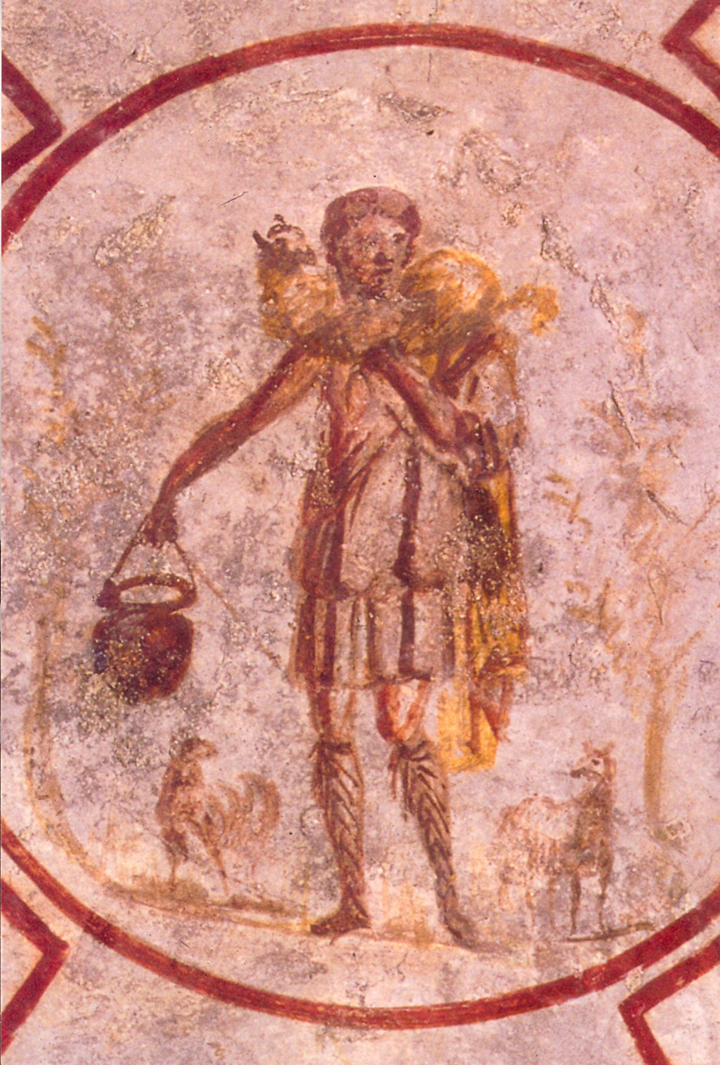
The Good Shepherd, Catacomb of Callixtus, Rome, mid 3rd century
John 10:27-30
Jesus said: “My sheep hear my voice; I know them, and they follow me. I give them eternal life, and they shall never perish. No one can take them out of my hand. My Father, who has given them to me, is greater than all, and no once can take them out of the Father’s hand. The Father and I are one.”
Sheep need a shepherd. The people of God need a shepherd to guide them in right living and in following the gospel. Jesus is the Good Shepherd. Many of the earliest known examples of Christian art are that of Jesus as the Good Shepherd, usually depicted with short hair and no beard (thus communicating his divinity to the people of the Roman Empire), and with a lamb over his shoulders.
There are numerous references to God being the Shepherd of Israel in the Old Testament: Gen 48:15; Gen 49:24; Ps 78:52-53; Ps 80:1; Is 40:11; Mi 7:14 and, most famously, Psalm 23: “The Lord is my shepherd…” There is a story of a poet and a priest participating in something of a competition over their recitations of the 23rd Psalm. The poet got up, recited the psalm, and everyone applauded at the masterful skill of the poet’s rendition of the legendary work of spiritual literature. Then the priest got up and also recited the psalm. The audience was left in tears, and hearts were moved to wonder at the magnificent love of God for us. When asked afterwards what made the people’s reaction to the priest’s recitation so much more profound than that of the poet’s, the host of the event replied, “It’s simple: the poet knows the psalm; the priest knows the Shepherd.”
The Old Testament refers to the leaders of Israel as shepherds of the people: 2 Sm 5:2; 1 Chr 17:6. The overarching theme of the prophets, however, is that the shepherds of Israel have failed in fulfilling their responsibility to properly care for and protect the people, instead leading them astray from their God: Is 56:9-12; Jer 10:21; Jer 23:1-2; Jer 25:32-38; Ez 34; Zech 11). But God promises that He will give to the people of Israel shepherds that are true and good and caring for His people:
“I will appoint you shepherds after my own heart, who will shepherd you wisely and prudently” Jer 3:15.
“I myself will gather the remnant of my flock from all the lands to which I have banished them and bring them back to their folds; there they shall be fruitful and multiply. I will raise up shepherds for them who will shepherd them so that they need no longer fear or be terrified; none shall be missing – oracle of the LORD” Jer 23:3-4.
God has fulfilled this promise in sending us His Son to shepherd us into eternal life.
But the mystery of the kingdom is that it is “already, but not yet.” Christ has won the victory and those who remain faithful to Him, uniting our sufferings to His, and placing our hope in the resurrection await our share in His glory. But we remain here for now, living out our life in Christ in the struggle of this mortal coil, desiring to be faithful and too often failing, and wondering at times what is the better way to go. God does not abandon us. Instead, He gives us bishops who lead the Church as shepherds in imitation of the Good Shepherd, until that day when He returns and shepherds us all into the fulfillment of His kingdom.
One such shepherd, the new chief shepherd of the Church, is Pope Leo XIV. As I learn more about him, I become more impressed, not only with his erudition, but by his leadership, honed by his experience as a missionary pastor, as superior of his religious order, the Augustinians, and as bishop in Peru. He held a critical role, as well, in choosing the shepherds who would serve and guide the Church around the world. He had not been a cardinal for even two full years yet, but the other cardinals obviously saw someting in him that led them to consider him as the best choice to lead the Church over what may possibly be the next 20-25 years. They saw in him, I think, the possibility of continuing the best parts of Pope Francis’ plans for the Church, especially synodality (Leo obviously admired Francis greatly, for he has referenced him numerous times), as well as building a bridge to those more traditional Catholics who sometimes felt lost under Francis’ papacy. The cardinals long for unity in the Church and clarity in Church teaching. They’re convinced they found their man, and I think there’s good reason to agree.
At Pope Leo’s first Mass celebrated at the altar of St. Peter’s Basilica, the music was in Latin, the readings were in English and Spanish, and he preached in Italian. Talk about Catholic! His first words on the loggia of St. Peter’s were words wishing peace to all. He has called for a renewal of Catholics as missionaries of the gospel and a continuation of Francis’ hopes for a more synodal Church, which I understand as welcoming the many to the work of taking the Church into the future, and not leaving it only in the hands of priest, religious, or even bishops. He has spoken in the past of the people of a diocese having a part in the selection of their bishop. Of course, that was the pattern in many parts of the early Church.
Pope Leo XIV is obviously a very intelligent man. He has an undergraduate degree in mathematics from Villanova University, just outside Philadelphia – no humpty-dumpty school that! – and a Doctorate in Canon Law from the Pontifical College of St. Thomas in Rome. He speaks five languages, including English, Spanish, Italian, French and Portuguese, and reads Latin and German. He has been taped for many leadership positions, both by the Order of Saint Augustine and by the Vatican. He was so popular and respected among his people in the Diocese of Chiclayo, Peru, and among the other bishops of Latin America that Pope Francis, a Latin American himself, named the Chicago-born Prevost president of the Pontifical Commission for Latin America. The word is that Robert Francis Prevost is well respected and loved by all who know him and “the nicest guy you’ll ever meet.” He is a true blue baseball fan, a tennis enthusiast, and enjoys playing Wordle (a man after my own heart!).
What can we expect from our new universal shepherd? He has been described as a progressive on social issues, such as care for the poor and for migrants, and a traditionalist on Church doctrine. He has retweeted tweets by others opposing President Trump’s policy of mass deporations of illegal immigrants, and one that said that Vice-President J. D. Vance was wrong in his interpretation of ordo amoris. He supported Pope Francis’ decree allowing priests and deacons to bless individuals in same-sex marriages and other irregular relationships while not blessing the relationship itself, but allowed that bishops conferences of different nations should have authority to interpret and apply it according to the culture of their particular Church. He has expressed concern over the impact of the gay agenda in culture and opposed the inclusion of gender ideology in Peruvian schools. He is opposed to women being ordained deacons, insisting that “clericalizing women” is not the solution to their greater participation in the life of the Church, while favoring Pope Francis’ decision to appoint qualified women and laity has head of Vatican dicastories. He insists that the Church must be active in responding to the crisis of climate change, is opposed to capital punishment and abortion, and has voted in most all of the recent general elections in the United States, including 2024. He is an American citizen, having been born in Chicago and raised in Dolton, a suburg of the Windy City, and became a naturalized citizen of Peru in 2015.
In other words, he is a Catholic with rather straightforwardly Catholic views on political and social matters and with a foot planted in multiple worlds. He is American. He is Peruvian. He is in positions of leadership at the Vatican. The U. S. cardinals, in a joint press conference, played down his being the first American pope, insisting that his being American was not a factor in his election. “He is a citizen of the world,” Cardinal Timothy Dolan of New York said.
I am optimistic. Yes, he’s only been pope for a few days. But what I’ve read about him and heard from him in this short period gives me a feeling of optimism. This is, of course, ridiculous. We have the promise of Jesus that the gates of hell will not prevail against His Church. There is nothing Pope Leo XIV will do or even can do to undermine that promise. So, there is no room for pessimism. And he is the pope! That means he merits my consideration in what he might say or do that I disagree with, my submission to what he might teach infallibly or from his position of authoritative teacher even if not declared infallible, and my loyalty in all things. I believe his intention is to make the temporal Church reflect better the supernatural Church, the Body of Christ. The Church is both a human institution and a divine mystery, just as each individual person baptized in Christ is a human being and a divine mystery. As with each of us, it is the challenge of the Church to live faithfully her divine mission in her human reality. I have no doubts whatsoever that Pope Leo XIV firmly desires that that challenge be met with faithfulness and sacrifice so that the Church may reflect well her Lord’s radiance and live well the mission of her Master.
Father, bless Pope Leo XIV with your wisdom to guide your holy Church over his reign with love and justice, always remembering that Your justice is mercy. May he be blessed with health in mind, body, and spirit for years to come and dedicate those years to challenging the faithful to fulfill their mission of bringing the gospel of Jesus Christ to the whole world, teaching others all what He has commanded us, and baptizing all in the name of the Father, and of the Son, and of the Holy Spirit. Like St. Peter before him, may he proclaim boldly that Jesus Christ is the true Son of God and beacon to the nations. As Pope Leo XIV begins his reign as chief shepherd of the Church may he find inspiration in Jesus, the Good Shepherd, Who leads us to the fulfillment of the kingdom as a Shepherd Who is one with You. May he seek out the lost, protect his sheep from the wolves, and prepare us for that day when our Lord will return to claim His flock as His own. We ask this through Christ our Lord. Amen.
Be Christ for all. Bring Christ to all. See Christ in all.
 Thoughts and Prayers for the Faithful