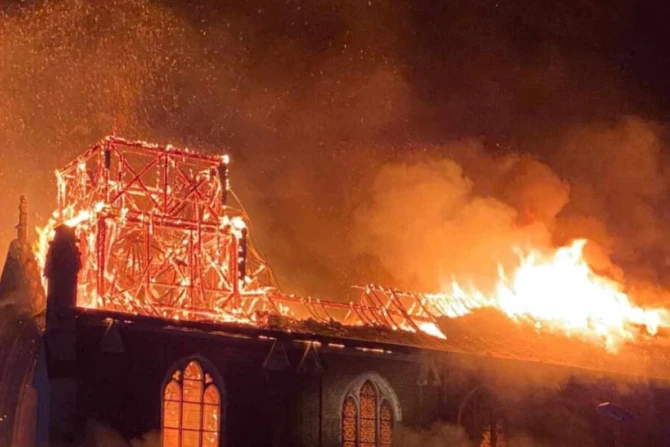
Church of the Immaculate Conception in Saint-Omer, in the Pas-de-Calais, northern France, destroyed by arson
Anti-Catholicism has been called “the last acceptable prejudice.” It is not the only prejudice, certainly. Anti-Semitism still lives, as well as racism, Islamophobia, homophobia, etc. The difference is that, while the other “antis” are, for the most part, condemned by the well-educated and civilized, the paragons of society and political and social elites, anti-Catholicism is often dismissed, ignored, or even justified. Three current examples:
- Pope Leo XIV accused of protecting abusers and covering-up abuse. It was to be expected. Every priest, bishop, cardinal, and even pope are going to have their records scrutinized for any hint of abuse or complicity in covering-up abuse. I honestly don’t have a problem with that, except that the same standard is never applied to others. Within hours of Cardinal Robert Prevost emerging from the loggia at St. Peter’s reports were circulating that he had been lax in addressing accusations of abuse. The problem is, the evidence against him is so paltry and the history of his actions so clear that the reports have all the signs of hit pieces published only for the purpose of selling papers or gaining more clicks or, more likely, discrediting the pope and the Church. Robert Herguth of the Chicago Sun-Times actually wrote the following in an article published on May 8, the same day Prevost became pope: “After Prevost left the Chicago province in 2001 to take over the [Augustinian] order internationally, Ken Kaczmarz, who had accused an Augustinian named John Murphy of molesting him as a boy years earlier at a South Side parish, contacted a Prevost colleague in the province to alert him that Murphy, then gone from the order, was serving as a docent at the Shedd Aquarium. ‘He refused to do anything about it,’ Kaczmarz said, referring to a now-deceased Augustinian leader…” Did you get that? The alleged victim didn’t contact Prevost, but “a Prevost colleague,” and this was after Prevost had left Chicago. The priest who was contacted did nothing about the fact that the man’s alleged abuser was working as a docent at an aquarium. Okay, first, Prevost has nothing to do with this matter, so why is he even mentioned in the account? Second, what was the “Augustinian leader” supposed to do about it? The alleged abuser was no longer an Augustinian. Are the Augustinians supposed to keep tails on former members for the rest of their lives, even after they have no association with the order? They would have no legal grounds to do so, and would likely subject themselves to a lawsuit, like my former employee snooping around to keep an eye on me well after I left their employ. Another accusation against Prevost is that he allowed a priest accused of abuse to live at a parish that was close to a Catholic elementary school, contrary to the rules adopted by the bishops in Dallas in 2002. But this matter came before 2002, and Prevost followed the rules in place at the time. The decision to put the priest at that parish was made so he could be supervised by the pastor, who was a professional therapist. When the bishops adopted the Dallas Charter in 2002, the priest was moved. Finally, three sisters (family, not religious) have accused Prevost of not acting to investigate their claims of having been abused. According to SNAP (Survivors Network of those Abused by Priests), “When Prevost was Bishop of Chiclayo (in Peru), three victims reported to civil authorities in 2022 after there was no movement on their canonical case filed through the diocese.” The women claimed that Bishop Prevost “failed to open an investigation, sent inadequate information to Rome, and that the diocese allowed the priest to continue saying mass.” However, according to the Catholic League for Religious and Civil Rights, this simply isn’t true. In 2022, the three sisters brought to Church authorities accusations against two priests of having abused them sexually in 2007 when they were minors. The Catholic League reports that Bishop Prevost removed the priest from active ministry, met with the sisters and encouraged them to report their accusations to the civil authorities, offered the sisters psychological counseling, opened a canonical investigation, and reported to the Dicastery for the Doctrine of the Faith (DDF) the results of the investigation. The DDF determined that a lack of evidence prohibited further action, and that the statute of limitations had expired. The civil authorities came to the same conclusion. The oldest sister started a media campaign, insisting that the Church and civil authorities were wrong about their conclusion. The case was reopened by the Apostolic Administrator in Chiclayo. By this time, Bishop Prevost had been assigned to the Dicastery for Bishops in Rome. There’s more to the case, but that pretty much summarizes Prevost’s involvement. So, who’s telling the truth? I don’t know. I don’t have a lot of trust in SNAP. They’ve been discredited by a lawsuit from a former employee who accused them of taking kickbacks from attorneys to whom they referred alleged victims. The top leadership of SNAP resigned in the midst of the scandal. But it seems to me that Bishop Prevost did what he was morally and legally obliged to do. There is no more fertile ground for discrediting the Church, or any particular minister within the Church, than to link them to the child abuse scandal, no matter how tenuous that link. In the case of Pope Leo XIV, however, it’s an obvious cheap shot. That won’t matter to the bigots, who are only too eager to believe anything negative about the Church, and the pope in particular.
2. Anti-Catholic violence in France mostly met with silence. 2024 saw a 30% increase in arson attacks on Christian churches in France compared to 2023, from 38 incidents to 50. Examples of other recent anti-Catholic incidents include:
- desecration of the church of Saint Jean Marie Vianney in Rennes
- vandalization of a parish hall in Normandy
- vandalization of a parish hall in Maurepas, south of Paris
- a man entering Saint-Ambroise Catholic Church in Paris with a knife just before Mass (police acted quickly and no one was injured)
- the tabernacle was ripped off the wall and the Blessed Sacrament stolen from a Catholic church in Saint-Aygulf
- the pastor at Notre-Dame-de-Bon-Repos in Avignon was surrounded by a group of Muslim youth who had asked if they could visit the church; when Fr. Laurent Milan welcomed them in, they shouted insults at him, at Jesus, and at the Catholic faith while threatening to return and burn down the church, departing with shouts of “Allahu akbar”
- a priest was assaulted by a man during a Good Friday service in a church in Beaucaire; the man slapped the priest when the priest instructed him to be quiet during the service
- also on Good Friday, a priest was assaulted by a man in Lisieux, who grabbed the priest by the collar and threatened him
The problem isn’t just the incidents of anti-Catholic violence, however. Perhaps a bigger problem is that no one seems to care, at least no one in the French press or the government. There has been little response to these incidents, little uproar. It reminds me of the hundreds of Catholic churches in the United States that have been attacked, desecrated, vandalized, or had their services disrupted by protesters since the overthrow of Roe v Wade. Little was said or done about these attacks and, as far as I know, little is being said or done about them. The most recent incident was the detonation of an explosive device at St. Teresa of Calcutta Church in the Diocese of Allentown, PA on May 6. Did you hear about it in the news? Neither did I. People are now bombing Catholic churches and the press is silent. We know that such attacks would not be met with silence if it were a synagogue or mosque. But, again, anti-Catholicism is the last acceptable prejudice.
3. Washington state passes law requiring priests to violate the seal of the confessional. Earlier this month, Gov. Bob Ferguson of Washington signed a law identifying all clergy as mandatory reporters of child abuse, and there is no exemption for a priest who hears of abuse in the context of the sacrament of Confession. Washington now joins New Hampshire, West Virginia, Guam, North Carolina, Oklahoma, Rhode Island, and Texas in denying an exemption for information on child abuse heard during Confession. In Tennessee, the exemption does not hold when the case involves child sexual abuse. Politicians, of course, justify this anit-Catholic violation of the First Amendment by pretending to be concerned about the safety of children. But there remains an exemption for attorney client privilege. Why? If, as Gov. Ferguson said when signing the bill into law, “Protecting our kids, first, is the most important thing,” then why is there still an exemption for attorneys? Is it because protecting kids isn’t more important than attorney-client privilege? The cynical part of me suspects they kept that exemption because many legislators got their start as lawyers. This is a stupid law on many fronts. First and foremost, if any of the above states attempt to apply it, it will be appealed and likely go to the Supreme Court, which will shut it down as the obvious violation of the First Amendment that it is. Second, priests aren’t going to oblige the state it’s mandate. There is no issue with reporting suspected child abuse outside the sacrament, but the sacrament itself is inviolable. The State has long attempted to get its ears into the confessional. Priests simply do not comply. They know the consequences of destroying the integrity of the sacrament is far too devestating. As well, priests who are concerned that they may be pressured by the state to report child abuse heard via the confessional could simply revert to only hearing confessions behind a screen, where the identity of the penitent is unknown. Most confessions are already heard in the manner, so it’s not clear what these state hopes to accomplish. What would be the purpose of a priest going to the authorities to tell them, “Someone confessed that they had abused a child, but I’ve no idea who it was”? Even if they had an idea of who it was, would they be so certain to accuse someone who may, in fact, be innocent? Can you imagine the police arresting a person on the grounds that, “Father Reilly heard someone confess child abuse, and he thinks it may have been you”! This also begs the question: is the confessional a tool by which child abusers escape justice? I googled this question, and AI gave an interesting answer: “While confession can be a place for victims to disclose abuse and for perpetrators to seek forgiveness, the secrecy surrounding confessions, known as the sacramental seal, can create an environment that protects child abusers from accountability and may contribute to a false sense of absolution, according to The Independent Inquiry into Child Sexual Abuse (IICSA).” So, I went to the IICSA website and found that there is nothing there to recommend that conclusion. There is literally nothing on their website that says anything about the sacrament creating “an environment that protects child abusers from accountability and may contribute to a false sense of absolution.” There was, however, the statement: “disclosure during confession is likely to be one of the less common ways in which the Church becomes aware of abuse”. Finally, there is this problem: why does this apply only to child abuse? Is murder not bad enough? Or rape? If someone confesses that they abused a child, the priest must report that to the authorities. But if someone confesses to a murder or rape, there’s no obligation? What’s up with that? The state regards murder and rape as less heinous than child abuse? Is it too much to imagine a slippery slope being created here? If breaking the seal of Confession becomes expected practice by our judicial system as regards child abuse, eventually some ambitious legislator who wants to get his or her name in the paper as a protector of society is going to introduce a bill that includes priests as mandatory reporters of any murders or rapes they hear of in the confessional. This law is an example of the state’s lack of respect for religious faith and conviction, as well as a lack of respect for the rights of the faithful as protected by the First Amendment of the Constitution. I hope it’s never applied. But if it is, I have confidence that it will be shut down. Priests have lost their lives protecting the seal of Confession. I don’t know any who wouldn’t rather go to jail than be excommunicated or violate the integrity of the sacrament.
Be Christ for all. Bring Christ to all. See Christ in all.
 Thoughts and Prayers for the Faithful