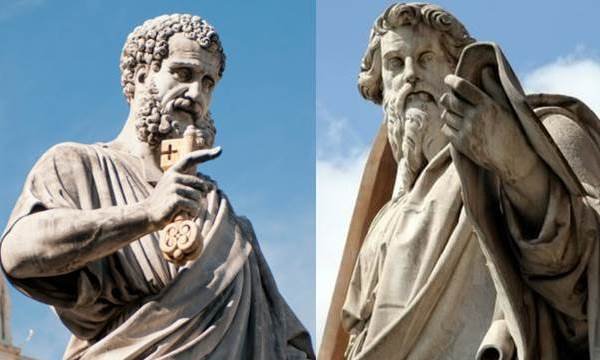
Statues of St. Peter and St. Paul, St. Peter’s Basilica, the Vatican
First Reading: Acts 12:1-11
Second Reading: 2 Timothy 4:6-8; 17-18
Gospel: Matthew 16:13-19
When Jesus went into the region of Caesarea Philippi he asked his disciples, “Who do people say that the Son of Man is?” They replied, “Some say John the Baptist, other Elijah, still other Jeremiah or one of the prophets.” He said to them, “But who do you say that I am?” Simon Peter said in reply, “You are the Christ, the Son of the living God.” Jesus said to him in reply, “Blessed are you, Simon son of Jonah. For flesh and blood has not revealed this to you, but my heavenly Father. And so I say to you, you are Peter, and upon this rock I will build my Church, and the gates of the netherworld shall not prevail against it. I will give you the keys to the Kingdom of heaven. Whatever you bind on earth shall be bound in heaven; and whatever you loose on earth shall be loosed in heaven.”
The account of Peter’s rescue from those who had imprisoned him is one of many rescues God achieved for His people. The first great rescue was the Exodus, when God freed His people from the chains of slavery in Egypt. The greatest rescue, of course, was Christ offering His very self to free all humankind from the chains of slavery to sin. Christ conquered death, and in doing so freed us from the darkness of death.
It is often asked, “Why did Jesus have to die to win our salvation?” Here is one answer: the only way to truly conquer an opposing kingdom is from within. You enter that kingdom and conquer it from within. That is what Christ did. He entered the kingdom of death and conquered that kingdom from within. As such, death is no longer our enemy, but our friend, our ally. Death is the portal through which we exit this temporal order and enter the eternal order of the kingdom of God.
The rescue of St. Peter is an image of both the Exodus and the Resurrection. Just as the Hebrews were rescued by an angel, the angel of death, so is Peter rescued by an angel. Just as the Hebrews were instructed to dress and leave quickly, so is Peter instructed to dress and leave quickly. Just as a column of fire guided the Hebrews on their journey out of Egypt during the night, so light infuses the jail cell to guide Peter and the angel out. Peter found sleeping is a nod to death, for sleep is a symbol of death. He is awakened and told to “Get up,” – in other words, he is told to “rise,” – so we have here a nod to the Resurrection. Just as many soldiers guarded the tomb of Jesus on Holy Saturday, but could not prevent the Resurrection, so Peter is guarded my many soldiers, but they cannot stop his escape, orchestrated by the angel.
Peter’s escape from prison is an image of our escape from sin and death. Just as the chains of the prison cell fell from Peter’s wrists, so the chains of sin and death fall from our souls as we are freed by the blood of Christ, shed for our salvation.
In his Second Letter to Timothy, the Apostle Paul is preparing for his death, a death that he is expecting to be imminent. He reflects back on his ministry carried out in the name of his Lord. He looks forward to when his blood, like Christ’s, will be poured out in a libation, a sacrifice given to the Father for the sake of the Son. Paul says that he has competed well. The better translation is “I have fought the good fight.” In other words, like one struggling to win the battle, he has struggled well and won, despite his imminent death, because the crown he longs for is not one that withers, but one that endures to eternal life. Often in his letters, Paul refers to his efforts to spread the good news of Jesus as a struggle, a struggle to which he has dedicated his life. Now that that life is coming to a close, he reflects on the fact that he has kept the faith. In his First Letter to Timothy, and again in this Second Letter, he encourages his young protégé to “guard the rich deposit of faith” that Paul had given to him (1 Tim 6:20).
Paul speaks of his faith journey as a race, and he tells Timothy, “I have finished the race.” Jesus spoke from the cross the words, “It is finished,” meaning it is accomplished, it is fulfilled. Paul’s race is now coming to its fulfillment, and he writes in expectation of the crown that Christ has promised. In the Book of Revelation, Christ says, “Remain faithful until death, and I will give you the crown of life” (Rev 2:10). The race Paul has run was well worth winning.
Paul speaks, too, of being rescued, first from the lion’s mouth and then of the Lord rescuing him from every threat. This first reference is to an earlier trial, where Paul was spared execution. The second is a reference to what the Church calls the grace of final perseverance. Paul is confident that Christ will give him the strength to withstand any temptations, especially the temptation to forsake the faith to spare his own life. Never would Paul consider such a thing! He and Peter are two in a long line of martyrs who faced the sword, or the cross, or the firing squad, or the gallows, or whatever means those who oppose Christ have come up with to kill those who follow Him. But, again, death is no longer our enemy, but our friend, our ally; the portal through which we enter the kingdom.
Simon’s profession of faith as recorded in the Gospel According to Matthew is especially dear to Catholics because it is the foundation of our faith in the papacy. Five things of significance I would like to point out:
First, Simon’s recognition of Jesus as “the Christ, the Son of the living God” is a twofold declaration. Simon declares Jesus’ mission by recognizing Him as “the Christ” or the Messiah, the one who came to redeem us. Simon declares Jesus’ identity by recognizing Him as “the Son of the living God.” He proclaims that Jesus Christ is God Himself!
Second, Jesus declares that Simon’s profession of faith, his recognizing who Jesus truly is, was not revealed to him by “flesh and blood,” that is, by any human source, either figured out by Simon’s wits, or taught to him by men, but it is a gift of God. This faith is a gift of the Father to Simon, indicating that Simon is worthy of, and also to prepare him for, the unique ministry Jesus is going to give him.
Third, Jesus changes Simon’s. In the Scriptures, when God changes someone’s name it always signifies a profound change in the person or in his or her status. God changed Abram and Sarai’s names to Abraham and Sarah. God changed Jacob’s name to Israel. When Naomi, King David’s great-grandmother, returned to her people, she instructed them to no longer call her Naomi, but Mara. And here, Jesus changes Simon’s name to “Rock.” Simon is made the Rock on which Jesus will build His Church. In the Greek, the word for “rock” is petra. Not wanting to give the chief Apostle a feminine name, in the Greek language of the Gospel, Simon is called petros. In Aramaic, the language which Jesus would have spoken, the word for “rock” is kepha’, so the change in name signifying Simon’s role as the Rock of Jesus’ Church would be even more clear: “So I say to you, you are kepha’, and upon this kepha’ I will build my Church.”
Fourth, the gates of every fortress were its weakest points. That is why the gates were so heavily guarded. But Jesus says that “the gates of the netherworld shall not prevail against” His Church. This is often thought of as the netherworld attacking the Church and the Church not being defeated. But think again! If the gates of the netherworld shall not prevail against the Church, that means that the Church is on the offensive. It is us who are attacking the fortress of hell, and sin, and death – and those gates shall not prevail against our attack! With Jesus our Redeemer in the lead, hell and sin and death are defeated!
Finally, Jesus gives to Peter, and to Peter alone, the keys of the kingdom. He also gives him the authority to bind and loose. Jesus will give this authority to the other Apostles, as well, later in the Gospel, and from this we understand our faith in the charism, the gift, of all bishops to share in the ministry of the Apostles. But to Peter alone Jesus gives the keys of the kingdom. When David was king of Israel, he had beside him his chief steward, his second in command, as it were. Whenever the king left for a military campaign or some other business, the king would hand over his authority to the chief steward to act upon in the king’s absence. This handing over of authority was symbolized by giving to the chief steward a key that he literally wore on his person. Isaiah 22 records that the position of chief steward was one that was handed on from a former chief steward to a successor, indicating that Peter’s role as head of the Church would also be handed over to successors. When the position of chief steward was handed over from Sheba to Eliakim, it was said of Eliakim that, “when he opens, no one shall shut; when he shuts, no one shall open” (Is 22:22).
The authority of the pope, and the authority of the bishops, to teach, govern, and sanctify under the guidance of the Holy Spirit, is a gift Jesus has given to us for the sake of our salvation. We are not left on our own to ascertain this scrap of truth or that scrap. No, we are given the whole truth of Jesus Christ through His Apostles. We believe in one, holy, catholic, and APOSTOLIC Church. Our faith is the faith of the Apostles. Our faith is the faith that was given by Paul to Timothy. Our faith is the faith of Peter that was given to his disciple, Mark, who wrote down his Gospel as Peter’s memoirs. The faith of the Apostles is the faith of the Church, the faith we are about to profess in our Creed. We are proud to profess it in Christ Jesus our Lord!
Be Christ for all. Bring Christ to all. See Christ in all.
 Thoughts and Prayers for the Faithful