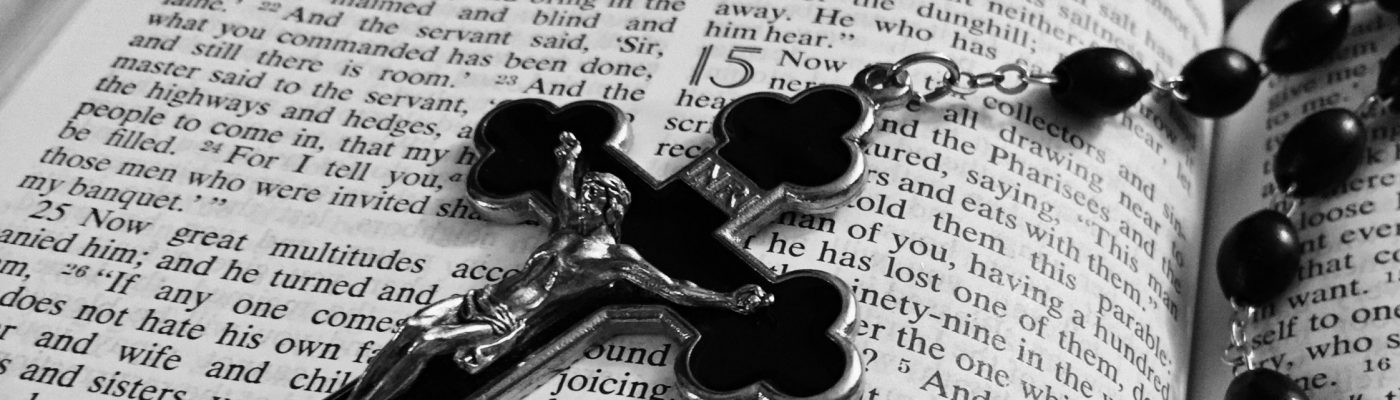

On October 19, Pope Leo XIV canonized seven beati, one of whom was Bartolo Longo, champion of the rosary and former Satanist priest!
St. Bartolo Longo was born on February 10, 1841 in Latiano, in southern Italy. Though born into a devout Catholic family, Bartolo’s father died when he was only ten years old, and this impacted him terribly. Though his mother re-married to a lawyer who would take charge of Bartolo’s education, the boy began to live contrary to the Church. During his teen years, Italy was ensconsed in revolution, and the peninsula was finally united into one country by Garibaldi. This, of course, meant the suppression of the Papal States, which led Pope Pius IX to begin his self-imposed imprisonment in the Vatican. The pope refused to travel beyond the walls of Vatican City State, thus making himself, and the papacy, and the Church more irrelevant to young minds, who were heavily influenced by the anti-Catholic sentiments within the nationalist movement. As such, in 1861, when Bartolo entered the University of Naples to study law, he was already an anti-Catholic nationalist. He would later write: “I, too, grew to hate monks, priests, and the Pope, and in particular [I detested] the Dominicans, the most formidable, furious opponents of those great modern professors, proclaimed by the university the sons of progress, the defenders of science, the champions of every sort of freedom.”
In the confusion that often attacks the minds of youth, and tempted by the Spiritualism that was all the rage in Naples at the time, Longo began attending seances and visiting mediums who promised him they could conjure up the dead. Desperate to speak with his father again, Longo promised everything he had to the Spiritualists who guided him into the darkest corners of their world, even to the point where Longo, after some study and persuaded by spiritual experiences, was consecrated a Satanist priest. For the next year of his life, Longo presided over satanic rituals, which included the most hideous blasphemies against God and the Church. Over the same year, Longo suffered terribly. According to the selection on Bartolo Longo in the 2016 book The Slaves of the Immaculate Heart of Mary, Longo suffered, “with a body reduced to skin and bones, two possessed eyes, frazzled nerves, a devilish beard, and a stomach ailment doomed to accompany him for the rest of his life.” Also, “He felt an ominous presence at his side, a being, that he referred to as his ‘angel’ … [a] dark companion.” Longo physical health was declining, along with the spiritual death he was experiencing.
All this time, Longo’s family kept unsuccessfully trying to dissuade him from his path. Of course, they prayed for his re-conversion to Catholic faith. Toward that end, they contacted Professor Vincenza Pepe, a devout Catholic at the University of Naples. Professor Pepe met with Longo over time and, recognizing the poor state of his health, physical and spiritual, Longo was convinced by Pepe to see a Dominican priest. Father Alberto Radante, along with Sister Caterina Volpicelli, befriended Longo and introduced him to devotion to the Blessed Virgin Mary and the rosary. After three weeks of conversation and conviction, Longo abandoned Satanism and returned to the Catholic faith. On the Feast of the Sacred Heart, 1865, Fr. Radante heard Bartolo Longo’s confession and gave him absolution. The man who had once presided over rituals that blasphemed God had now returned to His merciful arms.
Longo moved in with Professor Pepe, who continually introduced Longo to devout Catholics. Longo continued his law practice and returned to Pompeii to handle the affairs of his friend, Countess Mariana di Fusco. He volunteered at the Neapolitan Hospital for Incurables. He became a Third Order Dominican in 1871. He promised celibacy so that he could dedicate himself to God’s work. He would return to his former Satanist hangouts, hold up a rosary, and publicly renounce his past life. But he still suffered emotionally and spiritually. Finding it difficult to believe that God could forgive his sins as a Satanist, Longo was driven to depression, even contemplating suicide. Then, God showed him the path to salvation.
Longo wrote: “One day in the fields around Pompeii, I recalled my former condition as a priest of Satan… I thought that perhaps as the priesthood of Christ is for eternity, so also the priesthood of Satan is for eternity. So, despite my repentance, I thought: I am still consecrated to Satan, and I am still his slave and property as he awaits me in Hell. As I pondered over my condition, I experienced a deep sense of despair and almost committed suicide. Then I heard an echo in my ear of the voice of Friar Alberto repeating the words of the Blessed Virgin Mary [to St. Dominic]: ‘One who propagates my Rosary shall be saved.’ Falling to my knees, I exclaimed: ‘If your words are true that he who propagates your Rosary will be saved, I shall reach salvation because I shall not leave this earth without propagating your Rosary.'”
From that point on, Longo became a champion of the rosary, as well as a champion of the poor. With the financial support of Countess Mariana di Fusco, Longo founded elementary schools, orphanages, a technical school for the children of criminals so they could be guided away from a life of crime. To support his ministry for the rosary, he wrote books on the rosary, composed novenas, and authored prayer manuals. Perhaps his greatest temporal work, again with the help of Countess Mariana di Fusco, was the Shrine of the Virgin of the Rosary of Pompei. Longo began restoring a dilapidated church in 1873. Two years later, he received as a gift a painting of Our Lady giving the rosary to St. Dominic and St. Catherine of Siena. At first, Longo didn’t like the style of the painting, but he didn’t want to refuse his friend, M. Concetta de Litala, a nun of the Monastery of the Rosary at Porta Medina. Not long after, the faithful began reporting miracles taking place benefiting those who prayed before the painting. People started flocking to the church. The bishop recommended that Longo build a bigger church. The cornerstone of that church was laid in 1876 and the church was consecrated in 1891. Longo developed and promoted the devotion of the “Fifteen Saturdays,” where the faithful pray the rosary and meditate on one of the fifteen mysteries of the rosary for each of fifteen consecutive Saturdays, and also assisting at Mass and receiving Holy Communion on each Saturday.
Over the years championing the rosary and providing for the poor, Longo and Countess Mariana di Fusco became friends with Pope Leo XIII. The Holy Father recommended that Longo and the Countess marry, and they did so, on April 7, 1885. The couple lived a Josephite marriage while continuing their spiritual and charitable works together. Twice, in 1902 and again in 1903, Longo was nominated for the Nobel Peace Prize. In 1906, the couple donated the campus of the Shrine of Our Lady of Pompei to the Holy See. The Shrine had been elevated to the status of basilica in 1901 by Longo’s friend, Pope Leo XIII. Longo would continue promoting devotion to the rosary until his death on October 5, 1926, at the age of 85, two and a half years after the Countess had passed away at the age of 87. Bartolo Longo’s remains are encased in a glass reliquary in the Shrine, clothed in the mantle and regalia of a Knight Grand Cross of the Order of the Holy Sepulchre of Jerusalem, a papal order of knighthood.
Bartolo Longo was beatified by Pope St. John Paul the Great on October 26, 1980, bestowing upon him the title “Apostle of the Rosary.” St. John Paul referenced Longo in his apostolic letter Rosarium Virginis Mariae (“The Rosary of the Virgin Mary”), writing, “By his whole life’s work and especially by the practice of the ‘Fifteen Saturdays’, Bartolo Longo promoted the Christocentric and contemplative heart of the Rosary, and received great encouragement and support from Leo XIII, the ‘Pope of the Rosary’.” Longo was canonized on October 19, 2025 by Pope Leo XIV.
“O Blessed Rosary of Mary, sweet chain that unites us to God, bond of love that unites us to the angels, tower of salvation against the assaults of Hell, safe port in our universal shipwreck, we will never abandon you. You will be our comfort in the hour of death: yours our final kiss as life ebbs away. And the last word from our lips will be your sweet name, O Queen of the Rosary of Pompei, O dearest Mother, O Refuge of Sinners, O Sovereign Consoler of the Afflicted. May you be everywhere blessed, today and always, on earth and in heaven.” Prayer composed by St. Bartolo Longo
St. Bartolo Longo, pray for us.
Be Christ for all. Bring Christ to all. See Christ in all.
Sources: https://dominicanfriars.org/former-satanist-priest-became-saint/; https://www.catholicworldreport.com/2025/10/04/bartolo-longo-a-patron-saint-for-all-those-who-are-lost/; https://en.wikipedia.org/wiki/Bartolo_Longo
 Thoughts and Prayers for the Faithful