Luke 18:9-14
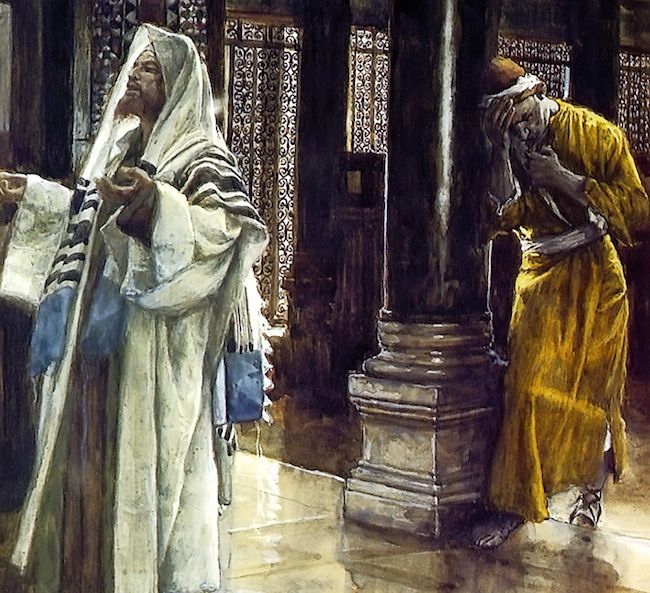
Jesus addressed this parable to those who were convinced of their own righteousness and despised everyone else. ‘Two people went up to the temple area to pray; one was a Pharisee and the other was a tax collector. The Pharisee took up his position and spoke this prayer to himself, “O God, I thank you that I am not like the rest of humanity – greedy, dishonest, adulterous – or even like this tax collector. I fast twice a week and I pay tithes on my whole income.” But the tax collector stood off at a distance and would not even raise his eyes to heaven, but beat his breast and prayed, “O God, be merciful to me a sinner.” I tell you, the latter went home justified, not the former; for whoever exalts himself will be humbled, and the one who humbles himself will be exalted.
“When we pray, do we speak from the height of our pride and will, or out of the depths of a humble and contrite heart? He who humbles himself will be exalted; humility is the foundation of prayer. Only when we humbly acknowledge that we do not know how to pray as we ought, are we ready to receive freely the gift of prayer. Man is a beggar before God.”
So says St. Augustine of Hippo. “Humility is the foundation of prayer.” When we pray, we ought first to consider the exalted status of the one to whom we pray. God is a mighty God. He cannot be manipulated. He cannot be extorted. He cannot be cornered. What we receive from Him, all that we receive from Him, is pure gift. There is nothing we can do to earn His favor or His grace, for then it could be said that God is obliged toward us, and God is obliged toward no one. “Man is a beggar before God.” To recognize such is to recognize His great status above us and His great love for us. For since God cannot be obliged to favor us, it is a manifestation of His love for us that He does favor us.
The opposite of humility is not only pride, but presumption, too. The Pharisee in Jesus’ parable presumes he stands in God’s favor because of his lack of greed, his honesty, and the fact that he has not committed adultery. Or perhaps he’s not presuming anything about where he stands before God, or giving any consideration to his relationship with God at all, since he presumes to congratulate himself, and even directs his prayer to himself. No doubt he thinks of himself as justified before God because of his good works, his fasting and his tithing.
But what is the motivation for such works? Jesus doesn’t say, but a reasonable conclusion might be that his motivation is endearing Himself to God so that God will reward Him. But such works fail to endear the Pharisee to God because God does not desire good works done for the purpose of endearing ourselves to Him. What God desires is good works motivated by pure love of Him, and love for others. Remember the two greatest commandments? “You shall love the Lord, your God, with all your heart, with all your being, and with all your strength, and with all your mind, and your neighbor as yourself” (Lk 10:27). The works that count toward our salvation, the deeds for which we will be judged when we stand before Christ, are those works performed out of pure love of God and neighbor.
We don’t really appreciate the position of tax collector in the Jewish culture of Jesus’ times. The tax collector was hated by the Jewish people, because he collected taxes, of course. But even more so because he was seen as a collaborator with Rome because the taxes the tax collector collected went to support the oppressive empire that controlled Palestine and its people. Also, tax collectors were in the habit of demanding more in taxes than what Rome required, and pocketing the difference. Jesus was in the habit of using in his parables the most despised of characters to make His point. Earlier, he created the example of a good Samaritan. Now, he puts into His parable a tax collector, perhaps the person most despised by the Jews because he was regarded as a traitor to his people.
The tax collector in Jesus’ parable is the embodiment of humility. Humility comes from the Latin humilitas, which comes from the Latin humus, meaning “earth”. So, we can derive two meanings of humility. First, humility means being lowly, of the dirt. The dirt is where the worms and bugs live, so one who is humble is one who is with the worms and the bugs. In other words, possessing no status for which any other need bother respecting or even recognizing. A second meaning of the word humility, though, suggests that the humble person, the person of the earth, is well-grounded. To be well-grounded is to be keenly aware of who you are and, when praying to God, to be keenly aware of the one before whom you stand.
This is the humility of the tax collector. The tax collector, when he comes to the temple to pray, is keenly aware of the one before whom he stands. So, he stands at a distance. He dares not even raise his eyes. Instead, he beats his breast and begs God “Be merciful to me a sinner.” The tax collector, for all his deceit and traitorous actions, knows that God is God, and that he is not God. He knows that our attitude when we approach God in prayer is not to be one of “Look what I did!” or “This is what I demand.” Rather, our attitude when we approach God in prayer is, “Lord, have mercy” and “Thanks be to God!” Man is a beggar before God. God owes us nothing. Yet the fact that He gives us so much, especially that He extends to us the grace won by Christ on the cross for the sake of our salvation, is solid proof of His great love for us. God who loves and gives so much is not likely to refuse our genuine needs.
When we approach God in prayer, let us approach Him with humility, as a people aware of the one before whom we stand, grateful for all He has given us in Christ Jesus, and ready to embrace the grace offered to all the sake of our salvation. To reject His grace because of pride or presumption is foolishness. To embrace His grace is true humility, because it requires our being well-grounded in who we are: that is, sinners in need of God’s mercy. The tax collector knows this. The Pharisee? Not so much. Humility is the foundation of prayer.
Be Christ for all. Bring Christ to all. See Christ in all.
 Thoughts and Prayers for the Faithful