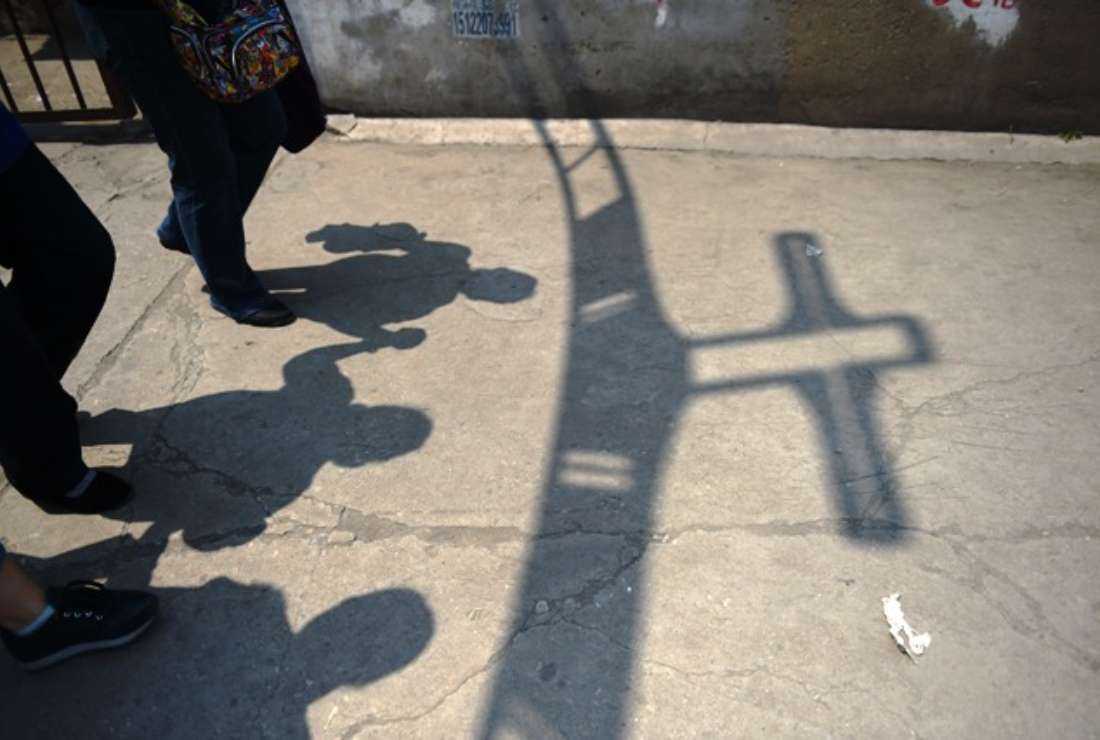
Worshippers walking past the shadow of a cross at the entrance to the ‘underground’ Zhongxin Bridge Catholic Church, after a service celebrating the Feast of the Ascension in Tianjin
In the days prior to Chinese General Secretary Xi Jinping’s meeting with President Donald Trump in South Korea, the Chinese Communist Party (CCP) began a new crackdown on religious freedom in China, especially targeting Christians. Since the takeover of mainland China, the CCP has limited religious freedom and sometimes directly targeted religion for persecution. These efforts haven’t been limited to Christians, as is evident by the CCP’s persecution of Muslim Uyghurs, even to the extent of imprisoning them in concentration camps and subjecting them to what some Western observers call genocide.
While religious freedom has sometimes been a talking point between China and the West, in particular the United States, the West has never put much pressure on the CCP to adopt reforms. This is, I think, for two reasons: First, China is a formidable foe. What, exactly, is the West going to do to convince China to be more open to religious freedom? No one wants a war with China, and we’re already committed to the security and independence of Taiwan. Taking on other commitments regarding China may be stretching American will and resources too far. Even the proof positive evidence that the CCP kills its own people to profit from the black market in organs hasn’t been enough for Western countries to poke the Chinese bear too forcefully. Second, China’s market represents, to the West, an opportunity for profit like few others. With a population of 1.4 billion, American companies, sports, and the entertainment industry want full access to China, without bothersome issues like human rights risking angering the Chinese and, thus, risking losing access to all those people. There’s money to be made in China. So, no one wants to make a big fuss about all those prisoners incarcerated in Chinese camps ending up with bullet holes surgically located at the base of their skulls, much less the cries of Chinese women forced into aborting their children, much less the demands of independent Christian pastors for Western-style religious freedom. You do what needs to be done so filming can be finished by Christmas. American farmers, too, depend on China purchasing millions of metric tons of soy beans. So, don’t piss anybody off with too much talk about human rights and religious freedom. LeBron James can holler all he wants about how oppressed he is in America, but he knows to keep his trap shut when it comes to human rights abuses in China. The NBA will not have it any other way. And James himself makes a pretty penny on the arrangement, no doubt.
The state of the Catholic Church in China remains a dual reality. First, there is the Chinese Catholic Patriotic Association (CCPA). Created by the CCP and Catholic leaders in 1957, the CCPA is officially recognized by the government and worships and teaches under the watchful eye of the CCP. It must include communist ideology in its teaching and preaching, does not allow children to attend worship or receive instruction, and is not in communion with Rome. In 2018, an agreement was reached between the Vatican and the CCP that allows some role for the pope in choosing bishops for the CCPA, but China has already broken this agreement and it’s generally agreed that it could do so again with impunity. The agreement has been renewed three times since and is up for renewal again in 2028, when Pope Leo will likely have to address the matter. The goal of Pope Francis at the time of the agreement was to keep the doors of diplomacy between the Vatican and the CCP open for the sake of Catholics in China. Whether that is working or not is up to debate, but experts on China generally agree that the Church doesn’t have much of a choice on the matter. It either continues with diplomacy, or writes off the Catholics in China. The Vatican deeply wants to improve relations with China and conditions for Chinese Catholics, but the CCP under Xi’s leadership gives short shrift to Catholicism at this point when tensions with the United States have increased over issues such as the tariff war and the continued independence of Taiwan. Plus, China is on the side of Russia in its conflict with Ukraine. There’s a lot on Xi’s plate right now. Relations with a Church whose members represent about 0.005% of its population is not at the top of his list.
The other reality for the Catholic Church in China is the underground Church. Those Catholics, lay and clergy, who have refused over the decades to join the CCPA worship underground in resistance to CCP control, and they have suffered for it. During the Cultural Revolution of 1966-1976, the Red Army would raid Catholic homes, confiscating Bibles and other religious articles and often imprisoning those participating in Catholic rites, especially priests. Persecutions have not always been so severe, but the underground Church remains underground for a reason. Remaining loyal to Rome, that loyalty has not always been returned. Part of the 2018 agreement with China on bishops involved what critics call the Vatican’s abandonment of the underground Church. The Vatican’s intention was that the agreement would join the underground Church with the CCPA, so the Vatican’s official position is that the underground Church no longer exists. It seems, however, that this represented extreme naivete on Pope Francis’ part. Thinking he could simply declare the break of decades healed by his word, neither the CCPA or the underground Church were buying it. The underground Church did, indeed, feel abandoned by the Holy Father, though they still remain loyal. As such, they continue to endure persecution.
On May 25, however, there was some glimmer of hope that the underground Church might be newly recognized by Rome. During his Regina Caeli address, Pope Leo made mention of the Day of Prayer for the Church in China, which is marked by the anniversary of Pope Benedict XVI’s letter to Chinese Catholics, where he acknowledged their “faithfulness to Christ the Lord and to the Church – a faithfulness that [they] have manifested sometimes at the price of grave sufferings.” Was it too much to hope for? Perhaps. On September 3, Cardinal Stephen Chow of Hong Kong, reported that, during his private audience with the Holy Father, Leo said he was “willing to continue Pope Francis’ approach to China at this stage, prioritizing the handling of issues with dialogue.” Then on September 10, Pope Leo announced the suppression of the dioceses of Xiwanzi and Xuanhua, both created by Pope Pius XII in 1946, and replaced with a new diocese with the same name, Zhangjiakou, as that established by Beijing decades ago, and without Vatican approval. Finally, Pope Leo, in agreement with the CCP, named Fr. Wang Zhengui as bishop of the new diocese. Should we be too hard on Leo? Maybe not. Again, the Church is hardly in a position of power in China. Still, perhaps the Holy Father doesn’t need to make his subserviance to the CCP quite so obvious, and could reach out, at least symbolically, a bit more to the underground Church, which has suffered so much.
Pray for the Church in China. Pray that Pope Leo XIV will not forget our confreres who continue to worship underground and who have remained so loyal to the Church. Pray for the conversion of all members in the CCPA to the one, true Church. Pray for the end of communism in China. All according to His plan.
Be Christ for all. Bring Christ to all. See Christ in all.
 Thoughts and Prayers for the Faithful