
An article published last month by The Catholic World Report purports to rank the Catholic dioceses in the United States by how fruitful each diocese is in terms of seminarians, weddings, infant baptisms, and adult receptions into the Church. Those diocese with higher rates of those four catagories as measured against the number of Catholics in that diocese were judged to be more fruitful than diocese with lower rates. So, for instance, my old stomping ground as a young man was the Diocese of Arlington in Northern Virginia. According to the stats reported in the CWR article, Arlington had one seminarian for every 10,827 Catholics, one Catholic wedding for every 327 Catholics, one infant baptism for every 90 Catholics, and one adult reception for every 227 Catholics. That means Arlington ranks 43rd among U. S. dioceses in fruitfulness. The CWR article doesn’t include this information, but there are just over 432,000 registered Catholics in the Diocese of Arlington. So, not too shabby for my old home diocese.
But Arlington doesn’t compare to what is going on in Tennessee. Of the 178 dioceses in the United States, the Diocese of Nashville ranks first in fruitfulness (tied with Tulsa, OK), the Diocese of Knoxville (my diocese) ranks fifth in fruitfulness, and the Diocese of Memphis ranks 10th in fruitfulness. So, all three of the dioceses within the state of Tennessee rank in the top ten for fruitfulness. I think that’s pretty amazing! I doubt that any other state even comes close to matching Tennessee in fruitfulness of Catholic dioceses. For the record, here are the stats for each Tennessee diocese in the four catagories used to measure fruitfulness:
Nashville: seminarians = 1/3,944 Catholics; weddings = 1/239 Catholics; infant baptisms = 1/47 Catholics; adult receptions = 1/137 Catholics
Knoxville: seminarians = 6,836; weddings = 1/270; infant baptisms = 1/64; adult receptions = 1/108
Memphis: seminarians = 1/5,558; weddings = 1/324; infant baptisms = 1/60; adult receptions = 1/187
What explains this? Why are the three dioceses in the state of Tennessee so fruitful according to the catagories CWR uses to measure fruitfulness?
One thing is for sure, it’s not because these dioceses have avoided controversy. In fact, Memphis suffered a crisis in leadership when Bishop Martin Holley was removed as bishop of Memphis after only two years on the job because of complaints from priests and laity about his leadership and management of the diocese. In Knoxville, Bishop Richard Stika was retired for health reasons after eleven priests sent a letter to Rome begging for relief from Bishop Stika’s leadership. Also accused of poor management of his diocese, Bishop Stika suffered the added disgrace of having been accused of poorly handling the case of a diocesan seminarian accused of raping an employee of the cathedral parish. A lawsuit that was filed against the Diocese of Knoxville and Bishop Stika was voluntarily dropped by the plaintiff only this week, the plaintiff citing poor health as the reason he did not want to continue with the suit. Only Nashville has escaped any significant scandals or controversies in recent years. Both Memphis and Knoxville seem to be doing well with their new bishops, David Talley and Mark Beckman, respectively.
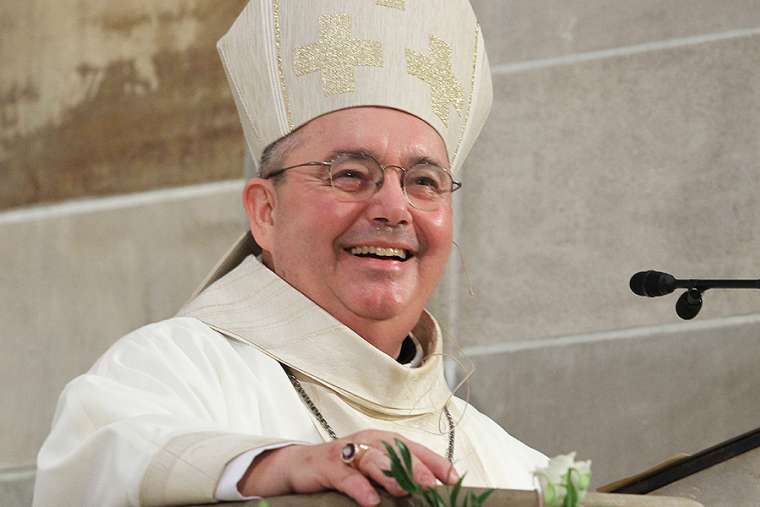
Bishop David P. Talley of Memphis
Yet, somehow, even in the midst of these controversies, the Tennessee dioceses continue to thrive. Why is that? The CWR article suggests that one reason might be that all of the dioceses in Tennessee are very small, some of the smallest in the nation. Memphis Catholics represent only 4.5% of the population of West Tennessee. Nashville Catholics make up only 3.1% of the population of Middle Tennessee. Knoxville Catholics are even more rare, making up only 2.8% of the population of East Tennessee. Indeed, when we first moved to the Diocese of Knoxville in 2000, Knoxville represented the smallest diocese in the United States when it came to Catholics as a percentage of the population. We’re still pretty tiny.

Bishop J. Mark Spalding of Nashville
And size, it seems, matters. The CWR article makes this surprising observation: “Correlation is not causation, but there does seem to be a terrible cost to souls once an American diocese grows over 700,000 Catholics: the combination of baptism, conversion, seminarian, and wedding rates inevitably falls below average.” What is the average for dioceses across the U. S.? It is 1 seminarian/14,473 Catholics; weddings = 1/453; infant baptisms = 1/113, and adult receptions = 1/413.
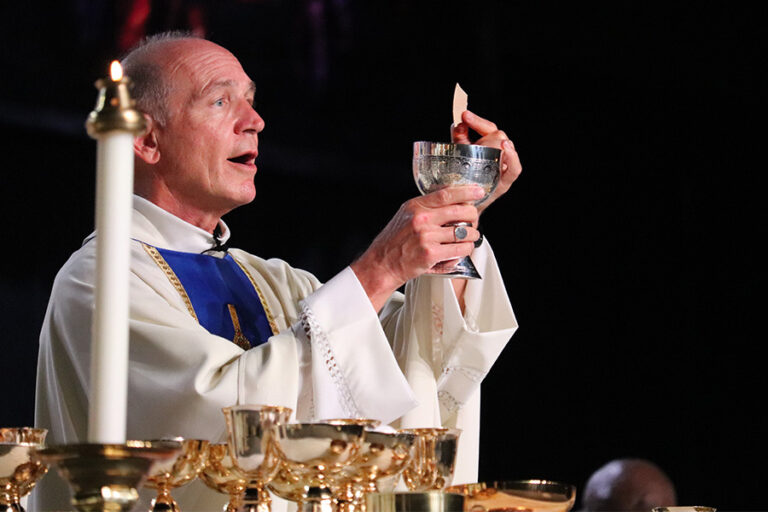
Bishop J. Mark Beckman of Knoxville
Advantages to a small diocese, both in numbers of Catholics and in territory, are that the people get to know their priests and their bishop fairly well. In fact, it’s almost like living in a small town, where everybody knows everybody. I know it’s true in Knoxville that, whenever there’s a big diocesan event, it’s like a family reunion. You get to see people you haven’t seen in a while and the opportunity to catch up. A smaller diocese generally means smaller parishes, at least outside the larger cities. This means that each parish is more akin to a family than an organization. I recently visited Mountain City in Tennessee to give an Advent Retreat at the parish up there, St. Anthony of Padua. The deacon of the parish, Joe Herman, is a classmate of mine in deacon formation, and we were ordained together. He treated me to dinner Friday night and breakfast the next morning and we ran a couple of errands prior to the retreat. It seemed everywhere we went, we bumped in to someone Joe knew. Also, in a diocese where the parishes are smaller, the people tend to take more ownership of their parish and responsiblity for its ministries, not leaving everything to the priests, deacons, or staff (if they have staff!).
All in all, it seems obvious that the Church in Tennessee is alive and well. I pray it stays so. Being smaller is nice, and it has it’s advantages. But, of course, the mission of the Church is to preach the gospel to all in hopes that all to whom the gospel is preached embrace it. So, here’s a prayer that the Church in Tennessee doesn’t stay so small!
Be Christ for all. Bring Christ to all. See Christ in all.
 Thoughts and Prayers for the Faithful