John 1:29-34
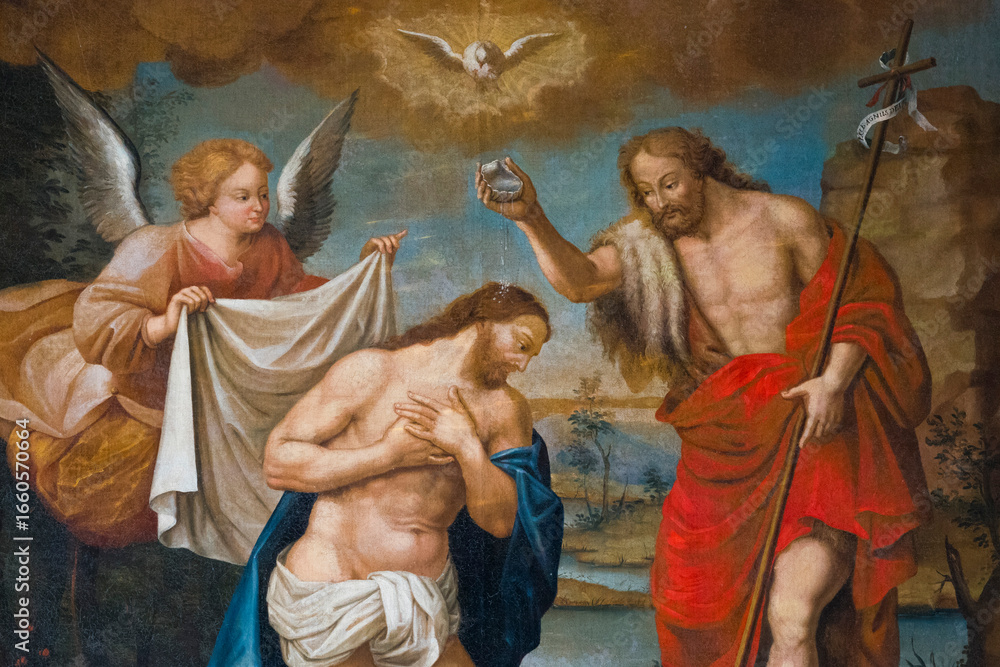
John the Baptist saw Jesus coming toward him and said, “Behold, the Lamb of God, who takes away the sin of the world. He is the one of whom I said, ‘A man is coming after me who ranks ahead of me because he existed before me.’ I did not know him, but the reason why I came baptizing with water was that he might be made known to Israel.” John testified further, saying, “I saw the Spirit come down like a dove from heaven and remain upon him. I did not know him, but the one who sent me to baptize with water told me, ‘On whomever you see the Spirit come down and remain, he is the one who will baptize with the Holy Spirit.’ Now I have seen and testified that he is the Son of God.”
The Exodus was the central saving act of God in the life of His people, Israel. The Exodus was preceded by the Passover, the tenth and last plague God brought against Egypt to convince the pharaoh to let His people go into the desert to worship. With the Passover, God threatened Egypt, through Moses, to kill the first-born of Egypt. The Israelites, however, were instructed to take a lamb, slaughter it, place the blood of the lamb on the doorposts and lintels of their homes, then roast the lamb and consume it in a communion meal. The Lord promised Israel that He would see the blood on their doorposts and lintels and the angel of death would “pass over” their homes, sparing their first-borns. Dr. Brant Pitre, in his book Jesus and the Jewish Roots of the Eucharist, says that, had any Israelite family placed the blood of the lamb on their doorposts and lintels, but not eaten the lamb in a communion meal, that family would have awakened the next morning to find their first-born dead. In any case, after the Passover and the death of all their first-born, pharoah agreed to allow Israel to leave Egypt, not just to worship for a handful of days in the desert, but for good, freeing them from slavery.
God commanded Israel to remember this central saving act in the life of His people through a ritualized meal every year that commemorated the Passover and the Exodus. It is important to understand that the Hebrew understanding of “remember,” as opposed to the Greek understanding (which dominates the current West), is not simply to bring to mind to recall the significance of the event. Rather, for the Hebrews to “remember” was to make present that saving act of God so that those throughout the generations could participate in that event. This is why, at every seder, the youngest boy in the family asks the family patriarch, “Why is this night like no other night?” Notice, he doesn’t ask, “Why was that night so long ago like no other night?” No, he asks, “Why is this night like no other night?” This cues the patriarch to recount the story of God saving the Hebrews from slavery in Egypt. That night is made present to the current generation, so they are able to participate in that saving act of God.
So it is that, at every Passover seder, the Jewish people remember the Passover and Exodus with a meal that includes sacrificing, roasting, and eating a lamb. By the time of Jesus, the Jewish people celebrated the Passover by each family bringing their lamb to the temple in Jerusalem. The priests would sacrifice the lamb, then give it to the family to roast and eat at home. The lamb serves as a sacrifice for people’s sins.
Jesus is the Lamb of God. Jesus is the Lamb provided by God the Father for the sins of His people. Instead of an annual sacrifice of a lamb brought to the temple by each family of Israel, God provided His Lamb as a one-time sacrifice to carry all the sins of all people throughout history. Just as at every Passover meal, the central saving act of God in the life of Israel is made present so those gathered in every generation can participate in that event, so at every Mass, the one sacrifice of Christ, His life, passion, death, resurrection, and ascenion, are made present so that those gathered in every generation can participate in that one sacrifice of Christ.
What a privilege God has given us, to participate in the one sacrifice of Christ made for the sake of our salvation! St. Paul writes in his Letter to the Colossian 1:24, “Now I rejoice in my sufferings for your sake, and in my flesh I am filling up what is lacking in the afflictions of Christ on behalf of his body, which is the church.” What could possibly be lacking in the afflictions of Christ? Our participation! We can take our own sufferings, such as they are, and unite them with the sufferings of Christ for the sake of our salvation. At every Mass, we participate in the one sacrifice of Christ made present on the altar. In both ways, we are united with Christ in the affictions He suffered for the sake of His body, the Church. In both ways, we cooperate with Christ in His sacrifice for our salvation.
Be Christ for all. Bring Christ to all. See Christ in all.
 Thoughts and Prayers for the Faithful