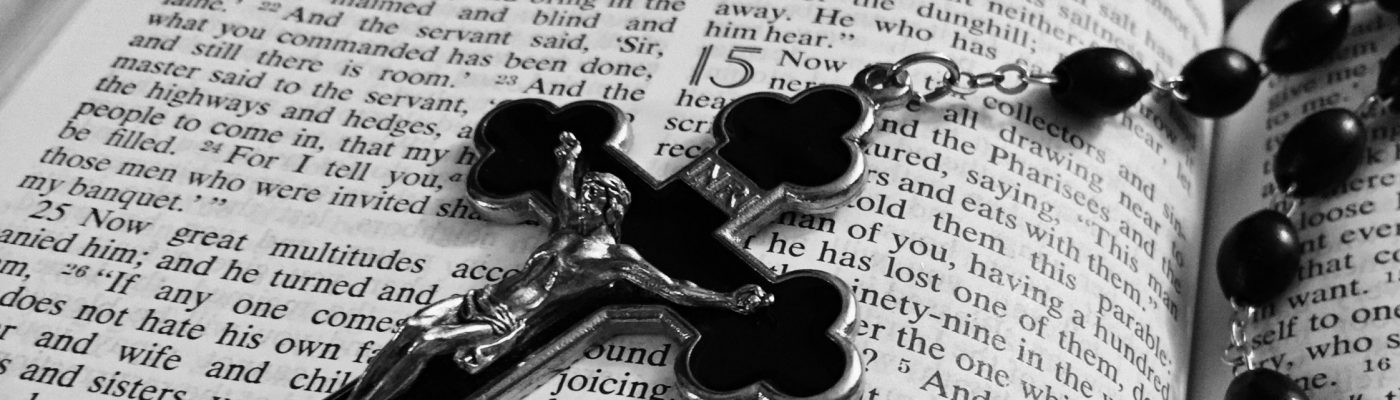

We know the story from the Gospel According to Luke that when Jesus was crucified, He was set on a cross between two thieves, the Good Thief, to which tradition gives the name Dismas, and the Bad Thief, to which tradition gives the name Gestus. Gestus lamented his fate, and turned to Jesus saying, “Are you not the Messiah? Save yourself and us!”
But Dismas rebuked him. “Have you no fear of God, for you are subject to the same condemnation? … We have been condemned justly, … but this man has done nothing wrong.” Then Dismas turned to Jesus and said, “Jesus, remember me when you come into your kingdom.”
Jesus said to Dismas, “Amen I say to you, today you will be with me in Paradise.”
Dismas finally dies, and he finds himself at the gates of the kingdom. An angel approaches and asks his name. “My name is Dismas,” he replied.
The angel scanned the Book of Life but was unable to find his name directly. He asked Dismas, “Were you a follower of Jesus?”
“Well,” Dismas admits, “not exactly. You see, I only just met him before I came here.”
“I see,” said the angel. “Well, did you live according to His teachings?”
“I don’t know what His teachings are, really,” Dismas answered.
“Were you a part of His Church? Were you baptized?” the angel inquired.
“Truly, sir,” Dismas said, “I do not even know what you are talking about. What is a Church? What is baptism?”
“Okay,” the angel said, a bit bewildered. “Well, did you follow the Law of God written on your heart, at least, doing right and avoiding wrong?”
“No,” Dismas answered honestly. “I do not think I could make a claim to that. I was a thief. I likely did more wrong than right during my life.”
“Well, if I could be blunt,” the angel explained, “you were not a follower of Jesus. You did not know His teachings. You were not a part of His Church or baptized. You did not even follow the Law of God written in your heart. These are the gates to the kingdom of God. These are the gates to Paradise. Why are you here?”
“Oh, I can answer that one!” Dismas lit up with a smile. “I’m here because Jesus said I could come!”
And with that, the angel opened the gates to Paradise, allowing Dismas to enter. And the first person he encountered in Paradise was the One who said He would meet him there.
Paddy Chayefsky wrote a play entitled “Gideon.” It is a theatrical rendition of the story of Gideon told in the Book of Judges in the Bible. Gideon was a Judge of Israel who was called on the Lord to save His people from the threat of the Midianites. Before the battle, in which three hundred Jews were to face off against 120,000 Midianites, Gideon is anxious, but not about the battle. He seems anxious about God’s love for him. Gideon turns his face up to God and asks Him, “God, God, tell me that you love me!” God replies, “I love you, Gideon.” Yet Gideon is not satisfied. Again, he looks up to God and asks, “God, God, tell me again that you love me!” “I love you, Gideon” God says again. Still not satisfied, Gideon paces back and forth, scratches his head, thinks about it. Finally, he turns once more to God and asks, “But God, God, why do you love me?” At that, God pauses. He paces back and forth, scratches His head, and thinks about it. Finally, He replies, “Well, Gideon, I really don’t know. Sometimes, Gideon, love is unreasonable.”
A young Sister of a religious community reported to her Mother Superior that she had been visited by a vision of our Lord. Mother, incredulous, decided to test the girl and her supposed vision. So, she instructed her young charge, “If the Lord comes to you again in a vision, I want you to ask Him a question. Ask Him what is the worst sin that I, your Mother Superior, have ever committed. If He truly is our Lord, then He will know.” The young religious returned to her cell and, sure enough, the next day she had another visit from our Lord in a vision. She did as Mother instructed her. After the vision, she went straight to Mother Superior’s chambers to report the event. “Well,” Mother asked, “Do you ask him the question? What is the worst sin I have ever committed?” Oh, yes, Mother!” the young one replied. “Now tell me what He said, and I will tell you if this truly is the Lord who is visiting you.” The young sister answered without hesitation. “He said, ‘I forgot.’”
I wrote a column years ago on my blog about Theodore McCarrick, the former and now deceased cardinal archbishop of Washington, DC who was removed from the priesthood in disgrace because of his crimes of abuse against minors. A friend called me and said he did not like the column. He did not feel that I was hard enough on McCarrick. I replied that I had no business being hard on McCarrick, or anyone else for that matter. Why? Because, while Theodore McCarrick’s sins were sufficient for his damnation, I know too well that my sins are sufficient for mine. Given that my own sins are sufficient for my damnation, who am I that I should condemn another for his or her sins? Better to encourage each other to put their hope for salvation in Jesus and His Divine Mercy. I do not know if McCarrick is in heaven or hell. It is not my job to assign him to either. But if he is in heaven, and I hope he is, it is because of the Divine Mercy, the only thing that could save him. And if I go to heaven, and I hope I do, it will be because of the Divine Mercy, the only thing that can save me.
God’s mercy is not like our mercy. We say that Justice is blind, she sees nothing, only balancing the scales of justice as they truly fall. But God’s mercy sees everything. He knows every moment, every thought, every nook and cranny of our very selves. And still He loves us. Still He desires nothing more for us than His everlasting kingdom, to share in His very nature. All He asks is that we put our lives in His hands, that we shape our priorities according to His will, that we trust Him to save us. “Jesus, I trust in You!”
I have often said that I am so glad that, when I die, Jesus is going to be my Judge. Were any man my judge, I would be damned to hell in a heartbeat. My only hope for salvation is that Jesus is my Judge. Jesus is a merciful Judge. He is a just Judge, to be sure. But our faith, our hope, is that God’s justice is mercy. Why is God’s justice mercy? Why does God love us? Because God’s nature is love. He cannot do otherwise. God cannot not love us. That is a truth of our faith.
When we stand before the throne where Jesus will sit during our own judgment, we will not stand before Him alone. There will be two others there. On one side will be Satan, whose name means “accuser.” He will be the prosecutor. On the other side will be the Holy Spirit, the Advocate. He will be our advocate, our defense attorney. When Jesus our Judge tells us, “Well done, good and faithful servant. Enter the kingdom prepared for you from the beginning,” the Accuser will shout out, “But Lord, Lord, look at these sins!” And the Advocate will say, “As far as the east is from the west, I have thrown his sins, and I choose to remember them no more!” Then the accuser will say, “But Lord, Lord, this is unjust!” And the Advocate will say, “My justice is mercy!” Then the Accuser will say, “But Lord, Lord, this is unreasonable!” And the Advocate will say, “Well, sometimes love is unreasonable!” And Jesus will throw the Accuser out.
This is our hope. This is our destiny. This is the promise of Jesus for those who take up their cross and follow Him, for those who remain faithful to Him, for those who unite their sufferings with His, for those who put their faith in the joy of the Resurrection and their hope in His Divine Mercy. This is our hope. This is our destiny. This is the promise of Jesus. And Jesus keeps His promises.
Be Christ for all. Bring Christ to all. See Christ in all.
 Thoughts and Prayers for the Faithful