The Religious Landscape
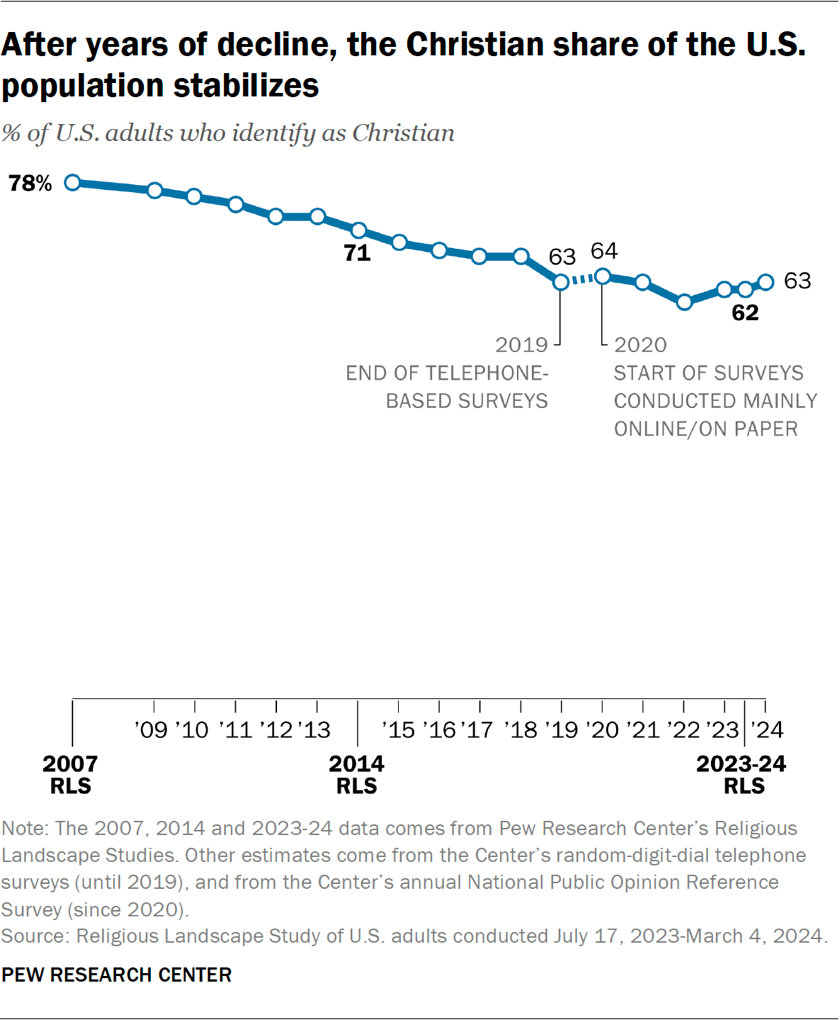
According to the 2023-2024 Religious Landscape Study, the decline in religiosity in the United States seems to have slowed, or even leveled off. It was bound to happen. It’s extraordinarily rare for such a phenomenon to go on forever, absent extreme social pressure or outright persecution. There is no pervasive social pressure, per se, against being religious in the United States. As well, there is no widespread persecution of religious people in the United States. Hence, it was almost certain to happen that the decline in religion would eventually level off.
Most of the decline in religiosity in the United States, in my mind, is attributed to the movement, especially strong from around 1955 to 1975, to identify religion with ethics, which is unsustainable, and the social pressure to commit oneself to other priorities, such as work, sports, or politics. Each of these were especially strong in taking the place of religion in the sensibilities of about two or three generations ago and has been handed on to those generations’ children. Hence, more young people are reporting that they were not raised in religious households.
Protestantism remains the largest religious tradition in the United States, with 40% of the population adhering to one of the several Protestant denominations, while Roman Catholicism remains far and away the largest single religious denomination in the United States, at 19%. The trends in both Protestantism and Catholicism have been pretty level for some years now. 29% of the population identify as not belonging to any particular religion, but these “nones” are all over the place in their religious beliefs, from outright atheism to their own personal theistic religious creed. The great majority of Americans, 83%, still say there is a God, and even more, 86%, say they have a soul or spirit besides their physical bodies. So, participation in a religious tradition has declined significantly since 2007, but spirituality has declined less so. This recommends that, for those who have come to identify with no particular religious tradition, atheism is not filling the void. Indeed, since 2014, the share of the population claimed by atheism has risen from 3.1% to only 4%, and only 6% of people who believe in God as a teenager adopt atheism as adults. The great evangelization efforts of the New Atheists so pervasive in popular culture a few years ago seems to have proved a colossal failure, at least in terms of converts to atheism.
What seems to be the great enemy of religion, then, is not atheism, but apathy. Indeed, it seems to me that there are many people who never consider the “big questions” of life: Who am I? Why am I here? Is there meaning to life beyond what I create for myself? Am I my brother’s keeper? In 2021, right in the middle of the COVID pandemic, Kelsey Dallas wrote that, while more people were considering the big questions, fewer thought it important to find the answers to them. Dallas quoted Scott McConnell of LifeWay Research in Nashville, who conducted a study on the matter: “In the midst of such a discouraging season, fewer Americans are convinced there is something more to this life than their daily activities. A growing number of Americans have become open to the idea that this might be as good as it gets.” Now, if that doesn’t depress you, nothing will!
Years ago, I wrote about a survey conducted by a parish priest of his non-church-attending registered parishioners. He was surprised to learn that, of the reasons people gave for not attending Mass, rejection of Catholic doctrine, a bad experience with a priest or religious, and even the sexual abuse scandal accounted for less than ten percent combined. The great reasons for people not attending Mass were two-fold: our 24/7/365 work cycle, and youth sports. The fact is, our society has chosen to keep everything open all the time, and somebody’s got to work those shifts. The fact is, families have decided that they would rather travel across state to get their kid to a sports tournament then travel across town to take their kid to Mass. These are the sad fact, and they have little to do with theism v. atheism or the great questions of life. They are all about apathy toward God and His plan for our lives. For too many, the question of God isn’t even on their radar. Maybe that’s the likely explanation for why the great evangelization efforts of the New Atheists were such a dismal failure; not because people rejected atheism for God, but because the question of God was never on their radar in the first place. In a way, that’s even more tragic.
So, what’s the Christian respone to all of this? Joy! C’mon, now. If you’ve been reading this blog for any length of time, you know that’s my answer to every question about how Christians are to respond to a matter. Joy! Real joy is the only answer. Why? Because only joy can adequately respond to apathy. “Although you have not seen him you love him; even though you do not see him now yet you believe in him, you rejoice with an indescribable and glorious joy, as you attain the goal of your faith, the salvation of your souls” (1 Pt 1:8-9). Who could not be filled with joy at such a truth?
Joy is the child of hope. And hope is what Christianity is all about. “Always be ready to give an answer to anyone who asks you for a reason for your hope” (1 Pt 3:15b). So, when we have hope, we have joy. And when we have joy, we will be considered odd in our society. As Flannery O’Connor supposedly said (and, if she didn’t, it sounds like her): “You will know the truth, and the truth will make you odd.” So, the truth of Christ gives us hope, and the hope we have in Christ gives us joy. And the joy we exude in our daily lives will attract the attention of the apathetic. Why are you always so happy? Why do you always have a smile? Why do you never seem to get out of sorts with things? These are the questions our apathetic contemporaries will ask us when the notice the joy that we live. Then, we can answer truly – our joy is the child of our hope, which is the child of the truth we have come to know in Christ Jesus!
Glory and praise to you, Lord Jesus Christ!
Be Christ for all. Bring Christ to all. See Christ in all.


You know absolutely nothing about atheism, so stop commenting on it. Your mind is fully captive to Jesus Christ nonsense, so stay in that lane, and leave the far greater rewards of non-religion to those great numbers of adults who said no.
LikeLike
You have no idea what I know about atheism, or anything, for that matter. In any case, one need not know anything about atheism or theism to be able to count. According to the numbers, there are approximately 13,604,000 self-declared atheists in the USA today (4% of 340,100,000), and 282,283,000 theists (83% of 340,100,000). Comparatively speaking, then, the number of atheists in the USA is not so great, after all.
I would be interested for you to elucidate on the “far greater rewards” of atheism. Though, judging by the anger apparent in your comment, it doesn’t seem that a happy disposition is one of them.
Also, I edited out your blasphemy of the Name of Jesus Christ. If you hope to have your comments posted here, you’ll need to avoid blasphemy and vulgar language.
LikeLike