
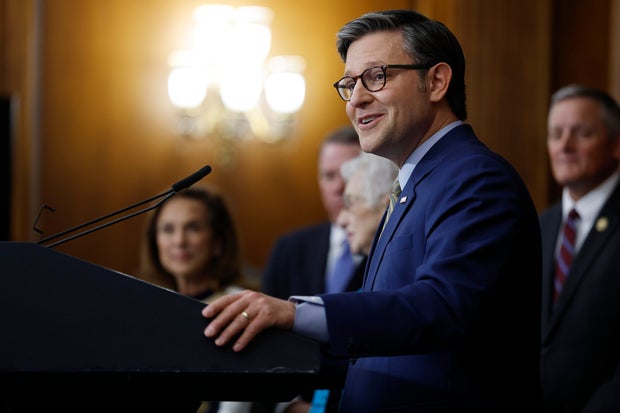
Speaker of the House Mike Johnson (R-LA) speaks to the press after the House of Representatives squeaked out passage of the “One Big, Beautiful Bill” by a margin of one vote
Elon Musk calls it a “disgusting abomination.” In a post on X, the billionaire who has been working in the Trump administration’s new Department of Government Efficiency (DOGE) and has identified billions of dollars in waste, wrote, “I’m sorry, but I just can’t stand it anymore. This massive, outrageous, pork-filled Congressional spending bill is a disgusting abomination.” I can’t blame him. After months of work identifying waste in government spending, Musk must feel betrayed or played now that Trump is pushing a budget bill that would add either $5 trillion, $3.8 trillion, or $2.4 trillion to the deficit (I’ve read all three – who knows which is correct?). Trump accuses Musk of only opposing the bill because it cuts funding for his EVs. Whatever.
Trump’s big, beautiful bill passed the House of Representatives by one vote. There were some Republicans who voted against it out of concerns over the added trillions to the deficit and, of course, all Democrats voted against it. Still, the House Republicans managed to eke it out, and now it goes to the Senate, which will likely make some changes. Then it will go to committee to hammer out a bill that both the House and Senate can pass and, if both do, it goes to Trump’s desk for his signature.
What’s in the bill passed by the House? Here’s some of the highlights, with my take on them. Much of the information for this post was garnered from Associated Press reports.
THE GOOD
Trump’s signature legislation from his first term, the individual and estate tax cuts from 2017 (that are set to expire) will be made permanent. There’s some good and some bad in this. Here I’ll address the good, and I’ll address the bad below. I don’t expect to save much in taxes, but more money in the hands of the people is generally good. I went to the White House website where they have a tool where you can put in your financial info and get an idea of how much money you’ll save on taxes. According to that tool, the savings are for those who make a signficant amount of their income from tips and overtime. I make no money from tips or overtime, so my estimated savings is zero dollars. And, while the no tax on tips and overtime is a good thing in the bill, these are only temporary savings, set to expire in 2028, after Trump leaves office. The good part of this is that those who make between $17,000 and $51,000 will save an average of $845 in 2026, and those who make between $51,000 and $93,000 will save an average of $3,245 in 2026. What this really represents, as far as I understand, is the amount of tax increase the people in these income levels will not suffer. This is because the 2017 tax cuts will still be in effect if the big, beautiful bill passes.
The bill will phase out the clean energy tax credits from Biden’s presidency. This is what Trump says Musk is peeved about. I don’t have a problem with this. Clean energy is fine, where and when it works. But it will not replace fossil fuels. The best prospect is in nuclear energy, so I would like to have seen tax credits continued for that.
The bill includes an increase in the standard deduction, bringing it to $16,000 for individuals (a $1,000 increase) and $32,000 for joint filers (a $2,000 increase). This reduces the amount of income that is subject to one’s income tax. Again, though, this is only temporary. There is also a temporary increase in the child tax credit of $500, for a total credit of $2,500. Again, expiring in 2028. There’s also a $4,000 increase in the standard deduction for seniors which is, again, temporary. These are all good ideas. Why are they temporary? Because if they’re made permanent than the increase to our deficit will be closer to $5 trillion. So, is this really a good idea? Are we sparing ourselves a bit of financial hardship to place a greater burden on our children and grandchildren? That’s a legitimate question. But my thinking is that we can off-set the loss in income by cuts elsewhere. Where? Well, take your pick. How did we get to the point where our country has a $36 trillion deficit? By the government paying for everything. Also, organizations that receive government funding tend to think of themselves as having a right to government funding, and begin to shout and holler when the government even considers cutting that funding, never you even mind ending it. For instance, why is the government sending any money at all to colleges and universities with multi-billion dollar endowments? No. Just stop. The American taxpayer doesn’t need to supplement the incomes of colleges and universities with multi-billion dollar endowments. Also, the tax cuts that have been extended to the very wealthy ought to be reversed. I address that below.
The state and local tax (SALT) deduction cap would be increased to $40,000 for families with incomes under $500,000 and decrease by 20% for every extra $100,000 earned by joint filers until it “caps” at $10,000. This would further decrease the amount of money subject to one’s income tax for most earners. Good.
Small businesses currently subtract 20% of their qualified business income from their taxes. This deduction has been raised to 23%. Also, businesses will – again, temporarily – be allowed to count as a full expense any domestic R & D costs, as well as the cost of machinery and equipment and other qualifying assests. This is a good thing. Businesses will be encouraged to invest more in growing their business. That should translate to more successful businesses, which should translate to more jobs.
The bill would create the opportunity for parents to open “Money Accounts for Growth and Advancement” (or MAGA – see what they did there?) for their children. For parents who do so, the federal government will kick in $1,000 for babies born between January 1, 2024 and December 31, 2028. Families would be allowed to contribute $5,000 a year. Once a child reaches 18, he or she could access 50% of the money in the account and use it to pay for college, job training, or a first-time home purchase. After the child reaches the age of 30, he or she has access to the full amount remaining in the account to use for any purpose.
The bill would also stop Medicaid funds from going to Planned Parenthood. The Democrats don’t like this because abortion is their one sacrament. They claim it would decrease access to healthcare for low-income women, making it more difficult for them to access cancer screenings and birth control. The truth is, PP does very little in the way of cancer screening and birth control, and what services they do provide in these areas has been declining. Also, the number of non-PP low-income clinics throughout the country outnumber PP by 15:1. So, there are plenty of other options for low-income women. Let’s just face the fact that Planned Parenthood is about abortion and, now, hormone therapy for people wanting to transition from male to female, or female to male. The federal government has no business funding this organization by any means.
The bill would re-organize the student loan program, requiring borrowers to enter one of two payback plans: a standard option spread out over 10 to 25 years, and a “repayment assistance” plan for those requiring assistance with their loans. The bill would also increase taxes up to 21% for college and university endowments. I have no sympathy for the colleges and universities here. Many of them sit on billions of dollar endowments while continuing to raise tuition every year. Also, the rise and tolerance of anti-Semitism on colleges and universities is abhorant. I know it’s a separate issue. But Harvard crying crocodile tears over possibly losing federal monies and the income from foreign exchange students is too much. They claim it will mean decline in cancer research. Well, only if Harvard decides to cut cancer research. Harvard currently sits on a $53.2 billion endowment. I think they can manage.
The bill would also allow more leasing of public lands for mining, logging, and oil drilling. It would also speed up the government approval process for developing lands. Royalty rates paid by oil, gas, and coal companies would be cut. All of this creating more jobs and more fuel for the country. Yes, that’s a good thing!
The bill would provide $4 billion to hire 3,000 more Border Patrol agents and 5,000 more customs officers, and there’s $2.1 billion set aside for signing and retention bonuses. There is also funding for 10,000 additional Immigration and Customs Enforcement (ICE) officers and investigators. Trump has been phenomenally successful in shutting down the border to illegal entry and in deporting criminal cartel and gang members. I don’t agree with all of his immigration policies. But the men and women who work for these agencies don’t make the policies, and they risk their lives addressing illegal immigration and the illegals who have entered this country to wreak havoc on our nation with their drugs, murders, rapes, kidnappings, and human trafficking.
$25 billion would go for the “Golden Dome for America.” When Reagan pushed this, the press called it “Star Wars” and considered it a fantasy. Not so much now. There are real possiblities. Israel has an Iron Dome for the purpose of intercepting incoming missiles targeting populated areas, and reports are that it has proven 87-90% effective in destroying those incoming missiles. Of course, the U. S. is much larger than Israel, and Israel has not faced the threat of a nuclear missile targeting their country. If ten nuclear missiles were launched at the U. S. and nine were successfully intercepted, that one missile would still kill hundreds of thousands of people, maybe millions, depending on what city was targeted. But that’s orders of magnitude better than the tens of millions who would certainly be killed if all ten missiles got through. If we can get this to work, why would we not do that? I also like the $9 billion set aside for “quality of life” related expenses for our service members, including for housing, health care, and special pay. Our military personnel don’t get paid enough.
THE BAD
The bad part of Trump’s tax plan contained in his big, beautiful bill is that those in the lowest quintile will actually see an increase in their taxes of $1,035, and those in the next lowest quintile, who make up to $17,000 will see an increase in their taxes of $705. How can we justify requiring people who make the least in this country paying more taxes? I don’t think we can. On the other hand, those in the highest 0.1% will enjoy a tax break of $389,280 in 2026. Those savings will decline (for all quintiles) over the next two years, but it seems Trump’s critics who accuse him of favoring tax cuts for the wealthy are right. I don’t understand why we’re doing this. These people should not be getting a tax cut. We can’t afford it, not with a $36 trillion deficit. The tax breaks for the wealthy should be reversed. However, these tax breaks for high earners and locked in and permanent, unlike the tax breaks on tips and overtime, which are temporary.
The estate tax exemption increases to $15 million in the bill. Don’t know why we have to give such an exemption to people whose estates are worth up to $15 million. Also, again, this tax exemption is locked in.
The Congressional Budget Office (CBO) says that the bill includes almost $700 billion in cuts to Medicaid. To be eligible for Medicaid, able-bodied adults without dependents would be obliged to fulfill 80 hours each month of “community engagement requirements,” through working, continuing education, or service. These requirements take effect on January 1, 2029 (after Trump leaves office, ‘natch!). The CBO estimates that around 10.9 million people would lose their healthcare over the next decade if Trump’s bill passes. This is not a good thing. Why are we trying to save money by cutting healthcare for people? How many people on Medicaid are “able-bodied adults without dependents” (ABAWDs is what the government calls them)? As it turns out, there are about 13.9 million (2022 numbers, most recent available). How many of those ABAWDs are not working at least 80 hours a week.? Well, that depends on how you count them, and how they’re counted depends on who’s doing the counting. The New York Times ran an opinion piece by RFK, Jr that says: “A recent analysis from an economist at the American Enterprise Institute examined survey data from December 2022 (the most recent month available) and found that just 44 percent of able-bodied, working-age Medicaid beneficiaries without dependents worked at least 80 hours in that month.” But Matt Bruenig, writing for People’s Policy Project writes that AEI’s figures do not accurately reflect the number of ABAWD Medicaid recipients who are working at least 80 hours a month. AEI counts only those receiving disability benefits as disabled. But we all know that’s not accurate. There are plenty of people who are disabled and on Medicaid who are not receiving disability, either because they’ve applied and are still waiting on getting disability (it can take as long as two years to get approved for disability, unless you’re a dialysis patient, then it’s approved rather quickly), or because they’re disability is short-term, or because they’ve fallen through the cracks of the system. These people should not be counted as ABAWDs, but they are. Also, AEI only looked at December, 2022. There are plenty of ABAWD Medicaid recipients who worked at least 80 hours in other months of 2022, but not in December. Also, there are those ABAWDs who have been on Medicaid less than a year. Once these people are considered, Bruenig writes that 71% of ABAWDs worked at least 80 hours for some of the months of 2022. Bruenig estimates that about 4 million ABAWDs work fewer than 80 hours a month (this doens’t mean they’re not working at all, only that they’re not working at least 80 hours a month – though, of course, there certainly are those who are not working at all, and could be; every system is going to have its cheaters). 4 million represents about 29% of all ABAWDs on Medicaid, 5% of all Medicaid recipients, and 1% of the U. S. population. I contend that we’re not doing the right thing by focusing on this 5% of the Medicaid population, while putting almost eleven million people at risk of losing their health insurance. Will 4 million of those 10.9 million be ABAWDs who are not working? Maybe. But there’s bound to be plenty who truly rely on Medicaid who are going to lose their health insurance because of this bill. If only 5% of the people in your system are cheating, honestly, you’ve got a pretty good thing going. Sure, work to get rid of that 5%. But don’t put the truly needy at risk.
The bill would cut spending for food stamps, formally known as the Supplemental Nutrition and Assistance Program (SNAP), by around $267 billion over the next decade. The CBO estimates that about 4 million people would lose their SNAP benefits if the bill becomes law. States, which currently contribute nothing toward the cost of benefits and pay half of administrative costs, would be required to pay 5% of benefist costs and 75% of administrative costs, beginning in 2028. Also, currently ABAWDs who receive food stamps have to fufill work requirements up to the age of 54. The bill would increase that to age 64. SNAP currently serves over 42 million people every month. The number of ABAWDs who receive assistance is estimated to be less than one million. Finally, the law currently exempts parents with children under the age of 18 from working. The bill would exempt only those parents with children under the age of seven. Because seven year olds are perfectly capable of caring for themselves while their mother is at work, right? I mean, okay, maybe make it children under the age of sixteen or even fourteen, but seven? Also, ABAWDs are considered those who are not on disability. But, as was discussed above, there are a lot of people who are disabled but don’t receive disability, for various reasons. All of these would be considered ABAWDs. Also, people who care for their elderly parents or extended family, and people who care for children they don’t claim on their taxes because they’re not the legal guardians, would be considered “without dependents.” Full disclosure: I grew up on food stamps. My family depended on them. My mother was not able to work because of mental and physical illness. Had she been required to work (because she was well under 64 and all of her children were over six years old) we would have lost our food stamps and a significant percentage of resources available to put food on the table. I’m all for limiting food stamp use to actual food products and not junk foods. But are we really trying to cut spending by taking a program away from millions of people that provides them with $1.40 per meal per person? I don’t think that reflects the American way.
The bill would get rid of a $200 tax on gun silencers, a tax that has been on the books since 1934. Why does anyone need a silencer for their gun? Of course, the NRA supports this, but does anyone else? I’m sure the police don’t. They’re the one’s who often have to ascertain where gunfire is coming from when an active shooter is on the scene. Silencers make this far more difficult. This doesn’t make sense. If the $200 tax dissuades even some people from getting a silencer, than it’s worth it. Most people who can afford to buy guns can afford a $200 tax on their silencer. Again, if someone can explain to me why anyone needs a silencer for their gun, I’m happy to consider your argument.
The bill would provide $46.5 million to resume building Trump’s border wall (that Mexico was going to pay for, remember?). Now, since we’ve been so successful in shutting down the border to illegal immigration, why do we need to spend money on a border wall? Maybe Trump is afraid that another Democrat president will revive Biden’s open border policy. I guess that’s a legit concern. But right now, I’m not so sure we need this. But I’m flexible. Also, the bill would require that migrants seeking asylum pay a $1,000 fee. These people are seeking asylum, not simply permission to move here or work here or study here, but asylum, which means they’re fleeing a bad situation in their home country. Why would we charge these people? I can’t imagine that these people are thinking, “Let’s remember to grab the $1,000 we have stashed away to pay Trump’s asylum fee while we flee death and despair in our home country!” No. Just … no. Trump also wants to spend money on removing 1 million immigrants annually and put 100,000 people in detention centers. Detention centers? We really want to put people in detention centers? Nah, I don’t think so. Deport the criminals, and give those who came here for a better life or to flee persecution an opportunity to make their case. If they can make a good case, put them on the path to citizenship. If they can’t make a good case, deport them. But detention centers?
The bill sets aside almost $150 billion in new funds for defense and national security. I’m torn on this one. One of the first responsibilities of government is to provide for a national defense. I get that. But I’m a bit weirded out with giving $150 billion to the Defense Department while kicking 10.9 million people off Medicaid and 4 million off SNAP. Doesn’t seem like a Jesus kinda thing to do. The bill provides $21 billion to restock our arsenal and $34 billion to expand our naval fleet. Whether these represent wise spending, I’m not in a position to say. But it just strikes me as abhorent that we put such emphasis on military spending while cutting our safety net.
THE UGLY
Finally, we get to the ugly. According to the CBO, the big, beautiful bill would add $2.4 trillion to our deficit. Other estimates are that it would increase the deficit by $3 trillion, with interest, and $5 trillion if the proposals in the bill are made permanent. We cannot afford this.
Why does the debt matter. The Peter G. Peterson Foundation offers a summary of the consequences of our huge deficit. Included are the signficant amount of interest we’re paying on the deficit. The U. S. spends more on the interest payments on our debt that we do on any particular federal progam other than Social Security. Money going to interest payments means money that could be going to federal programs, such as boosting Medicare and SNAP, necessary military expenditures, or supporting the arts and education, are not available for these purposes. If our debt is so high, businesses and other nations will be less likely to invest in America. Our credit rating used to be AAA, which represents a perfect score. Fitch Ratings and S&P Global downgraded our credit rating in 2023 to AA+, and Moody’s downgraded our credit rating from Aaa to Aa1 just last month. All of these cited our increasing national debt and our inability to deal with it effectively as the reason for our being downgraded. A downgrade in our credit rating may inspire investors to not invest in the U. S., reducing economic and job growth. The debt also makes it more difficult to respond to a financial or natural crisis, because the emergency funds just aren’t there. 78% of Americans regard addressing the national debt as a priority. So why aren’t our politicians in Washington as concerned. The Republicans keep talking about how the Democrats are on the wrong side of so many 80:20 issues. Well, our national debt is an 80:20 issue, but nobody seems concerned. The Peterson Foundation has brought together various organizations to come up with solutions to the debt, and they’re optimistic that it can be effectively addressed. But not if our representatives, including our president, keep pushing it aside. We need leadership on this matter and, while Trump kept talking about how important it was to address in past years and while campaigning, it seems he’s forgotten all of that in recent weeks.
So, despite the good things in the bill that I support, I cannot support passage of this bill. The bad and the ugly far outweigh the good. That’s my take. I’m happy to consider yours.
Be Christ for all. Bring Christ to all. See Christ in all.

