My homily for the Solemnity of Corpus Christi:
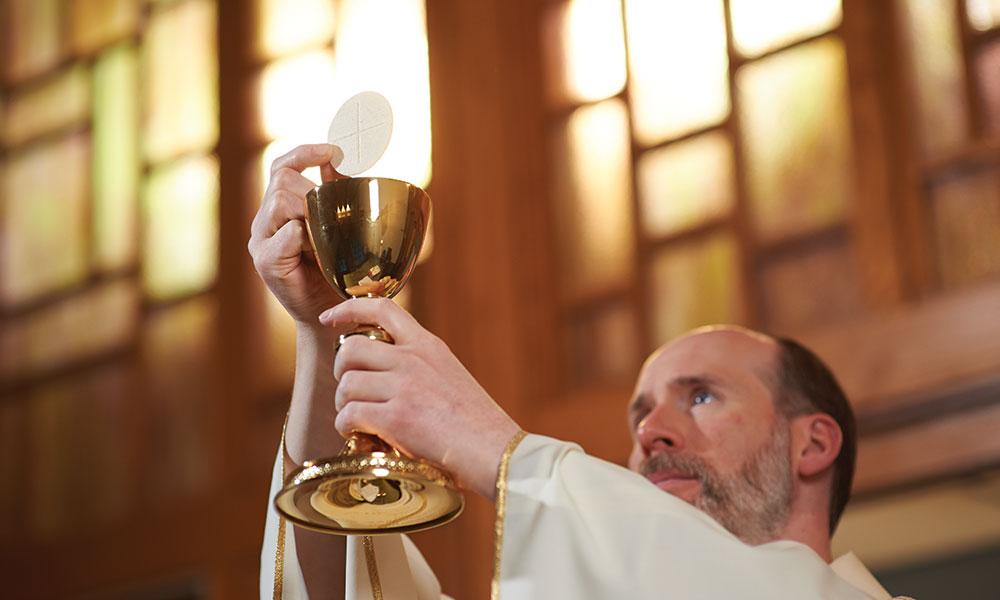
Today is the Solemnity of Corpus Christi, the Body and Blood of Christ. Today we celebrate especially the great mystery and gift that is the Eucharist. As Catholics, we believe in the Real Presence of Christ in the Eucharist. We believe that the bread and wine offered on this altar, by the power of God, is transformed into the Body and Blood of Christ. It is not bread we consume, but the Body of Christ. It is not wine we consume, but the Blood of Christ. This mystery, this gift, has been a central, defining doctrine of Catholic faith from the beginning. The Fathers of the Second Vatican Council called the Eucharist “the source and summit of our faith.” That it is.
Why did Jesus institute the Eucharist? Dr. Lawrence Feinberg is a Jewish convert to Catholicism who became a Catholic theologian. In his great missive, “Eucharist: Mystery of Presence, Sacrifice, and Communion” he delineates three reasons Jesus instituted the Eucharist.
Jesus instituted the Eucharist, first, to perpetuate His presence among men as our Redeemer and the divine Victim for our souls. In ancient Israel, the people of God referred to God’s presence among them has His shekinah. God made His presence, His shekinah, known to His people by way of cloud by day and fire by night. When Moses, under God’s guidance, set up the tent that was the tabernacle of the Lord as they traveled the desert, God would make His presence, His shekinah, known by consuming the tent with a cloud. When Moses desired to speak to God, he went to the tabernacle, because that is where God’s shekinah was made manifest. When the Lord permitted Solomon to build a temple for Him, He made His presence known in the temple.
Just so, Jesus our Lord and Redeemer, desired to be present with us on our journey of faith. He instituted the Eucharist, His Real Presence, to be cherished, venerated, and adored in every tabernacle, in every church throughout the world. Regardless of where we are in the world, we can find a Catholic church and come before His presence. Regardless of our struggles, conflicts, faults and failings, we can come before Him, confident that He will hear us and be present to us. Be it the grandeur of a medieval cathedral or the simplicity of a country chapel, where there is a Catholic tabernacle, there is the Lord Jesus present with us.
Second, Jesus instituted the Eucharist to perpetuate His redemptive sacrifice, the supreme act of His burning charity, and allow us to join with Him in offering it to the Father. At every Mass, the one sacrifice of Christ on Calvary is made present on the altar so that those gathered throughout the ages may participate in that sacrifice. We come to Mass to participate in the suffering and sacrifice of Jesus, uniting our sufferings and our sacrifices to His, and offering them, with Him, to the Father. St. Paul, in his Letter to the Colossians, says: “Now I rejoice in my sufferings for your sake, and in my flesh I am filling up what is lacking in the afflictions of Christ on behalf of his body, which is the church” (Col 1:24). What could possibly be lacking in the afflictions, in the sufferings, of Christ? Our participation! At every Mass, we participate in the suffering and sacrifice of Christ, we unite our sufferings and sacrifices to His, and we offer this to the Father for the sake of our salvation.
Finally, Jesus instituted the Eucharist to unite Himself in intimate communion with us so as to be our spiritual food and drink. Jesus desires a deep, intimate relationship with each of us, and you don’t get more intimate than “Eat my body; drink my blood.” With each Eucharist, we are transformed more and more into the image of Christ. With each Eucharist, we become more and more the Christ we consume. St. Augustine of Hippo would exhort the faithful, “Behold what you are, become what you receive.” Beholding the Eucharist, we recognize who we are; in receiving the Eucharist, we become more and more the presence of Christ in this world. God became man so that man might become God! The Eucharist is the food that nourishes us on that journey of transformation, of divinization, and makes possible that transformation, that divinization. At every Mass, when the deacon or priest prepares the chalice, he says quietly, “By the mystery of this water and wine, may we come to share in the divinity of Christ who humbled Himself to share in our humanity.” This is our faith, that the power of the Eucharist is such that Christ can transform even me, even you, into Himself.
But, you know, doing something every week, or even every day, has the risk of becoming mundane. We get used to it. We may, then, forget the power and glory, the profound mystery in which we participate at every Mass. We may need to wake up, be conscious of what we are doing here, of what God is doing here.
There is a story I like to tell. Some of you may have heard me tell it. It’s about a miracle from the Middle Ages, captured in a marvelous children’s book by Josephine Nobisso called “The Weight of a Mass.” She tells the story of a prince and his bride who are about to be married in the local cathedral. An old, poor woman comes into the finest bakery in town, filled with villagers purchasing their gifts for the royal couple, and asks the baker for a piece of stale bread. The baker demands payment, but the woman insists, “I have no money.” The baker asks, “Well, what will you give me for this piece of stale bread?” The poor, old woman tells him, “I am going to the cathedral to attend the Mass for the prince and his bride. I will offer my Mass for you.” The baker scoffs, unimpressed. He says to the woman, “What is one Mass to me?” But he’s not finished. He intends to mock the old woman and her pledge of one Mass. So, he tears off a small corner of tissue paper, writes on it “One Mass,” and places it on his bakery scale. Then he takes a cupcake, tells the crowd that has gathered, “Let’s see if we can calculate the weight of a Mass,” and places the cupcake on the scale opposite the tissue paper One Mass. And the scale didn’t move!
Bewildered, the baker gathers more cupcakes, and some scones and tarts, as well, and places them on the scale opposite the tissue paper One Mass. And the scale didn’t move! “I don’t understand!” the baker says. “I only had this scale calibrated yesterday!”
Then he takes from his shelf breads, buns, and biscuits, and sets them on top of the other items already on the scale, opposite the tissue paper One Mass. And the scale didn’t move!
Finally, he goes to the back of his shop and brings out the massive, beautiful cake he had baked for the prince and his bride. With the help of his son, he hoists it up on top of all the cupcakes, and scones, the tarts and breads, the buns and biscuits that were already on the scale, opposite the tissue paper One Mass. AND THE SCALE DIDN’T MOVE!
The weight of one Mass! The weight of this Mass, this Mass here in this church, on this night! This Mass is our redemption! This Mass is our salvation! By this Mass, by our receiving the Body and Blood of our Lord Jesus Christ at this Mass, we are transformed into Christ. Now take that Christ that you are, take Him out into that world, and transform that world by the grace of God, into one that better reflects the sacrificial, eternal, and redemptive love of God.
Be Christ for all. Bring Christ to all. See Christ in all.
 Thoughts and Prayers for the Faithful
Beautiful beyond words PatSent from my iPhone
LikeLiked by 1 person
You are very gracious. May our good Lord bless and keep you always.
LikeLike