
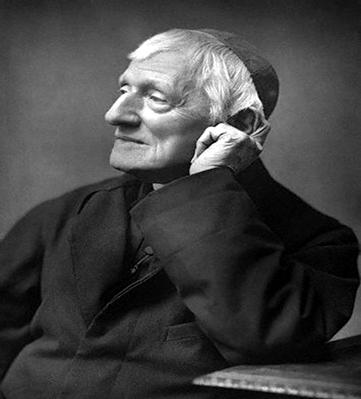
St. John Henry Newman
BIOGRAPHY
St. John Henry Newman was born in London in 1801, the oldest of six children. He pursued his education at Trinity College, Oxford, where he was made a fellow of Oriel College, Oxford, in 1822. He went on to be given more responsibilities at the university, each with greater status than its predecessor, to the point where Newman became vicar of St. Mary’s in Oxford in 1828. His record of advancement at university was a testament to the fact that everyone who came to know John Henry Newman was quickly introduced to his intellectual brilliance. That intellectual brilliance would sometimes hide a profound spirituality inspired by an intimate personal relationship with God. Newman took as his episcopal motto cor ad cor loquitur, which means “heart speaks to heart.”
The Oxford movement began in 1833 among Anglicans for the purposes of emphasizing the Catholic elements of the Christian faith in England and of reforming the Church of England. Newman quickly became the intellectual leader of the movement. Oxford movement prelates, including Newman, wrote a series of tracts to impress upon others the importance of the movement’s purposes, and Newman’s Tract 90 became the line in the sand for many. Tract 90 took on the 39 Articles of the Church of England, giving them a Catholic interpretation and insisting that Anglicanism was closer to Protestantism. Many left the Anglican church when Tract 90 was condemned, knowing they would not be free to live their Catholic principles in the Anglican church.
Newman hesitated in entering the Roman Catholic Church because he had difficulty reconciling the idea that the early Church and the Catholic Church of his day were the same Church. He wrote on essay applying the concept of historical development to the Church and convinced himself that the early Church, through legitimate development of doctrine, was the same Church as the Roman Catholic Church in 19th century England, and universally. He entered the Catholic Church on October 9, 1845. Shortly afterwards, he published his Essay on the Development of Doctrine.
Newman was ordained a Catholic priest in 1847, joining the Oratorians, a group of priests and brothers sharing the same desire for community and charitable living. Newman founded the Oratory of Birmingham in 1848 and was soon called to Ireland to serve for four years as the founding rector of a Catholic university in Dublin. After he was ordained, it became clear that other Catholic priests and bishops were suspicious of what they regarded as Newman’s liberalism. But Newman was no liberal. He relished the continuity of the Church over the centuries, even as the Church developed. He emphasized the primacy of conscience in the Catholics life.
In 1864, Newman was challenged by the author Charles Kingsly on the honestly of his Anglican life. In response, Newman wrote Apologia pro Vita Sua (“A Defense of His Life), a collection of his religious views and the story of his conversion. Apologia was so popular among Catholics in England that Newman finally received the welcome by them that he deserved all along. Newman’s status in the Church grew to immense heights, and in 1879 Pope Leo XIII elevated him to the rank of cardinal of the Church (though, per his request, Newman was not consecrated a bishop). Newman participated in the First Vatican Council in 1870 and voted in favor of papal infallibility.
Newman continued to write and preach into his older years. He died in 1890 at the age of 89. He was canonized by Pope Francis in 2019, and in 2025 Pope Leo XIV declared that St. John Henry Newman a Doctor of the Church. His feast day is October 9.
ST. JOHN HENRY NEWMAN’S ARGUMENT FOR THE EXISTENCE OF GOD
St. John Henry Cardinal Newman argues for the existence of God from natural religion and conscience. By natural religion, Levering writes, Newman means “what pious pagans have been able to discern with regard to God and human morality.” Natural religion is grounded in conscience. “By conscience,” Newman says, “I mean the discrimination of acts as worthy of praise or blame. . . . Here then are two senses of the word conscience. It either stands for the act of moral judgment, or for the particular judgment formed. In the former case it is the foundation of religion, in the latter of ethics.” In a sermon he gave on “The Influence of Natural and Revealed Religion Respectively” Newman said, “Conscience implies a relationship between the soul and a something exterior, and that, moreover, superior to itself; a relation to an excellence which it [conscience] does not possess, and to a tribunal over which it has no power.”
Newman argued that, by following his conscience, the pagan can come to know God and some attributes of God (ie: goodness, power, wisdom). The pagan knows that conscience means there is a mind superior to his own which has a bind on him in that it lets him know if he’s done good or bad by impressing righteousness or guilt on his conscience. Newman famously described conscience as an “aboriginal vicar of Christ.”
However, the pagan can only know so much about God, as Newman writes, the pagan knows of God “the infinite power and majesty, the wisdom and goodness, the presence, the moral governance, and, in one sense, the unity of the Deity.” This is more what Levering calls “an intelligent world-soul,” and not so much the personal Creator God. For that, one requires revelation.
Newman takes us to St. Paul’s speech at the Areopagus of Athens, where Paul acknowledges the possibility of pagans to know that God is and what God is. The Old Testament does more, revealing a personal God who adopts a people as His own, promising His protection but demanding Israel’s obedience. This, Newman says, is to prepare the people for the coming of Jesus, who reveals that God is Father and that He is God and Redeemer. Newman explains that “revelation meets us with simple and distinct facts and actions, not with painful inductions from existing phenomena, not with generalized laws or metaphysical conjectures, but with Jesus and the Resurrection.” Levering writes, “In Jesus, the divine principle that the pagan philosophers sought manifests himself as a personal redeemer.”
So, by way of natural religion, we acknowledge our conscience and, by conscience we acknowledge one who is superior to us and has a bind on us. This is God. Revelation, then, offers us more: that God is personally invested in us, our safety, our moral uprightness, our redemption. This prepares us for Jesus, who reveals God as a loving Father and Himself as God and Redeemer.
ST. JOHN HENRY NEWMAN’S ARGUMENT FOR THE EXISTENCE OF GOD
- Natural religion is grounded in conscience, because it is by conscience that we feel bad when we’ve done a bad thing, and feel good when we’ve done a good thing.
- Conscience implies a relationship between the soul and
- something exterior to conscience
- something superior to conscience
- something more excellent than conscience
- something over which the conscience has no power
- It is this something that communicates to us by way of our conscience when we have acted well or have acted badly by impressing upon our conscience a corresponding feeling of righteousness or guilt.
- To accomplish this, this something must be eternal, powerful, wise, good, and possessing of unerring moral governance.
- This something is God.
Criticism of Newman’s argument for God
Newman’s argument requires support by an argument from design, which he found distasteful, in order to understand conscience as guiding us toward moral truth. So, there is “a conflict between Newman’s dismissal of design and his own argument from conscience. If the argument is to succeed, we need a reason to think that conscience is truth-oriented—a reason traditionally provided in the West by an appeal to the obvious design of creation.”
Without an understanding of conscience as that which guides us toward moral truth, as well as the understanding that conscience must be properly formed, conscience can be misunderstood as “what I want to do for my own sake because I don’t think it’s wrong.” Conscience is not simply about what we think is right or wrong, but what actually is right or wrong. For this, you need the conviction that conscience is oriented toward the truth, grounded in the truth that there is an objective morality that reflects the will of God.
Response: yeah, they’re prolly right!
Sources: https://www.britannica.com/biography/Saint-John-Henry-Newman
https://en.wikipedia.org/wiki/John_Henry_Newman
Proofs of God: Classical Arguments from Tertullian to Barth by Matthew Levering, Baker Academic, 2016
Be Christ for all. Bring Christ to all. See Christ in all.
 Thoughts and Prayers for the Faithful
Curious how christians can’t agree on what morals their god wants or what it considers to be a sin. So your claims of “conscience” being evidence for your god fails.
Happily, the ideas of behaving humanely have been around far longer than your religion. The ignorance and arrogance of christians trying to claim everything is theirs is notable.
LikeLike
Clearly, you either didn’t read Newman’s argument or missed his point, for his argument is the opposite of the ignorance and arrogance you claim of Christians.
Newman argues that the presence of conscience in those who do not have the benefit of revealed religion to prescribe a moral code demonstrates the existence of God. Where does this understanding of right and wrong come from in those who have never learned a moral code from religion? Why does it have such an impact on the individuals, inspiring feelings of righteousness or guilt? The origin of conscience, as well as the authority of the natural moral code on one’s conscience, is evidence of God.
So, you see, it is precisely the fact that the moral code that lives in the heart of the pagan, a moral code that is not the Christian moral code, but is a moral code nonetheless, demonstrates that there is a moral authority above and beyond that of the individual, that does not emerge from the individual, because it is universally held and because it judges the individual, and binds the individual with such authority that it impacts the individual negatively when the moral code is broken.
St. Paul writes in his Letter to the Romans 2:14-16, “For when the Gentiles who do not have the law by nature observe the prescriptions of the law, they are a law for themselves even though they do not have the law. They show that the demands of the law are written in their hearts, while their conscience also bears witness and their conflicting thoughts accuse or even defend them on the day when, according to my gospel, God will judge people’s hidden works through Christ Jesus.”
St. Paul was aware that there were those who did not have the benefit of revealed religion, yet held themselves bound to a moral code. Newman’s question is: Where does this moral code that binds the conscience come from? It does not belong to the individual, for it judges the individual. To be able to pass judgment of right or wrong on the acts of the individual, the something, as Newman argues, must be eternal, powerful, wise, good, and possessing of unerring moral governance. That describes God, and so recommends the existence of God.
LikeLike
I did read his argument and I know his point and claim is that the conscience is evidence for god. Christians themselves can’t even agree on what is “right” and “wrong”.
The understanding right and wrong is taught with perhaps some very small exceptions. The idea of if someone gets something, I also should may be more innate since we see that behavior in apes. The cases of feral children show your and his claims to be entirely false. They do not magically get morals. Righteousness and guilt are also taught, since humans can’t agree on what to be righteous or guilty about.
You still have no evidence for your imaginary friend. There is no “natural moral code”. Every Christian assumes that their particular code is the “natural” thing and nothing supports that.
Happily, my moral code is what I consider vastly superior to yours, since I don’t have to make excuses for a genocidal idiot, a god that supports slavery and a god that kills people, including children, for things they didn’t do or have control over. Many of the morals you claim as Christian have been around for far far longer than your cult. So your ignorance and greediness are just the typical nonsense Christians display.
No moral authority since again, theists can’t even agree on what their imaginary friends want.
Paul, is a fraud and a liar, so why do you think I care about what your cult’s book says? Paul makes nonsense up, just following along with the rest of the bible. No god judging anyone, and again, your sadistic fantasies will never come true.
Humans invent morals. That means they are indeed subjective and happily can change. No god needed at all. If human morality tends to be similar, that’s because we are human, not because some imaginary being give morality.
BTW, your god never gives morality ever per your own bible. Eve takes it. You might want to read your bible someday.
LikeLike
No one is asking you to respond within a certain time frame, so save your excuses and your attempts at martyrdom.
You have yourself said that “Newman argues that the presence of conscience in those who do not have the benefit of revealed religion to prescribe a moral code demonstrates the existence of God. “ I’ve said nothing different. Why is this so hard for you to admit?
Your ”clever” way is no more than you making an ignorant comment and ignoring what I’ve posted.
AI has its place, and often it is wrong. This particular AI product I checked, so your implied offense is just amusing. Nice of you to demonstrate that one should check on what AI spits out. Since we do not know the conditions before the big bang or if it is possible to have a “nothingness” without fields and energy, your claims still fail.
Catholic “philosophers” aka theologians had no idea about what the universe consisted of and they still pretend that they know some god exists, so their supposed ‘knowledge’ is quite useless. So what ignorant theologians claim as “nothing” doesn’t matter. It’s like thinking that since the bible says stars are little lights in a solid dome that can be knocked off should be blindly accepted as the “truth” when it isn’t even remotely correct.
Chesterton is one of those ignorant theologians since evolutionary theory has been repeatedly shown to be true and the predictive scientific theory it is. He can’t show his god merely exists, much less it has done anything, just like you. The basic idea of evolutionary theory hasn’t been revised, dear, so your common creationist lie fails yet again. Strange how christinaty has been revised for the last 2000+ years to the point vesions of it directly contradict each other. Does that mean its wrong too, since not one of you can sho wtha your version is true or any better than the rest? Yes or no?
Then you try a common creationist lie yet again, with your claim that a pencil is analogous to reality. Sorry dear, your cult can’t show its god exists or that it created anything at all. Every cult make the same claims as your cult doeds and surprise, not one of you can show any magic happens, any supernatural being exists. You want to claim your god “always existed” which makes your claim that everything was created just a lie and nothing more than special pleading.
You have no “design” to marvel at since per your own myths, what we see isn’t what your god wanted. You try to claim but but we can still see what god wanted despite the fall but that makes no sense when you claim *everything* changed. Which is it? Stephen Hawking never believed in your cult’s lies, so your “thanking” him is just more lies from a cult that tries to coopt anyone who is smart into their nonsense, much like how Mormons try to baptize everyone in to their version of he cult. BTW, the name of the book was The Grand Design: “The Grand Design is a popular-science book written by physicists Stephen Hawking and Leonard Mlodinow and published by Bantam Books in 2010. The book examines the history of scientific knowledge about the universe and explains eleven-dimensional M-theory. The authors of the book point out that a Unified Field Theory (a theory, based on an early model of the universe, proposed by Albert Einstein and other physicists) may not exist.[1]
It argues that invoking God is not necessary to explain the origins of the universe, and that the Big Bang is a consequence of the laws of physics alone.[2] In response to criticism, Hawking said: “One can’t prove that God doesn’t exist, but science makes God unnecessary.”[3] When pressed on his own religious views by the 2010 Channel 4 documentary Genius of Britain, he clarified that he did not believe in a personal God.[4][5]“ The Grand Design, Wikipedia
You fail again.
LikeLike
Well, your most recent post was quite a rant. More insults to fill in for poor arguments. I’ll go back to your post of November 20 and respond to that one for now.
Yale psychologist Paul Bloom reports that his research on babies reveals that morality is evident even in very young babies, as young as 3 months old. Bloom says, “I think the strongest evidence that morality has a genetic component has little to do with human differences, and everything to do with human universals. Every normal person has a sense of right and wrong, some appreciation of justice and fairness, some gut feelings that are triggered by kindness and cruelty. I like how Thomas Jefferson put it—the moral sense is ‘as much a part of man as his leg or arm.'”
When asked what he would say are the moral principles which young children share, Bloom answers, “A list would include: An understanding that helping is morally good, and that harming, hindering, or otherwise thwarting the goals of another person is morally bad. A rudimentary sense of justice—an understanding that good guys should be rewarded and bad guys should be punished. An initial sense of fairness—in particular, that there should be an equal division of resources. And alongside these principles are moral emotions, including empathy, compassion, guilt, shame, and righteous anger.” https://www.scientificamerican.com/article/the-moral-life-of-babies/
That strikes me as quite a bit more than “some very small exceptions.” The case of feral children hardly discounts the argument for an objective moral code. The experience of trauma and isolation in feral children suppresses the development of a moral code, just as starving a child suppresses normal growth. The fact that feral children when removed from isolation and placed with families or others who provide proper care and love demonstrates, I think, some innate moral code that caring people can work with in achieving some level of healing, though the trauma and isolation they’ve suffered may never be completely overcome. https://fisherpub.sjf.edu/cgi/viewcontent.cgi?article=1209&context=verbum That some of these sorts of behaviors are seen in apes is not surprising, since humans and apes share a common relative from many years ago. The point is, morality is part of our DNA. Yes, a great deal of shaping that morality is accomplished by education, but there’s something already there to work with.
You claim that morality is subjective, but you also claim that “my moral code is what I consider vastly superior to yours.” But the only way to make this judgment is to compare each of our moral codes to an objective moral code and determine which better reflects that objective moral code. Otherwise, a superior and inferior moral code is meaningless. If morality is subjective, then we have no basis on which to judge horrific acts. Indeed, “horrific acts” itself would be meaningless, since we would have no reason to presume our moral code superior that of the atheist regimes of Stalin, Mao, or Pol Pot, where millions were killed, including innocent children. It would simply be that Stalin, Mao, and Pol Pot regarded their atheist moral code as superior, or even just theirs. If morality is subjective, what right would anyone have to judge them? Even today, Xi’s China regularly forces women to have abortions, incarcerates innocents for petty crimes and murders them to harvest their organs to profit from the black market on organs. They surveil their citizen’s lives, watching almost every move they make, supressing freedom of thought and free speech as well, of course, religious freedom. Yet, who can say that the atheistic Chinese Communist Party is wrong in adopting these measures? If morality is subjective, all we can say is that that’s their atheistic morality and they’re free to have it. Of course, the U. S. and the rest of the West have no trouble trading with China, even though much of what they produce is produced by slaves, and no problem showing our movies and playing our sports in China, because what matters is profit. No one may assume the moral authority to condemn China’s policies and practices, because morality is subjective, and murder being a grave offense is just one man’s judgment, like judging chocolate ice cream superior to vanilla.
As I wrote above, “Conscience is not simply about what we think is right or wrong, but what actually is right or wrong. For this, you need the conviction that conscience is oriented toward the truth, grounded in the truth that there is an objective morality that reflects the will of God.” You’re correct in claiming that one person’s moral code may be superior to another’s. But the only way we can make such a judgment is to compare both moral codes to the objective moral code that reflects the will of God.
LikeLike
Ah, again with baseless claims. Unsurprsingly, Bloom says nothing about morality being magical, so your appeals to him fail. His research says that it is evolutionary and it is genetic. Where is your god now?
Unsurprisngly, feral children aren’t small exceptions at all. You have yet to show how morality is objective and which morals are objective. You invent nonsense of suppression, with no evidence as usual. As is typical for you, reality doesn’t support your invented nonsense about having “proper care” changes them. Morality may be part of our DNA, still no magical imaginary friend causing it.
Of course, I find my moral code superior to yours. That is an opinion too, and yet again you have no evidence morality is objective. Christians often falsely clami that there need to be some objective standard to compare moralities to, and that is nonsense. Two subjective thins can be compared and contrasted, and you have yet to show any objective morality at all.
Again, where is it? What is it?
Then you go to the usual dog’s vomit of trying to blame atheism, the conclusion that a particular god or gods doen’t exist, for atrocities. Alas, tha doesn’t work since the actual commonality between those cases is megalomania, not atheism. Your lies fail since I have no need commit genocide and I find it wrong. Your god commits genocide and you have no problem with it at all.
I can always say someone is wrong by comparing them to myself. Yep, it’s subjective. So?
Conscience is only what we think is right and wrong, so your lies aboaut it being about what “actually right and wrong” fail. You have only your own opinion on what is right and wrong and no imaginary friend to back you up. You Christians can’t even agree on what the “will of god” is, so your prating about knowing what this god wants is just a bunch of cultists who make up what they want, and cloak it in claims that some imaginary being agrees with you and only you.
LikeLike
Your response here to the fourth installment of my series is a response to my response yesterday to your comments to the fifth installment of my series. No trouble. I’ll put my response here.
It’s a challenge some times to find a coherent argument among the numerous insults you employ to fill in for good arguments. You dismiss anyone who disagrees with you as ignorant, so you don’t have to take their arguments seriously. Of course, this is a common strategy for atheists. Perhaps people finally realizing this is why the number of atheists in the U. S. has plateaued. While I’m sure it’s fun for the emotionally immature to regard themselves as smarter than everyone else and, as such, having no obligation to give them the regard that is their due, only so many people are going to be convinced by insult over argument. In any case, let me see what arguments I can parse from your rant.
You write, “AI has its place, and often it is wrong. This particular AI product I checked, so your implied offense is just amusing.” What implied offense? I avoided using AI in my earlier responses because I didn’t know if you regarded it as an authoritative source. Your using AI told me that I could go there, so I did. You often presume ill motives of me. I have to wonder why that is, but it does suggest less confidence in your position. People who are confident that they possess good arguments and a strong position don’t insult or presume ill motives of their interlocutors.
You write, “Since we do not know the conditions before the big bang or if it is possible to have a ‘nothingness’ without fields and energy, your claims still fail.” No, my claims don’t “fail.” At worst, they are claims and not facts. You’re reducing your argument to a “science of the gaps” – “since we don’t know yet if your claim is right, it’s wrong!”
You wrote, “what ignorant theologians claim as ‘nothing’ doesn’t matter.” It matters a great deal. It may be that the what preceded the universe was never reduced further from “quantum fluctuating fields,” into absolute nothingness, but even that wouldn’t demonstrate the God doesn’t exist or isn’t necessary, because God not only created the universe but sustains the universe. If Catholic philosopher’s idea of a universe from nothing didn’t matter and didn’t, frankly, intimidate some contemporary scientists, then they wouldn’t bother redefining “nothing” to mean “something we’re going to call ‘nothing.'”
You wrote, “Chesterton is one of those ignorant theologians since evolutionary theory has been repeatedly shown to be true and the predictive scientific theory it is. … The basic idea of evolutionary theory hasn’t been revised.” Again, you aren’t reading carefully. Chesterton did not reject evolution itself, only the dangers of Darwinian materialism, the use of Darwin’s theories to justify eugenics, and evolutionary philosophy that claimed that natural processes along explained everything. Also, no where I claim that the “basic idea of evolutionary theory,” that is, (from AI again) that “species change over generations through a process of natural selection, and that all life forms share a common ancestor.” You misrepresented what I said so you could refute it. This is called a straw man and it’s a logical fallacy. Rather than attacking my actual argument, you set up a false equivalent and attack that. Again, using logical fallacies is not going to convince anyone of your position, but tend to undermine your position, for if you had a strong position, you wouldn’t have to resort to such intellectually dishonest techniques. The fact is, Darwinian evolutionary theory has been revised by applying knowledge of biology, genetics, etc. that Darwin didn’t have at his time.
In point of fact, the Catholic Church does not and never has opposed or condemned the theory of evolution. Why would it? Evolution is a scientific theory and, in and of itself, has no bearing on the faith and morals of the Catholic Church. The problem is when evolutionary scientists or atheists presume to much in claiming that evolution somehow disproves God, pushes a materialistic philosophy, or is exploited to recommend a morality that justifies the horrors of eugenics, racism, and ethnic cleansing.
You wrote, “Then you try a common creationist lie yet again, with your claim that a pencil is analogous to reality.” I think you meant “a pencil is analogous to the universe.” Either that, or you’re saying reality is the same thing as the universe. That point could be argued, but I’m not going to argue it here. A pencil is analogous to the universe (or “reality” if the universe is what you mean by “reality”). Both the universe and a pencil are creatures. All creatures, whether one as simple as a pencil, or as vast and GRAND as the universe, possess order and intelligibility. This order and intelligibility is what makes studying them possible and, hence, makes sciense possible. Since every creature possesses order and intelligibility, then every creature requires a creator. A pencilmaker, in the case of a pencil. A mind behind the design, in the case of the universe. Atheists acknowledge this for every creature except the universe itself. Yet, there is no reason to consider the creature that is the universe as different from other creatures. Special pleading is a logical fallacy that assigns characturistics or attributes (a creator) to all other members of a group (creatures) except one particular member of that group (the universe) for no good reason. This is the ultimate special pleading!
You wrote, “You have no ‘design’ to marvel at since per your own myths, what we see isn’t what your god wanted. You try to claim but but we can still see what god wanted despite the fall but that makes no sense when you claim *everything* changed. Which is it?” This is incoherent. I’ve no idea what you’re trying to communicate here. Perhaps you could try again. Or, perhaps not.
I’m aware that Hawking believed there was no God. But he did recognize design in the universe. It’s a shame that you don’t. I’m not sure that even many scientists woul agree with you, as they’re constantly arguing that the universe only has the “appearance” of design.
LikeLike
No, Hawking didn’t recognize design, but nice lies dear. It’s hilarious to watch you fail yet again. You use special pleading constantly for your god. You mus insist that it is “eternal” when you then turn around and claim everything else needs a designer.
the universe isn’t a creature, but nothign new that you make such silly claims.
I’ll be happy to show how the rest of your nonsense fails in a few days.
LikeLike
Hawking did recognize what he called the “astonishing fine-tuning” of the universe. That’s close enough to design for government work. Interesting that he used the multiverse theory to explain the fine-tuning, given that the multiverse isn’t properly a scientific theory.
Special pleading, as I explained in an earlier post, is assigning a characteristic or attribute to all other members of a group except one particular member of that group for no good reason. Your accusation of special pleading fails because God is not a part of the group “created things,” or perhaps you prefer calling the group “those things that are part of physical reality,” or “the universe and all its componants.” This is why atheism so often fails to offer coherent arguments against God. Many (most?) aheists conceive of God as too small, as something within the universe, as just one thing among the many other componants of the universe. Of course, this is ridiculous. God is not part of the universe He created, but necessarily stands outside the created order. Not to press the point too far for one who obviously knows little about the Catholic understanding of God, God does not exist, per se. Rather, God is Existence. God is not a being, God is Being. If God were part of the created order, just one of many componants of the universe, He would not be God.
The universe most certainly is a creature. What else is it? Don’t object to a point I make just for the sake of rejecting it. Your reputation here as a defender of the atheist position is already piss poor. Don’t make it worse by resorting to middle school antics (well, of course, you already do with all the insults, epitaphs, and screams of “ignorant!”). But, I’m still enjoying myself. As long as I’m having fun I hope you are.
LikeLike
Hawking says seems fine tuned not that there is fine tuning:
““The laws of science, as we know them at present, contain many fundamental numbers, like the size of the electric charge of the electron and the ratio of the masses of the proton and the electron…. The remarkable fact is that the values of these numbers seem to have been finely adjusted to make possible the development of life.””
and ““The laws of science, as we know them at present, contain many fundamental numbers, like the size of the electric charge of the electron and the ratio of the masses of the proton and the electron…. The remarkable fact is that the values of these numbers seem to have been finely adjusted to make possible the development of life.”” Hawking, S. W.; Hertog, Thomas (February 2006). “Populating the Landscape: A Top Down Approach”. Phys. Rev. D73 (12) 123527
Hawking never claimed that the multiverse was the answer.
Special pleading is what you have been doing. You keep claimnig that “everything” needs a creator, then you turn around and claim your god doesn’t. That is special pleading: “Description: Applying standards, principles, and/or rules to other people or circumstances, while making oneself or certain circumstances exempt from the same critical criteria, without providing adequate justification. Special pleading is often a result of strong emotional beliefs that interfere with reason.”
You try to claim your god isn’t part of the group of “everything”, and thus fail miserably. Your god interacts with the universe which means it can’t be outside of time, space, etc since time and space are needed for action, which your god supposedly takes.
Your claims about god are just the baseless claims of a cult, in this case catholicism, just onemore version of the cult of christianity. God can’t be existence, if that is true then you have panentheism, not the monotheism of your cult.
the universe isn’t a “creature”. Creature: ”
: something created either animate or inanimate: such as
a
: an animal that is not a human being
wild creatures of the forest
b
: a human being
He’s a social creature.
The poor creature has had a hard life.
I’m a creature of habit; I like my routine.
c
: a being of anomalous or uncertain aspect or nature
creatures of fantasy” – merriam webster.
The universe is reality. Your “points” are baseless claims showing an amazing ignorance. Unsurprisngly, my reputation of showing how christianity fails and being an atheist is doing quite well, despite your attempts to lie otherwise, dear.
I’m having fun seeing a christain demonstate how the religion doesn’t make anyone a better person.
LikeLike
This is in reply to your comment of November 21, 7:49pm.
You wrote, “Unsurprsingly, Bloom says nothing about morality being magical, so your appeals to him fail. His research says that it is evolutionary and it is genetic. Where is your god now?” Part of the difficulty in taking your arguments seriously is that you argue from a position of little understanding of a Catholic concept of God, so you reduce God to an imaginary friend who performs magic. This idea of God is unrecognizable to Catholics, so we’re already passing each other like ships in the night. Because of the lack of understanding of what Catholics believe about God, you assume that I will protest the notion that morality is part of evolution and genetics. Nothing could be further from the truth. Grace builds on nature. It is perfectly coherent within Catholic understanding of God that He works through nature, evolution and the genetic code simply being the tools by which He forms and manipulates His created order. You ask where God is. His hand is right there in the workings of evolution and the genetic code. Why wouldn’t He be? I’m not here to defend God as you understand Him, but as I understand Him, as a devout Catholic who knows my faith. If you expect me to offer a defense of your inadequate, infantile idea of who and what God is, then we’re both wasting our time.
You wrote, “Unsurprisngly, feral children aren’t small exceptions at all.” Again, another example of your not reading carefully. Methinks I’m going to stop responding to these examples of your not reading carefully.
You wrote, “You have yet to show how morality is objective.” You have shown that morality is objective by claiming your moral code is superior to mine. Superior and inferior are value claims, made on the basis of which of two compared moral codes better reflect the objective moral standard. Without an objective standard, superior and inferior are meaningless. This works for all comparisons, whether comparing moral codes, circles, apples, or what have you.
You wrote, “reality doesn’t support your invented nonsense about having ‘proper care’ changes [feral children].” Are you serious? Again, you simply dismiss the source cited because you don’t like the conclusion it makes. That’s not how serious critique works. The paper reported on three cases of feral children whose behavior improved from violent, self-isolating behaviors to calm, cooperative behaviors over time after receiving proper care from a family or from others. You don’t get to cover your ears and eyes and holler “Na-Na-NaNa-NAAA-Na” because you don’t like what your seeing or hearing. Again with the middle school tactics. Be an adult, for pete’s sake. No one’s asking you to accept her findings, but you could be a lot more adult about your critique of them. Is this what atheism is reduced to?
You wrote, “the actual commonality between those cases [of atheistic regimes] is megalomania, not atheism.” I would argue that the atheism caused the megalomania. Based on what you’ve written here so far, atheists suffer too often from megalomania, of thinking themselves smarter than everyone else, of regarding others who disagree with them as being of less value and unworthy of their respect. Stalin, Mao, and Pol Pot only exhibited these characteristics to an order several times grander than most atheists. But I honestly wonder if other atheists who possess less worldly power would carry that power to the same extremes. Sam Harris once opined that the beliefs of some people are such that it may be justifiable to kill them. Also, you’re certainly not the only atheist to argue that morality is subjective. If an atheist today possessed the power of a Stalin, Mao, or Pol Pot it wouldn’t be surprising to witness their rejecting objective morals and the moral standards of civilized people. We don’t have to look far for such an example. Xi in China certainly lives up to this.
You wrote, “I can always say someone is wrong by comparing them to myself. Yep, it’s subjective. So?” In point of fact, this is an objective exercise, not a subjective one. You are simply holding up yourself as the objective standard by which you judge the other to be wrong. You don’t see that?
More tomorrow. I want to respond to your comments in the fifth segment of my series.
LikeLike
The supposed catholic idea of god is nothing new or different from the others. You try to make your god ever so much better than those other Christians, and can’t show it exists any more than those Christians. Your god is just as petty and ignorance as their gods.
Your god *is* an imaginary friend that performs magic, nothing more. You try to claim it is reality, it is the universe, and yet you can’t show that is true at all. Morality is part of evolution, and your god is no where to be found. You try to lie that your god somehow causes evolution, which is not what your bible claims at all. You have tried to make your fairy tales match with reality since you can’t show the nonsense of creation from your god to have happened at all.
If your god “builds on nature” then the whole nonsense of the “fall” fails miserably. No fall, then no jesus needed. Your attempts to make your cult’s nonsense fit with reality fails. DNA fails horribly and often, so your lies that this god somehow designed it fail.
You claimed that feral children are not evidence that there is no innate moral code. Again, curious how you can’t show that is true or what moral code is the “right” one. If there is an innate code, then we should be able to see that it is taken up by everyone for magical reasons. We don’t see that since humans do not have an innate moral code. Any similarties can be explained by humans being humans, no magical moral god needed.
Again, you lie and claim that I show that morality is objective by claiming that my moral code is superior to yours. Okay, dear, just how does that work since all I h ave said is that morality is subjective and I find my morality better than yours. Superior and inferior are opinions not facts. You are ignorant as usual. No objective standard is needed at all, and you have yet to give one. I can say a pink lady apple is better than an evercrisp apple, simply contrasting them against each other in my opinion. No plato’s ideal of an apple is needed.
Yes, dear, I’m serious when I pint out how your lies fail. The source cited fails since it does not support its claims, so your lies about me simply dismissing something because I don’t like it fail. It’s hilarious to see you show the behavior you accuse me of. There is still no innate morality and your claims of how children can be taught morals shows your claims fail yet again.
It’s notable how you make yet more baseless claims like “I would argue that the atheism caused the megalomania.” So, argue for it. You have tried to lie about me yet again, and that’s nothing new. I don’t think I’m smarter than everyone else. Respect is earned and only those who fail at that complain about that fact. I do not think you have less value than me, but your morals are far worse in my opinion. And since you are an atheist too, your claims would indicate that you must think yourself better than others, that you don’t have to give respect and that you are smarter than everyone else. Do you think that way? I do not.
What I do find interesting is that religion allows people to think they are better than others, insisting that only their morality be followed, and fantasizing that anyone who dares disagree with you deserves eternal torture. You pretend you are best friends with some omnipotent omniscient being. That certainly shows quite a lot of ignorance and arrogance.
Atheists have many different opinions, so your attempts to make us all the same doesn’t work very well. Your fantasies have no basis in reality as usual. I can point out how many religious people have caused as much or more harm than any atheist and for the sole reason that their god supposedly wanted it. The catholics you laud have quite a history of murder and hate thanks to their religion. The cathars, the jews, the muslims, protestants, etc can all point to the catholic religion as their persecutor.
You have no idea what objective or subjective means, do you? I have yet to show my opinions as the “objective standard”. I have presented them as what *I* hold to. Your delusions of persecution have made you unable to think straight. Objective: expressing or dealing with facts or conditions as perceived without distortion by personal feelings, prejudices, or interpretations – merriam webster.
LikeLike
Clubshad, you’re back! And with two comments. Unfortunately, your strategy of offering insult rather than argument continues. You simply say “You’re wrong!” “You’re arrogant and ignorant!” but never get around to actually demonstrating how my arguments fail, other than offering your declaration that they fail. You also continue to rely on the straw man logical fallacy, not responding to what I actually say, but misrepresenting, or misunderstanding, my arguments and attacking the straw man rather than my actual arguments.
I’ll respond to your first comment first.
You write: “Hawking says seems fine tuned not that there is fine tuning,” and “Hawking never claimed that the multiverse was the answer.” Hawking recognized the fine-tuning of the universe and was impressed by it. He dismissed it as an illusion because he couldn’t emotionally accept the implication of the fine-tuning – that there is someone who fine-tuned the universe for life. Also, from AI on the question: “Did Hawking explain the fine-tuning of the universe by the multiverse: “Yes, in books like The Grand Design, Stephen Hawking did propose that the multiverse could explain the fine-tuning of our universe, suggesting that the existence of countless universes with different physical laws makes our universe’s specific properties less improbable. However, his later work, including his final paper with Thomas Hertog, questioned the viability of an infinite multiverse, instead proposing a more limited and less varied set of possible universes.” So, clearly the claim that Hawking “never claimed that the multiverse was the answer” is false. He did propose the multiverse as the answer to fine-tuning. That he changed his mind on the idea that an infinite number of universes exist doesn’t change that. In fact, nothing in this summary suggests that he changed his mind about the multiverse being the answer to fine-tuning, only that he changed his mind on the multiverse being made up of an infinite number of universes. Now, he may have changed his mind on the matter. If you have a source for that, please share. Even still, Hawking did once propose the multiverse as the explaination of fine-tuning.
You write, “Special pleading is what you have been doing. You keep claimnig that ‘everything’ needs a creator, then you turn around and claim your god doesn’t.” In point of fact, I have never claimed anywhere in our conversation that “everything” needs a creator. Though I don’t make such a claim, you say I do, and then attack what you say I said rather than what I actually said. This is a straw man fallacy. The same straw man fallacy is often employed by atheists in responding to St. Thomas Aquinas’ argument from efficient causes. Atheists say, “Since Thomas says everything has a cause, what caused God?” But Thomas never argues that everything has a cause. Rather, he points out the obvious fact that “We see that there are some things that cause other things.” Relying on the straw man fallacy is a regular tactic of yours.
You write, “You try to claim your god isn’t part of the group of ‘everything’, and thus fail miserably. Your god interacts with the universe which means it can’t be outside of time, space, etc since time and space are needed for action, which your god supposedly takes.” That time and space, etc. are needed for action is an uncertain claim, and cannot be demonstrated in the case of God. A person who builds a computer must necessarily exist outside the computer, though he or she is perfectly capable of interacting with the computer. Just so with a chair, an airplane, or anything that a person or people might make. Just so, the creator of the universe must exist outside the universe and, thus, outside of time, space, matter, and energy. That God chooses to interact with the universe means that He is within the confines of time, space, etc. is no more clear than that a person who interacts with a computer must exist within the computer. So, you’ve founded your argument on an uncertain claim that you insist must be accepted as certain. Another logical fallacy. Also, I never claimed that God was not part of the group “everything.” I claimed that God was not part of the group “created things.” Again, you misrepresent or misunderstand what I say and then attack your misrepresentation. Another straw man.
You write, “Your claims about god are just the baseless claims of a cult, in this case catholicism, just onemore version of the cult of christianity. God can’t be existence, if that is true then you have panentheism, not the monotheism of your cult.” Well, I suppose I could say that your claims about God are just the baseless claims of a cult, but I prefer to offer rational argument than hyperbolic sentiment. God is existence, and everything else that exists exists in so much as it participates in the quality of God that is existence. Nothing to do with pantheism at all. In fact, it’s the opposite of pantheism. Pantheism is the belief that the universe is God. Monotheism is the knowledge that there is only one God and all else derives their existence from the one God and are sustained by the one God. Without God, nothing would exist.
The universe is, indeed, a creature, because the universe was created. If the universe is not created, that would imply that the universe is eternal, which is the same as saying that the universe is the cause of its own existence. But we know perfectly well that the universe isn’t eternal. The universe had a beginning. And, if it had a beginning, it had a cause. Being that nothing can be the cause of its own existence, then it’s reasonable to conclude that someone made the universe. This is also supported by the order and intelligibility in the universe, the design manifest in the universe. Order, intelligibility, and design point to a designer, a mind behind the design. All you have in response is “You’re wrong!” “You’re ignorant!” “You fail!” Those aren’t retorts. They demonstrate that you have nothing to offer in response.
You write, “I’m having fun seeing a christain demonstate how the religion doesn’t make anyone a better person.” Then you must be having fun somewhere else, because whether Christianity makes anyone a better person has not been even remotely a componant of our conversation. So, I don’t know where this remark comes from.
Clubshad, the vast majority of your responses to my arguments consist of your misrepresenting what I said, misunderstanding what I said, or simply making up out of whole cloth what you say I said. You rely on logical fallacies, mostly special pleading and straw man arguments, or uncertain claims, or outright contradictions. You often don’t bother to respond to my arguments, but dismiss them with invectives such as “You’re wrong!” “You’re ignorant!” or “You fail!” usually joined by some sort of insult. This really isn’t the way to carry on a civil discourse. My attempts to get you to think about these important matters are met with evidence that I am wasting my time. You really don’t know how this works, and I don’t have the time to teach you. I will read through your last comment and may or may not respond to it. This has been an interesting exercise. I’ve enjoyed it up to a point, but the point has been reached where I am left despairing on receiving from you any sort of rational argument.
LikeLike
Why, yes, I am. I took a week off for the holiday. Unsurprisngly, you still have no evidence for your claims. I don’t simply say you are wrong, I show it, and it’s notable how you must make further false claims to deny what I’ve done. I’ve also not made a strawman fallacy, but do show where I have if you want to make that accusation. Can you? I’ve also not misunderstood your claims nor misrepresented your claims. But again, do show that if you want to make the accusation.
Yep, Hawking says “seems” so your desperate attempts to claim that Hawking sees design are false. You contradict yourself when you claim that Hawking “dismissed” design, so your lies that he “recognized” it fail rather miserably. Hawking mentioned various ways for the universe to come about and not a single one was your imaginary friend. If someone changes their mind, what they said before is invalid.
You also try to repeatedly lie about your use of special pleading. You have claimed that everything needs a creator. “Thomas doesn’t argue that everything has a cause; Thomas argues that everything that has a beginning has a cause. God does not have a beginning (or else He’s not God), so He does not require a cause. This is not special pleading. Special pleading is attributing a characteristic to a member of a group, or applying different standards or rules that you do not attribute or apply to the other members of the group for no justifiable reason.” Unfortuantely, for you, Aquinas does argue that everything has a cause, and wasn’t bright enough to offer an exception. You even admit that here “Quantum mechanics presents a direct challenge to Aquinas’s premise that everything must have a prior cause.” Aquinas’ argument is this:
There is an efficient cause for everything; nothing can be the efficient cause of itself.
It is not possible to regress to infinity in efficient causes.
To take away the cause is to take away the effect.
If there be no first cause then there will be no others.
Therefore, a First Cause exists (and this is God).
“Objection 2. Further, a thing requires an efficient cause in order to exist. Therefore whatever cannot but exist does not require an efficient cause. But no necessary thing can not exist, because whatever necessarily exists cannot but exist. Therefore as there are many necessary things in existence, it appears that not all beings are from God.”
Again, this is no more than special pleading, establishing a “rule” and then insisting that your case doesn’t have to follow that rule. You fail yet again.
Unsurprsingly, there is nothing uncertain that time and space are needed to accomplish action. You again simply make a baseless assertion. Show how this god doesn’t need these things. Time is sequence, so does your god magically now not need to do something to have it done? This is the typical tactic of religion, make baseless claims and insist they are true when no evidence of your god is to be found. Again, no more than special pleading.
Alas, atheism isn’t a cult, aka a religion, so what you claim to be able to say is impossible. All you have is a playground argument. You have yet to offer any rational arguments, or show that your god merely exists. The baseless claim “god is existence” is worthless. You have no idea what panentheism is at all, do you? You claim that god is existence, which means god is the universe, and that is indeed panentheism. Monotheism has a god *and* has existence, they are not one in the same. No evidence anything needs your god, so again, where is it?
The nonsense that existence, aka the universe is a “creature” is hilarious. The universe may be eternal and this is one iteration of it. You speak from ignorance as usual. This universe had a beginning. Beyond that, we have no good idea. And you still can’t produce your god.
There is order to the universe. The laws of physics take care of that, no god needed. Nothing shows that your god is the “cause” of anything. That we understand the universe is because wer are part of it. And again, claims of design always fail since your god is an evident idiot since our sun gives us cancer. Claims of the fall fail since that would mean that this god allowed its creation to be corrupted and stay corrupted by an underling.
I am having fun seeing a Christian fail at showing that her religion is true and that it does not make someone a better person. It doesn’t have to be part of our conversation since we haven’t talked about that particular topic. It can be why I am having fun. That’s not that hard to figure out. You have consistently lied about me and to me.
Again, more accusations. Please do support them if you can.
LikeLike
Regarding your comment of Dec 1, 6:27pm:
I hardly know where to begin. Same territory, really. The expected onslaught of insult, harangue, not reading carefully, misrepresentation or misunderstanding, logical fallacies, etc. All substituting for rational argument. You really don’t know how to do this, do you? At first, it was kind of funny. Now, it’s just boring. You’re boring me, Clubshad.
Let me see if there’s any meaningful point you make, other than taking what I say (and sometimes what I don’t say), and responding “You’re wrong!” “Your ignorant!” “You fail!” without any assessment of why. Or, let me see if I can find a rational argument in this tirade.
OK. I give up. I honestly cannot find anything meaningful, logical, or even interesting to respond to, except the following:
You write, “Again, you lie and claim that I show that morality is objective by claiming that my moral code is superior to yours. Okay, dear, just how does that work since all I h ave said is that morality is subjective and I find my morality better than yours. Superior and inferior are opinions not facts. You are ignorant as usual. No objective standard is needed at all, and you have yet to give one.”
I find this interesting because I’m really struck that you don’t get this. You claim that morality is subjective, but then claim that one moral code is superior to another. Whether it’s yours or mine or whoever’s is irrelevant. The relevant point is that you claim that one moral code is superior to another. But if morality is subjective, on what basis do you claim that one moral code is superior to another? Again, superior and inferior are value claims. Yes, that one moral code is superior to another is opinion. But you’re basing that opinion on which moral code better corresponds to the best moral code – the objective standard. Otherwise, superior and inferior mean nothing. Better or worse mean nothing. Your opinion that one moral code (yours or anybody’s) is superior to another moral code (mine or anybody’s) is incoherent and nonsensical. You may still have your opinion on what is right and wrong. You may think that my opinion on what is right and wrong is unsound, and still regard yours and mine equal, because morality is subjective. But if you claim that your moral code is superior, then there are only two options: your basing that on which moral code more closely adheres to the objective moral standard, or your basing that on your opinion, which is the same as setting up your moral code as the standard by which other moral codes are to be judged superior or inferior, so your moral code becomes the objective standard. I don’t see how you don’t see that.
You also demonstrate the contradiction in your claim that morality is subjective by criticizing the crimes committed by Catholics over the centuries. What crimes? If morality is subjective, there’s no such thing as a crime, no such thing as a moral horror. The holocaust is only a moral horror because you think it is, not because there’s any objective moral code that condemns genocide. Those who committed the holocaust thought otherwise, and who is anyone to say they’re wrong and others are right, or vice versa? No one. It’s just one person’s opinion against another. By that standard, the standard of subjective morality, the act of freeing the Jews from the concentration camps was no more moral or right than burning them in the ovens. There is nothing to determine right or wrong except, I suppose, power. “What I say is right is right because I say so and I have the power to force others to do as I say!”
Anyway, as I said above, you’ve become boring. If you have any meaningful points to make, or rational arguments to offer, I’m happy to consider them. But I’m not going to respond to boring, anymore. I’ve given you enough of my time. Get back to me when you have something constructive to offer. And, by constructive, I mean interesting.
LikeLike
I know you have no idea where to begin. That happens when you have nothing but more false accusations you can’t support. It’s a typical Christian tactic to whine abut being “bored” when you have nothing and need to claim to be such a martyr.
Yep, more false claims from you when you make such a lovely claim “OK. I give up. I honestly cannot find anything meaningful, logical, or even interesting to respond to, except the following”
Notably, you still cannot grasp that a standard is not needed to make a comparison. A comparison can made between two items needing a standard. I can compare two apples and never need a platonic idea of an apple.
Value claims are subjective and opinion. Nice of you to finally admit that. Again, I am not saying anything about what moral code corresponds to the best moral code. There is no “best moral code” so your argument fails. Better and worse are simply value claims and yep, as you admitted they are opinion. I find my code better than yours. See, no need for a standard at all.
You again return to the lie of a objective morality that you can’t show exists. I’m still waiting. I criticize your cult’s actions by comparing those actions with what I would like done or not done to me, no one else. There is indeed moral horror, based on what *I* find moral, no standard needed. Yep, the catholics and nazis, etc all thought that they were doing the “right” thing and the “right” thing is opinion. The Christians they killed were sure they did the “right” thing too, and again, it is just opinion.
Yes, what someone’s opinion is their morality, and all say they are “right” with no standard at all. Christians love to claim that their morality is the “standard” and they can’t support that claim. Yep, it requires power to force others to do things. So?
What is the standard, and how do you know?
LikeLike
You write: “You keep claiming that ‘everything’ needs a creator, then you turn around and claim your god doesn’t.” This is a straw man. In point of fact, no where in our conversation have a claimed that “everything” needs a creator.
You write: “The basic idea of evolutionary theory hasn’t been revised.” This is a straw man. I never claimed that the basic idea of evolutionary theory has been revised. I claimed, rightly, that Darwinian evolutionary theory has been revised by applying knowledge of biology, genetics, etc. that Darwin didn’t have at his time.
Both of the above are also serve as examples of where you have misrepresented what I’ve written. The straw man fallacy and misrepresentation of your interlocutor’s views rather go hand in hand. I’m not going to offer every example of where you’ve misrepresented what I’ve written. The examples are too many. It is a common tactic of someone who cannot respond to another’s actual argument to create a misrepresentation of that argument, a straw man, and attack that. It is also a tactic of someone who doesn’t have a great deal of confidence in their position, or in their ability to defend their position, to attempt to insult or ridicule their interlocutor, or to dismiss their claims as ignorant, baseless, etc. rather than to actuallly address the argument.
You write: “You try to claim your god isn’t part of the group of ‘everything.'” This is a misrepresentation of what I said. I said that God is not part of the group “created things.”
You write: “Unfortuantely, for you, Aquinas does argue that everything has a cause.” No, he doesn’t. You need to stop relying on atheist websites or books that try to refute Aquinas and read Aquinas himself. Here is what Aquinas writes on the argument from efficient causes:
“The second way is from the nature of the efficient cause. In the world of sense we find there is an order of efficient causes. There is no case known (neither is it, indeed, possible) in which a thing is found to be the efficient cause of itself; for so it would be prior to itself, which is impossible. Now in efficient causes it is not possible to go on to infinity, because in all efficient causes following in order, the first is the cause of the intermediate cause, and the intermediate is the cause of the ultimate cause, whether the intermediate cause be several, or only one. Now to take away the cause is to take away the effect. Therefore, if there be no first cause among efficient causes, there will be no ultimate, nor any intermediate cause. But if in efficient causes it is possible to go on to infinity, there will be no first efficient cause, neither will there be an ultimate effect, nor any intermediate efficient causes; all of which is plainly false. Therefore it is necessary to admit a first efficient cause, to which everyone gives the name of God.” https://www.ccel.org/a/aquinas/summa/FP/FP002.html#FPQ2OUTP1
You’ll see that nowhere here does Aquinas claim that everything has a cause. Rather, your source for Aquinas interpreted the first line of the argument from efficient causes as, “There is an efficient cause for everything.” This is a bogus interpretation, as Aquinas clearly does not claim this.
On my blog, where I discuss objections to Aquinas’ Argument from Efficient Causes, I wrote:
“If everything has a cause, what caused God? Simply put, Thomas never argues that everything has a cause, so this objection relies on a misrepresentation of his argument. He argues, rather, that we see that there are some things that are caused by other things and that nothing can cause itself. The fact that some things are caused by other things is a matter of experience. The fact that nothing can cause itself is a matter of common sense, for nothing can exist before it existed in order to cause itself to exist. There must, then, be an uncaused cause, which everyone understands to be God.”
You write: “Objection 2. Further, a thing requires an efficient cause in order to exist. Therefore whatever cannot but exist does not require an efficient cause. But no necessary thing can not exist, because whatever necessarily exists cannot but exist. Therefore as there are many necessary things in existence, it appears that not all beings are from God.” It would be helpful if you could give me the reference for this quote. It doesn’t come from Aquinas. Perhaps it’s someone’s interpretation of Aquinas.
You write: “You even admit that here ‘Quantum mechanics presents a direct challenge to Aquinas’s premise that everything must have a prior cause.'” Where is this from? You suggest that it’s a quote of mine, but I didn’t write it. I did include the objection to Aquinas from some physicists that quantum mechanics refutes Aquinas’ Second Way because it demonstrates that things come into and go out of existence without a cause. I also wrote:
“Dr. David Albert, professor of philosophy at Columbia University and author of Quantum Mechanics and Experience, writes in his New York Times article, “On the Origin of Everything” (March 23, 2013) that:
‘Relativistic-quantum-field-theoretical vacuum states – no less than giraffes or refrigerators or the solar system – are particular arrangements of elementary physical stuff. The true relativistic-quantum-field-theoretical equivalent to there not being any physical stuff at all isn’t this or that particular arrangement of the fields – what it is (obviously, and ineluctably, and on the contrary) is the simple absence of the fields! The fact that some arrangements of fields happen to correspond to the existence of particles and some don’t is not a whit more mysterious than the fact that some of the possible arrangements of my fingers happen to correspond to the existence of a fist and some don’t. And the fact that particles can pop in and out of existence, over time, as those fields rearrange themselves, is not a whit more mysterious than the fact that fists can pop in and out of existence, over time, as my fingers rearrange themselves. And none of these poppings – if you look at them aright – amount to anything even remotely in the neighborhood of a creation from nothing.'”
You write: “Unsurprsingly, there is nothing uncertain that time and space are needed to accomplish action. You again simply make a baseless assertion. Show how this god doesn’t need these things.” It is the claim that “there is nothing uncertain that time and space are needed to accomplish action” that is the baseless assertion. This is another example of your inability to comprehend that God exists outside the created order. You regard Him as simply another object within the universe, and thus limited by time and space, etc. But God is not within the created order, any more than the maker of the computer exists inside the computer. God is outside of the created order, where time, space, matter, and energy do not apply. Time and space were created with the universe. Before the universe these did not exist. God does not need time and space because He is outside the created order. Your demand that I demonstrate how God does not need these things is another example of your demanding that I defend God as you understand Him, rather than as I understand Him. I’m not here to defend your God. I’m here to defend mine. This, too, is a straw man fallacy. You prop up God as you understand Him and demand that I defend that God rather than defend the God I claim. This is a regular tactic of atheists when arguing with theists.
You write: “Monotheism has a god *and* has existence, they are not one in the same.” The one God is existence. His essence is to exist. He is the necessary Being, in that He cannot not exist. To say that existence itself does not exist is absurd. Everything that exists does so to the extent that it participates in the essence of God that is “existence.” This is neither pantheism nor panentheism. AI has a pretty good summary: The phrase “God is existence itself” suggests that God is not a being in the same way creatures are, but rather the pure, self-existent “Act of Being” from which all other existence comes. This theological concept, often associated with figures like Thomas Aquinas, holds that God is not composed of essence and existence like everything else; instead, God’s essence is His existence. This view distinguishes God as the ultimate, uncaused source of all being, as seen in the biblical statement “I am who I am”.
You write: “You have yet to offer any rational arguments, or show that your god merely exists.” On the contrary, all of the arguments I’ve offered are rational arguments for the existence of God. That you are not convinced doesn’t mean the arguments are not rational, or even that they aren’t convincing. There are many reasons atheists reject that there is a God. Two popular arguments from faith that atheists offer include the argument from theodicy and the argument from absence. Most of the arguments for atheism are faith arguments. If you have a rational argument, I’m happy to entertain it. There are emotional grounds, as well, for atheists rejecting God. These include anger at their parents, or frustration with life not working out according to their expectations. Frankly, the only arguments you’ve offered that God does not exist are, implicitly, that science relegates God to an unnecessary explanation for the universe, and, again implicitly, that Christians aren’t very good people.
You write: “There is order to the universe. The laws of physics take care of that, no god needed.” The laws of physics are descriptive, not causative. They describe how physical things act. They do not cause physical things to act that way.
You write: “I am having fun seeing a Christian fail at showing that her religion is true and that it does not make someone a better person. It doesn’t have to be part of our conversation since we haven’t talked about that particular topic. It can be why I am having fun.” This is illogical.
LikeLike
It is not a strawman. Aquinas, and you, claim everything needs a creator. Except your god. This is special pleading. If you say that your god doesn’t, then you are making an exception to a rule you claim holds for everything else.
You then try to claim that you haven’t said that the basic theory of evolutionary theory hasn’t been revised. You have and you do so again right here “I claimed, rightly, that Darwinian evolutionary theory has been revised by applying knowledge of biology, genetics, etc. that Darwin didn’t have at his time.” The basic idea of attributes being selected by environmental pressures has not changed. IT seems you have no idea at all what the basics of evolutionary theory even are.
So, you still have nothing. You cannot offer examples since they don’t exist, and this is a common false claim by Christians when they have nothing. The examples aren’t too many they don’t exist at all. You have failed at two attempts. Care to make it three?
You do claim that your god is not part of everything. Again, if your god is not created, then you exempt it from the Aquinian claim that everything must be created, except this god.
I quoted Aquinas so it’s rather silly for you to deny what he has claimed. What you have quoted also shows you are wrong. “There is no case known (neither is it, indeed, possible) in which a thing is found to be the efficient cause of itself; for so it would be prior to itself, which is impossible.” It is here where Aquinas uses special pleading.
You write: “Unfortuantely, for you, Aquinas does argue that everything has a cause.” No, he doesn’t. You need to stop relying on atheist websites or books that try to refute Aquinas and read Aquinas himself. Here is what Aquinas writes on the argument from efficient causes:
My “source” was the catholic website new advent. Try again.
Aquinas does argue that everything has a cause and then uses special pleading to exempt his god.
ROFL. That quote about objection 2 is from the Summa by Aquinas.
Quantum mechanics shows that Aquinas is wrong and that there is no magical god. We already know that something can come from nothing, so no cause needed and most especially no cause that is a god that needs blood sacrifices. Albert is not a physicist and his opinions of looking at things “aright” is an uninformed opinion.
So, show me how action happens without space and time, if it is a baseless assertion on my part that it needs those things. Surely you can, right? If not, then you lose. You can’t show your god to merely exist, much less exist outside of space and time which determine existence. You hide in nonsense that is meaningless. What does it mean to be outside of space and time? You simply make baseless assertions yet again. Yes, I do demand you defend your claims, and you can’t. Your god supposedly experiences time per the bible, so your claims aren’t evne true per that silly book. It must travel to see things, so sit can’t be outside of space either.
Christians have invented this “outside of space and time” nonsense to excuse why you can’t produce your god. The bible has this god making personal appearances, which you can’t explain without negating your new baseless claims.
Again, god is not existence in monotheism or in Christianity. God is god, and existence is his creation. Nothing shows that your god is necessary, the only thing that requires it is your religion. Your act of being nonsense is no more than the “ground of being” from Tillich and Armstrong, which is meaningless yet again. If your god exists, you can show that. You can’t and must hide amongst philosophical claims that are based entirely on presuppositions you cannot support.
You claim rational arguments, but again, they are based on presuppositions you cannot support and thus aren’t rational. I reject your god since there is no evidence, so your nattering about why atheists reject your imaginary friend don’t work. They aren’t faith arguments, they are the same reasons you don’t believe in other gods.
There are indeed emotional arguments to not believe in your god. I have no need for them. My parents are very nice people and are still alive. I have a fabulous life with being married to my best friend for 30+ years. Your lies to yourself don’t help your claims.
Science does regulate Christianity to fantasy. Stars aren’t little lights in a solid dome that can be knocked off. Hailstones are not kept in magical warehouses. You can’t show your god merely exists, just like every other theist. Good people can be Christians. Christians aren’t necessarily good people.
Show the laws of physics aren’t causative. I’m sure the nobel prize will be impressed. Yep, they describe how things act. What makes them unable to be causative?
If you want to claim something is illogical, then demonstrate it. You can’t, can you?
LikeLike
You write: “It is not a strawman. Aquinas, and you, claim everything needs a creator.” Clearly, your definition of a straw man fallacy is, “Whatever I say it is!” If you’re not going to play the game by the rules, get off the field. Please document where in our conversation I wrote, “Everything needs a creator.” Or don’t. You won’t find it, and you’ll just make up same lame excuse as to why you can’t or why you won’t. On the other hand, it is true in the sense that God is not a thing. Things are created, and God is not created.
You write: “You then try to claim that you haven’t said that the basic theory of evolutionary theory hasn’t been revised. You have and you do so again right here “I claimed, rightly, that Darwinian evolutionary theory has been revised by applying knowledge of biology, genetics, etc. that Darwin didn’t have at his time.” The basic idea of attributes being selected by environmental pressures has not changed. IT seems you have no idea at all what the basics of evolutionary theory even are.” Clearly, you’re not able to provide a rational or meaningful response to what I do say, so you purposefully misrepresent (that is, you make up) what I say and respond to your misrepresentation.This is purposeful on your part. It’s also childish. You’re an adult. Argue like one or, again, get off the field.
You write: “There is an efficient cause for everything; nothing can be the efficient cause of itself.
It is not possible to regress to infinity in efficient causes.
To take away the cause is to take away the effect.
If there be no first cause then there will be no others.
Therefore, a First Cause exists (and this is God).”
Please provide the link to the New Advent website where you found this summary. Or don’t. I expect you to provide another lame excuse for not doing so. I also asked for the reference for Objection 2. You only say that it comes from Aquinas, but don’t say where. That’s not helpful which, I suspect, was purposeful. In any case, I was able to find it. It is an objection from Aquinas’ Summa Theologiae. As such, it doesn’t represent Aquinas’ position, but an objection to Aquinas’ position to which he responds. Since you’re obviously not terribly familiar with Aquinas, I don’t fault you on not realizing this. I didn’t recognize it as a position Aquinas took, which is how you presented it. And, in fact, it is not a position Aquinas takes, but an objection to his position that he presents in order to refute.
You write: “I reject your god since there is no evidence, so your nattering about why atheists reject your imaginary friend don’t work. They aren’t faith arguments, they are the same reasons you don’t believe in other gods.” There is a great deal of evidence for the existence of God. The arguments I’ve given in this series are only four of dozens of such arguments. Again, that you are not convinced by these arguments demonstrates neither that they are not rational nor that they are not convincing. As I alluded to earlier, I suspect that your difficulties in seeing the rationality of these arguments is related to your inability to comprehend that God is outside the created order. Were God inside, or part of, the created order, then St. Augustine, St. Anselm, St. Thomas, and St. John Henry Newman’s arguments would not work. You insist that God be a being within creation which, of course, is absurd. If God were within creation, a part of creation, then He clearly would not be God. The theist claims that God is Creator and Sustainer of all that is created. As such, He obviously cannot be within the created order, or a part of the physical universe, anymore than the maker of the computer can be within the computer. If God is not Creator and Sustainer, He is not God. If there is no Creator and Sustainer, there is no God. These are the basic claims of a theist. These are claims that science cannot prove or disprove, and the wise scientist knows this. This is why the Catholic Church does not object to scientific investigation, nor is the Catholic Church confounded by scientific discoveries. All truth is from God. There are some scientific discoveries that can support that there is a God, but not prove that there is a God.
You write: “They aren’t faith arguments, they are the same reasons you don’t believe in other gods.” I’ve explained why I don’t believe in other gods. In point of fact, I don’t believe that there are no other gods. I know there are no other gods. More than one God is irrational. You can pretend that there are as many gods as you like if you profer a definition of God that is contrary to the Judeo-Christian understanding of God. That you do so no more demonstrates that there is more than one God than your profering a different understanding of “Irishman” proves that I am French. God being that than which nothing greater can be conceived, there must necessarily be only one God. Most (all?) of the arguments against God that atheists propose are faith arguments. Theodicy relies on the belief that, if there is a God, then there would be no suffering in the world. The argument from absence relies on the belief that, if there is a God, He would make Himself utterly obvious, as in speaking from the skies, or a giant hand reaching down from the clouds (I actually got that one from a young lady who said she is an atheist). Both of these are positions of faith, not reason.
You write: “My parents are very nice people and are still alive. I have a fabulous life with being married to my best friend for 30+ years.” I never suggested otherwise of you. Another example of your not reading carefully, or of my hitting a nerve? In any case, I’m happy for you. But, given that your life is so wonderful, why are you so angry? Are you one of those “atheists” who say you believe there is no God, but are angry at Him?
You write: “Christians aren’t necessarily good people.” I never claimed they were. In fact, prolly no one knows this better than Christians. I have often said that the actual sins of Catholics over the centuries are so many and so heinous it amazes me that people still feel the need to make things up (such as the Catholic Church was an ally of the Nazis).
You write: “Show the laws of physics aren’t causative.” By definition, the laws of physics are not causative. This is basic. I cannot show you in an internet conversation that water is wet. You either know this or you don’t.
You write: “If you want to claim something is illogical, then demonstrate it.” You wrote that “I am having fun seeing a Christian fail at showing that her religion is true and that it does not make someone a better person. It doesn’t have to be part of our conversation since we haven’t talked about that particular topic. It can be why I am having fun.” It is not logical to claim that you are having fun watching a Christian fail to show something when there has been no effort to show that something. Worse than being illogical, it’s delusional. That you don’t see this is remarkable, and that you twice now have attempted to justify it is even more so.
Clubshad, you have regularly demonstrated an inability or unwillingness to engage in this conversation according to the basic precepts of debate. You redefine the straw man fallacy to suit your needs. You regularly refuse to respond to what I actually have said, preferring to make up or misrepresent what I said because it’s easier for you to respond to your misrepresentation. While I have noticed that the attempts to insult or ridicule me have somewhat tempered, I simply cannot justify going on with this conversation considering your refusal to engage with me honestly, which is the only insult of yours that really hit home. As such, I am hereby declaring this conversation over. If you attempt to post anything more, I’ll delete it. I see no reason even to burden the people who read my blog with your distorted concept of a reasonable conversation. It was fun at the start, and I’m sorry you weren’t up to the task. Be well. Good bye.
LikeLike