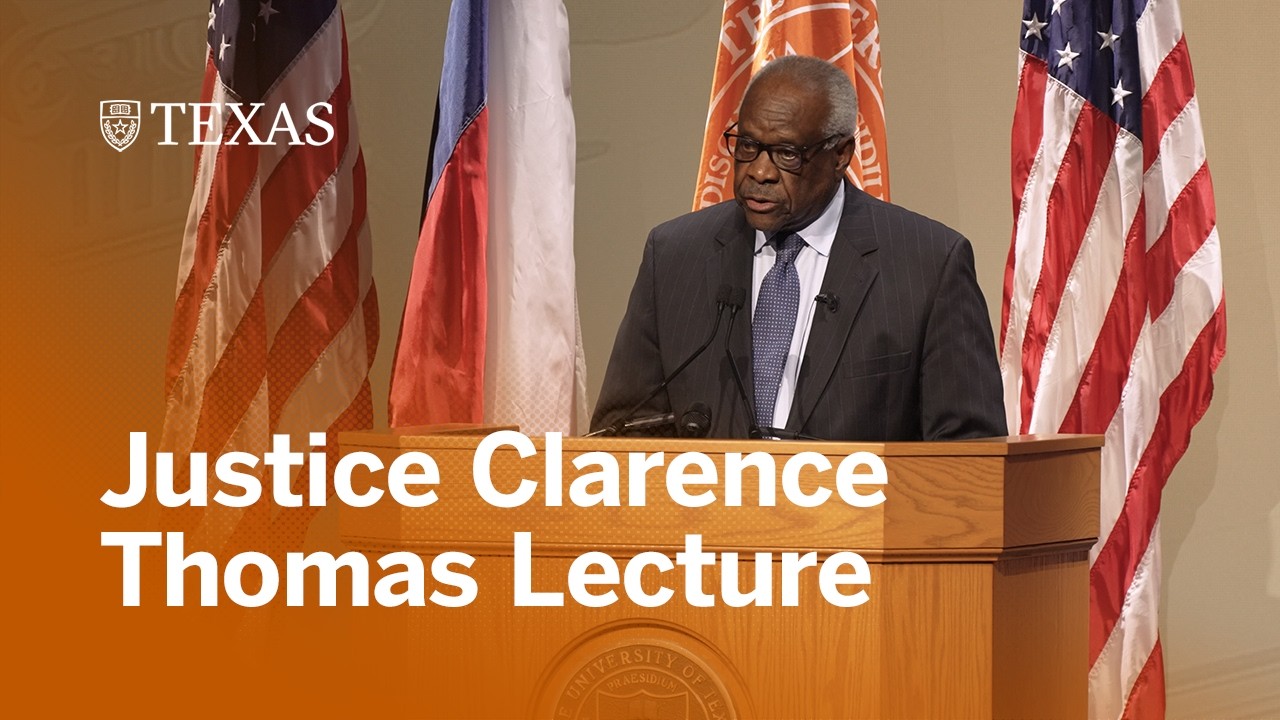
Please find the time to listen to this speech by Justice Clarence Thomas of the United States Supreme Court. It will take about an hour, and Thomas is not a very dynamic speaker, but it’s worth it.
Thomas, speaking at the University of Texas, Austin to celebrate the 250th anniversary of the Declaration of Independence, first congratulates the university for committing to making Civics and the study of Western Civilization once again a core feature of the education they provide.
He then goes on to reminisce about his childhood, growing up in the segregated world of southern Georgia. Even though the laws of the land imposed segregation, he and the larger black community around Savannah believed in the principles of the Declaration of Independence: “We hold these truths to be self-evident, that all men are created equal, that they are endowed by their Creator with certain unalienable rights, that among these are life, liberty, and the pursuit of happiness.” Thomas recounts that he and his fellow students at St. Benedict Elementary School, run by Catholic Sisters, were taught these principles and believed them. Why? Because they knew that their rights didn’t come from men. After all, it was the man-made laws that were denying them their rights. So, it seemed clear to them, self-evident, if you will, that their rights must come from God. They were convinced that, even if according to the laws of men they were unequal, in the eyes of God they were equal.
Thomas insists that the Declaration gave us the principles on which the United States was build, empowering it to become the freest, wealthiest, and most powerful nation in the history of the world. The Declaration also provided the principles by which slavery and segregation would be overcome.
The Declaration then promotes a theory of government, of why government exists and from where the authority of government derives. After stating the above, the Declaration says: “That to secure these rights, Governments are instituted among Men, deriving their just powers from the consent of the governed.” And there it is. Our rights come from God, and the purpose of government is to secure those rights that come, not from government, but from God. And the government’s authority is derived from the consent of the people. The government is never to over-reach it’s authority, never to claim an authority that is not given to it by the consent of the governed.
Thomas then claims that the last sentence of the Declaration of Independence is the most crucial: “For the support of this Declaration, with a firm reliance on the protection of divine Providence, we mutually pledge to each other our Lives, our Fortunes and our sacred Honor.” If the men who signed the Declaration were not committed to giving their all to support and defend it and its principles, then the Revolution would have been stillborn. It was their commitment to give all that made the Declaration real, that made its claims possible and sustainable.
But at the beginning of the 20th century, Justice Thomas recounts, new principles emerged among men in government that challenged those of the Declaration of Independence. President Woodrow Wilson, inspired by the state-centered society of Bismark in Germany, championed a new understanding of the origin of our rights and of the role of government. It came to be called Progressivism, and it challenged directly the Declaration’s claim that rights come from God and the purpose of government is to secure those rights. No, Wilson and the Progressives insisted, rights come from the government, and good order in society requires that the people be subservient to the government, not the government subservient to the people. Wilson redefined “liberty” as “the right of those who are governed to adjust government to their own needs and interests.” In other words: government precedes liberty, rather than government being formed to protect liberty. Wilson lamented that the people of America were “slow to see the superiority of the European system” where rights find their origin in the government, and the government’s authority does not rest in the consent of the governed; rather, the government concedes certain rights to the governed. But, if that’s the case, the government can limit or take back those rights. Thomas mentions that, given his thinking, it was not a surprise that Wilson re-segregated the federal government.
We need to re-commit ourselves to the principles of the Declaration of Independence: that our rights come from God, that the purpose of government is to secure those rights, and that the authority of the government rests in the consent of the governed. There are many in academia and in politics who believe fiercely that more government control is the answer to everything. A consequence of this, I personally think, is the over-powerful Executive Branch of our government. The Legislative Branch represents, more than the other two branches, the will of the people. Our senators and representatives are beholden to the people who put them in office, and office that is supposed to be a public service and, as such, a sacrifice. Our system of Federalism, of equal but divided branches of government, is set up to ensure that no one branch beomes dominant and able to form government policy on its own. It is a reminder that we are not ruled by kings, but by the consent of the people. The Legislative Branch is that branch of government that is supposed to most closely reflect the will of the people. When it is weak, the impact of the people on the direction of government is weakened. When presidents believe they can do what they want without bothering to consult or consider Congress, then we really are at risk of a Progressivism that will destroy our system of government. As I read American history, every president since FDR has toyed with Progressivism, wanting the power to form government policy without consideration of the peoples’ branch of the government.
President Joe Biden, when campaigning for president, insisted that a president that governs by Executive Orders was trying to be a dictator. Then, on the first day of his presidency, he signed dozens of Executive Orders, attempting to shape the direction of government on his own. The same was true with the student loan forgiveness debacle. Biden knew he had no authority to forgive student loans that came from the government. Congress controls the purse of the country, and only Congress could pass legislation to forgive these loans, should they choose to do so. The Supreme Court made this clear. Biden’s administration did all it could to ignore the Supreme Court’s ruling and get around the rules. In 2025 alone, President Donald Trump signed no fewer than 225 Executive Orders. That’s more than Biden signed over four years in office, and almost as many as Obama and G. W. Bush signed in eight years each as president. Obama found a way to establish a treaty with Iran without Congressional approval (he simply didn’t call it a treaty). Trump has somehow found a way to go to war without Congressional authority (he simply didn’t bother to declare war againt Iran).
Presidents in recent decades have decided that they want what they want and they’re going to act to get it, Congressional approval or not. This is a dangerous pattern. It assigns the voice of the people, most clearly manifested in the representative branch of the government, to secondary status. If we, as a governed people, are not proactive in taking back our authority as the source from which government gets its authority, then we will soon find oursselves with little say in how our country is managed, and in what direction our country will go in the future. Presidents aren’t kings. It is not for the president to rule a country of docile, subserviant citizens, as Wilson apparently looked to. The American people have the right to make their voices heard over the din of congressional backfighting, judicial overreach, and presidential power grabs. If we fail to do so, the Declaration of Independence will be reduced to nothing more than a decarative wall piece or coffee table picture book: nice words with no substance.
Be Christ for all. Bring Christ to all. See Christ in all.

