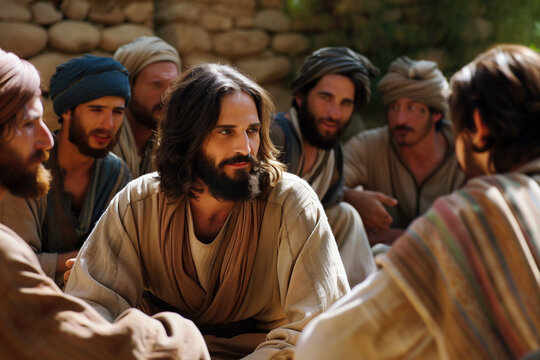
Christ and His disciples
Second Reading: Romans 6:1-3, 8-9
Brothers and sisters:
Are you unaware that we who were baptized into Christ Jesus
were baptized into his death?
We were indeed buried with him through baptism into death,
so that, just as Christ was raised from the dead
by the glory of the Father,
we too might live in newness of life. If, then, we have died with Christ,
we believe that we shall also live with him.
We know that Christ, raised from the dead, dies no more;
death no longer has power over him.
As to his death, he died to sin once and for all;
as to his life, he lives for God.
Consequently, you too must think of yourselves as dead to sin
and living for God in Christ Jesus.
Gospel: Matthew 10:37-42
Jesus said to his apostles:
“Whoever loves father or mother more than me is not worthy of me,
and whoever loves son or daughter more than me is not worthy of me;
and whoever does not take up his cross
and follow after me is not worthy of me.
Whoever finds his life will lose it,
and whoever loses his life for my sake will find it.” “Whoever receives you receives me,
and whoever receives me receives the one who sent me.
Whoever receives a prophet because he is a prophet
will receive a prophet’s reward,
and whoever receives a righteous man
because he is a righteous man
will receive a righteous man’s reward.
And whoever gives only a cup of cold water
to one of these little ones to drink
because the little one is a disciple—
amen, I say to you, he will surely not lose his reward.”
St. Paul says that when we are baptized into Christ, we are baptized into His death. We are buried with Christ in baptism. Our going down into the water is our dying with Christ. Just as Jesus was raised from the dead, however, we are raised from this death at baptism by being raised out of the water. We are made a new creation in Christ. This is the new life in Christ of which St. Paul speaks. The word “live” in this passage is a translation of the Greek peripateo, from which we get our Engish word “peripatetic,” which means to walk around, or move from place to place. St. Paul means to say that we are to walk with Christ, to “live with Christ.” It is not enough to “talk the talk.” We must be willing the “walk the walk.” And to “walk the walk” with Christ means to live the life of the gospel.
How do we do this? Just as Christ died to sin once and for all and lives for God – “walks the walk” with God – so too we must regard ourselves as dead to sin and living for God in Christ Jesus. To sin is to offend God and ourselves. We who are baptized in Christ have become a new creation. Sin taints that new creation. Sin involves a denial or a forgetting of who we are before God. Sin offends God because it is an action or an inaction (don’t forget sins of omission!) that is rooted in the fear or lack of trust that God will come through for us, will keep the promises He made to us. We are effectively calling God a liar. But it is not God who is a liar. The devil is the father of lies. God always keeps His promises; He always keeps His word. To deny or reject this in sin is to deny or reject that God is God. This can never be for one who is a disciple of Christ. We avoid sin by trusting in God, remembering that He always keeps His promises.
In today’s Gospel, Jesus makes clear that, to be His disciple, one must put Christ first. A disciple is a student, a follower of the teachings of a Master. We must put Christ first, even over mother and father, or son or daughter, because the only way we can love another fully, completely, including our family, is to love them with a love that is inspired by and radiates from our love for Christ. God is love, and when we love others we do so as a participation in the love that is God. There is no other who is love. In a sense, we can say that God does not love. Why? Because to love is to participate in the love that is God, and God does not participate in His own Being. He is His Being, and His Being is love. We love when we participate in the love that is God.
Being found worthy of being a disciple means taking up our cross, as Christ took up His cross. This means not running from or trying to flee from our sufferings, as if we could. Suffering is endemic to the temporal order and to our broken humanity. As such, no one much over the age of sixteen can escape suffering, and our younger ones only do so because we protect them from suffering as much as possible. But our suffering need not be for nothing. Servant of God Dorothy Day, co-foundress of the Catholic Worker movement, which offered non-violent resistence to the oppression and injustices in society and who was a servant of the poor, who fed and sheltered them, once said, “Love is a harsh and dreadful thing, but it is the only answer.” Christ on the cross is a harsh and dreadful thing, but it was the only answer to the problem of our alientation from God; it was the only hope for our redemption. Just so, it is a harsh and dreadful thing when we love others. Love is hard. It involves sacrifice, and sacrifice involves blood, pain, and sometimes death.
But our loving others can be redemptive. How so? We can unite our sufferings, such as they are, to the sufferings of Christ on the cross, to that harsh and dreadful thing, and in so doing Christ will transform our sufferings so that our own sufferings, united with His, can be efficacious for the redemption of the world. Christ not only redeemed us, but He empowered us to share in His redemptive mission. What a privilege! We also participate in the redemptive mission of Christ in every Mass. At every Mass the one sacrifice of Christ is made present on the altar so that those present throughout the centuries can participate in that one sacrifice.
We also participate in the redemptive mission of Christ when we serve Him in what St. Teresa of Calcutta called “the distressing disguise of the poor.” When we feed the hungry, clothe the naked, give drink to the thirsty, care for the infirm, and visit the incarcerated. That is why the first reading (of the couple providing hospitality to the prophet Elisha) and the Gospel today speak of hospitality. In the ancient Near East, hospitality was a chief virtue. In such a rugged and challenging landscape, where much of the geography is desert and water is scarce, the duty to show hospitality even to the stranger was paramount. Such hospitality could mean the difference between life and death for the one traveling such a threatening terrain. This is the context in which Christ encourages us as His disciples to receive other disciples as we would Christ – to receive the prophet, the righteous man, and to not neglect to offer a cup of cold water to one’s fellow disciple and, by extension, to the poor. By offering hospitality to those who are disciples of Christ, we offer hospitality to Christ, because to receive one’s disciple is to receive the disciple’s Master.
Be Christ for all. Bring Christ to all. See Christ in all.

