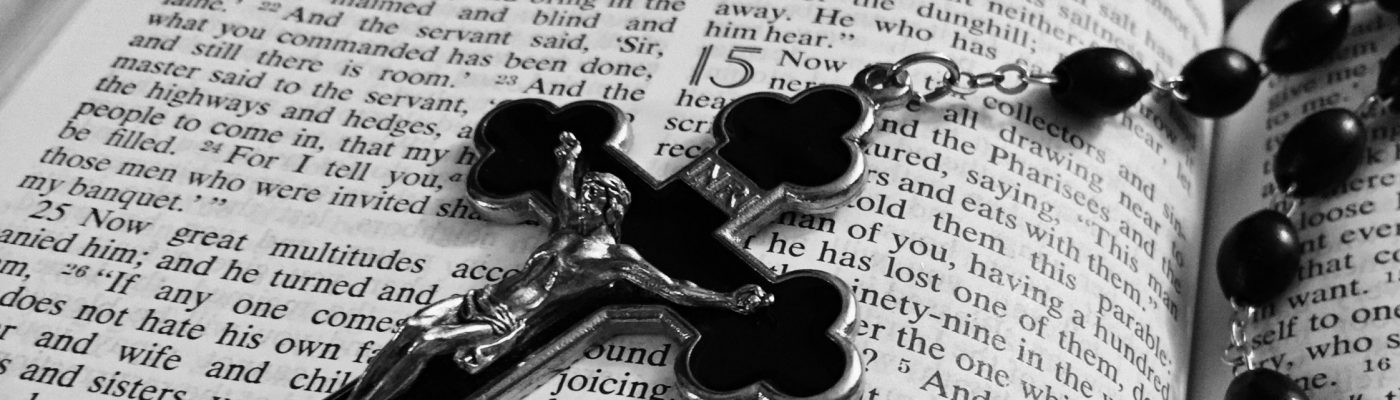

I sometimes peruse the internet looking for apologetics material, or to listen to music. This week, I came across a video by a young woman named Aarynn Bosshart, who runs a website called “Humbled Catholic”. Ms. Bosshart is an author, musician, speaker, wife and mother of four. The video struck me as interesting, so I thought I would share some of what Ms. Bosshart has to say. The video is entitled “10 Bible Verses That Are Hard to Explain Without Catholicism.” Yes, I am shamelessly stealing her material. But, hey, it’s the Bible, so it belongs to everyone. I was happy to learn that I was already aware of all the verses Ms. Bosshart points out and have used them many times in my own efforts to communicate the Catholic faith via Scripture. While Ms. Bosshart identifies these Scripture verses in her video, the refelctions below are mine.
Here are ten Scripture verses that are hard to explain without Catholicism, plus six more that came to my mind:
- James 2:24 – “See how a person is justified by works and not by faith alone.” The old debate between Catholics and Protestants on whether we are saved by faith or saved by faith and works is, in my mind, putting the focus in the wrong place. The bottom line is: we are saved by the grace of God! Faith is necessary for justification, of course. Faith is ultimately embracing the grace that God extends to us. Works are also necessary for justification, in that they embody the faith we have in our Lord. Without works, faith is dead, as sure as is a body without breath. What is the difference between salvation and justification? Salvation is our ultimate hope, our being forgiven our sins and reconciled with God and sharing in the divine nature. Justification is how we are made holy, how we are made worthy by God to be saved. Initial justification, our coming to God, is the free gift of God’s saving grace extended to us on the basis of our faith or the faith of our parents or guardians who speak for us at our baptism. The grace is unmerited; there is nothing we can do to earn it. This is why we can baptize babies, because we can do nothing to earn or merit our initial justification, whether we are three months old, or thirty, or ninety! Ongoing justification, however, is living the life of the gospel. Ongoing justification involves nurturing the faith we have and embodying that faith in good works. It’s to what Paul was referring when he wrote to the Philippians, “work out your salvation with fear and trembling” (Phil 2:12b). But what about where Paul says, “For by grace you have been saved through faith, and this is not from you; it is the gift of God; it is not from works, so no one may boast” (Eph 2:8-9)? Notice that St. Paul says “you have been saved.” So, he’s talking about a justification that has already taken place, which our good works cannot accomplish. This is the grace of justification that is God’s doing. We embrace this grace of initial justification through our faith (or we receive it in response to our parent’s faith if we were baptized as infants or young children). But keep in mind that, when Paul writes about “works,” he almost always means “works of the law.” So, Paul is teaching that practicing the law of Moses, even if to perfection, is not what saves us. We cannot save ourselves, as if doing certain things obliges God to welcome us into His kingdom. No! We receive the initial justification via baptism in respone to our faith, then we receive ongoing justification by nurturing that faith and embodying it in the works we do for pure love of God or neighbor. Only those works carried out for pure love of God or neighbor count toward our justification. All of this in hopes of being saved by God’s grace and coming to share in the divine nature, the very life of God (2 Pt 1:4). By the way, Ms. Bosshart is correct in pointing out that, in all of Scripture, this is the only verse where the phrase “faith alone” is found, where James writes that we are not justified by faith alone!
- 2 Thessalonians 2:15 – “Therefore, brothers, stand firm and hold fast to the traditions that you were taught, either by an oral statement or by a letter of ours.” One of the foundational doctrines of Protestant Christianity is sola scriptura, the doctrine that Scripture is the only source of God’s revelation in Christ. This is why, in so many conversations with Protestants on matters of what the Catholic Church teaches, the constant refrain is: “Where is that in the Bible?” There’s an obvious problem with this: There are plenty of things that Protestant Christians believe that cannot be specifically or even tangentially found in the Bible. Perhaps the most relevant to this point is the fact that the doctrine of sola scripura itself is no where found in the Bible! Another example related to the first is the canon of Scripture. The Bible didn’t come with an index. Also, there were many other books written by orthodox Christians contemporary, or nearly so, with the writings of the New Testament. So, how do we know which books belong in the New Testament canon, and which don’t? The Church prayed for discernment on this question and, over the course of about 100 years (or by the end of the second century), it was revealed to the Church the books that belong in the canon and the books that don’t. Certain criteria were employed, of course. But the bottom line is, the canon of the New Testament, and the Old Testament for that matter, is a matter of Sacred Tradition. Indeed, the first formal pronouncement of the Church on the canon came from Pope Damasus I toward the end of the fourth century, and the final word of the Church on the question was decisively promulgated by the Council of Trent in the middle of the sixteenth century, in response to the challenge of the Protestant revolutionaries regarding some books in the Old and New Testaments. Another belief to which Protestants submit is the doctrine of biblical inerrancy, the teaching that the original texts of the Scriptures are free from all error on matters of revelation and history and science and … well, you get the picture. This doctrine is no where to be found in the Bible and, indeed, is a relatively new doctrine, emerging from the teachings of Protestant professors at Princeton in the 19th century in an effort to defend the credibility of the Scriptures in the face of scientific discoveries that challenged a literal interpretation. Finally, there are Protestant Christians who believe the teaching of “once saved, always saved.” This, as it sounds, is the belief that, once a person gives him or herself to Christ by, perhaps, praying the “Sinner’s Prayer” (also, no where in the Bible), then that person can never lose their salvation. Those who apostatize and turn to a life of sin after dedicating to Christ are said to have never really been a Christian in the first place. Which basically means that we can never have ultimate confidence in anyone’s identity as a Christian, perhaps not even our own. Catholic faith is that the Church is the instrument of God’s revelation in Christ. There are two sources for this revelation, both coming to us from God through the Church. One is Sacred Scripture, the revelation of God given to us in the written word. The second is Sacred Tradition, the revelation of God given to us, not necessarily in the written word, but by the faith of the apostles and the movement of the Holy Spirit in the life of the Church to reveal to us all that God intends to reveal (“The Advocate, the holy Spirit that the Father will send in my name—he will teach you everything and remind you of all that [I] told you” John 14:26). It simply cannot be that the Scriptures are the only source of divine revelation, for how was it then revealed to us which books belong in the biblical canon? How was it then revealed to us the relationship between the distinct Persons of the Holy Trinity, which is no where delineated in the Bible? How was it then revealed to us that Jesus Christ is fully divine, and fully human, because many early Christian thinkers rejected either one or the other, and justified their teaching with the Scriptures? Sacred Scripture and Sacred Tradition, together, comprise the revelation of God in Christ given through the Church to the faithful. Sola scriptura simply doesn’t make sense. And it’s not in the Bible!
- 1 Timothy 3:15 – “If I should be delayed, you should know how to behave in the household of God, which is the church of the living God, the pillar and foundation of truth.” Speaking of the Church being the instrument of God’s revelation in Christ, Paul, in his First Letter to Timothy, speaks of the Church as “the household of God” and “the pillar and foundation of truth.” Paul doesn’t say that Sacred Scripture is the pillar and foundation of truth, but that the Church is. This only makes sense. God would not have given us His written revelation without an instrument to ascertain which of the many writings of “the household of God” were, indeed, the “Word of God in the words of men,” and to provide an authoritative interpretation of that written revelation. The truth is, even Scripture says that Scripture can be difficult to understand, and that “the ignorant and unstable will distort [the Scriptures] to their own destruction” (2 Pt 3:16b). How can Protestants claim that God’s revelation is limited to Sacred Scripture, and also claim that Sacred Scripture is the basis of their faith, and then split up into 47,000 different Protestant denominations, all claiming to teach the truth of Sacred Scripture? If a priest on one side of town was teaching one interpretation of a Scriptural passage, and another priest on the other side of town was teaching a different interpretation of the same passage, how do I know who’s interpretation is correct? I have the Church, which is the final authority on the interpretation of Scripture because the Church is the instrument of God’s revelation in Christ and the “pillar and foundation of truth.” But if a Baptist minister on one side of town was teaching one interpretation of a Scriptural passage, and another minister on the other side of town was teaching a different interpretation of the same passage, how does a Baptist know who’s interpretation is correct? In point of fact, he doesn’t! The Baptist simply has to decide for himself who’s right and who’s wrong, knowing that, though they can’t both be right, they could both be wrong! I cannot believe that our good and gracious Lord would leave us in such a state. No! He gave us the Scriptures and He gave us a Church to authoritatively interpret those Scriptures. It cannot be otherwise.
- John 20:20-23 – “When he had said this, he showed them his hands and his side. The disciples rejoiced when they saw the Lord. [Jesus] said to them again, ‘Peace be with you. As the Father has sent me, so I send you.’ And when he had said this, he breathed on them and said to them, ‘Receive the holy Spirit. Whose sins you forgive are forgiven them, and whose sins you retain are retained.'” When Jesus, in Mark 2:1-12, forgives the sins of the paralytic that had been brought before Him by the man’s friends, the scribes who observed this began to ask themselves how Jesus could presume to do such a thing. After all, only God can forgive sins. Jesus did not correct them. Why? Because they were right! Only God can forgive sins. Rather, He told them, “that you may know that the Son of Man has authority to forgive sins on earth – he said to the paralytic – I say to you, rise, pick up your mat, and go home” (Mk 2:10-11). And the paralytic did just that, demonstrating that Jesus had the authority to forgive sins and, as such, demonstrating that He was God. If God can forgive sins on earth, then God has the power to pass on this authority to whom He will. Jesus, the Second Person of the Holy Trinity become incarnate, chose to pass on the authority to forgive sins to His apostles. The bishops are the successors of the apostles, who received this authority through the laying on of hands from the first apostles. This apostolic succession is how we can have confidence in the authority of the bishops to teach, govern, and sanctify: because that authority ultimately came down through the centuries from the first apostles, the Twelve, who received it from Jesus Himself. When the Church began to grow so that the bishop could not personally attend to all of the needs of the people, he extended his ministry by passing on his authority to his priests. This is how priests have the authority to forgive sins. Only God can forgive sins. But bishops and priests are the instruments by which His grace for the forgiveness of sins is poured out to the faithful.
- Luke 1:28 – “And coming to her, he said, ‘Hail, favored one! The Lord is with you.'” The translation given here as “Hail, favored one!” has become dominant, even among Catholic translators of the Scriptures. The traditional translation found in the Douey-Rheims, “Hail, full of grace!” is based on St. Jerome’s Latin (Vulgate) translation from the original Greek: gracia plena. I think the translators of the Revised Standard Version, Second Catholic Edition (RSV, SCE) have the better argument, however. While recognizing that “favored one” or “highly favored” are possible translations, they judge them as inadequate. They write, “Because of the unparalleled role that Mary accepts at this turning point in salvation history, the best translation is the most exalted one.” St. Stephen is described as “full of grace and power” in Acts 6:8, but that use indicates that St. Stephen has been filled with grace and power at that moment. The use of “full of grace” in Gabriel’s greeting to Mary indicates a filling with grace that has already taken place. In other words, the angel is recognizing Mary has one who is already filled with grace, not as one being filled with grace, or who soon will be full of grace. Again, the notes in the RSV, SCE: “[The use of “full of grace” here] indicates that God has already ‘graced’ Mary previous to this point, making her a vessel who ‘has been’ and ‘is now’ filled with divine life.” Regardless of the translation, the Church has spoken authoritatively that the angel Gabriel’s greeting to Mary indicates her special role in the history of our salvation. Protestants, then, can hardly set her aside as a secondary character in our faith tradition. Pope Pius IX turned to Luke 1:28 in formally defining the dogma of the Immaculate Conception in 1854. That the Scriptures speak of our Lord’s Blessed Mother as “full of grace” points to the unique grace Jesus granted His mother, first, simply because she is His mother and, second, to prepare her for the tremendous responsibility she would have in raising the incarnate Son of God and the pain she would suffer because of the sacrifice He made on the cross. Other verses that speak to Mary’s unique and exalted role in God’s plan for our redemption include Luke 1:46-48 – And Mary said: “My soul proclaims the greatness of the Lord; my spirit rejoices in God my savior. For he has looked upon his handmaid’s lowliness; behold, from now on will all ages call me blessed.” Mary predicts here that all ages will call her blessed and, indeed, all ages have. Why some Christian traditions downplay Mary’s role is likely attributed to the fact that the Catholic Church so readily and properly exalts her, as God has done, and as the angel Gabriel recognized in his greeting to her. In my mind, that’s simply petty. Regardless of how a non-Catholic Christian feels about the Catholic Church, he or she ought not fail to give Mary the honor she is due as the mother of our Lord, the one who nourished Him at her breast, protected Him as a young child, cared for Him as He grew, feared for Him when He was left behind in Jerusalem, and carried within her heart all the human memories of the one she, too, worshipped as her Lord. Also, John 2:3-5 – “When the wine ran short, the mother of Jesus said to him, ‘They have no wine.’ [And] Jesus said to her, ‘Woman, how does your concern affect me? My hour has not yet come.’ His mother said to the servers, ‘Do whatever he tells you.'” The wedding at Cana is one of my favorite Scripture pericopes for many reasons, not least of all because it affirms the holiness of marriage and the need to invite Jesus to be a part of your wedding and, hence, your marriage. But what is interesting here is that Jesus seems to almost rebuke His mother for getting Him involved in a concern of hers. She knows that to run out of wine would be a massive social faux pas for the family, one that our own culture cannot fully appreciate. Reputations would be ruined, even careers lost as a result of such a gaffe. She brings her concern to Jesus who, again, seems almost to rebuke her. He explains that His time has not yet come. Well, she has other ideas. She knows who He is, and she knows that He is love embodied. She knows, then, that He cannot say “No” to such a genuine need and sincere request. She doesn’t even respond to Him when He basically tells her that this is of no concern to Him. She simply turns to the servants, tells them to “do whatever he tells you,” and walks away. Indeed, Jesus cannot refuse her. She is His mother. He then performs His first sign, thereby initiating His public ministry. Mary, in effect, is the one who tells Jesus, “Your hour has come!” Finally, there is Acts 1:14 – “All these devoted themselves with one accord to prayer, together with some women, and Mary the mother of Jesus, and his brothers.” This verse, speaking of the apostles gathering back in the upper room after the Ascension, testifies to Mary’ presence at the center of the early Church. She was not discarded or forgotten. No, there she is, right in the middle of them all, joining them in prayer. St. Mary, our Blessed Mother, rightfully is given her place in the midst of the people of God, though also as the first disciple, the Queen of All Saints, our universal Mother. When Jesus gave His mother to the care of the Beloved Disciple (Jn 19:26-27), He gave her to us all.
- Acts 15:23-29 – “The apostles and the presbyters, your brothers, to the brothers in Antioch, Syria, and Cilicia of Gentile origin: greetings. Since we have heard that some of our number [who went out] without any mandate from us have upset you with their teachings and disturbed your peace of mind, we have with one accord decided to choose representatives and to send them to you along with our beloved Barnabas and Paul, who have dedicated their lives to the name of our Lord Jesus Christ. So we are sending Judas and Silas who will also convey this same message by word of mouth: ‘It is the decision of the holy Spirit and of us not to place on you any burden beyond these necessities, namely, to abstain from meat sacrificed to idols, from blood, from meats of strangled animals, and from unlawful marriage. If you keep free of these, you will be doing what is right. Farewell.'” In her video, Ms. Bosshart only includes Act 15, verse 28 on her list. I thought 23-29 better captured what’s going on here. To put it in context, one of the first challenges to Christian unity was what came to be called the “heresy of the Judaizers.” This heresy was promulgated by some Jews who had become Christian who taught that, for Gentiles to become Christian, the men needed to be circumcized and the people needed to follow the Mosaic law. Others, like Paul, countered this, insisting that Christ’s sacrifice had freed us from the burden of the law. To settle the matter, the apostles gathered together in Jerusalem to discuss the pros and cons of each position, pray over the matter, and render a decision. Some have come to call this the Council of Jerusalem, and the account of the Council takes up almost the entirety of chapter fifteen in The Acts of the Apostles, St. Luke’s history of the very early Church. The first key verse here is: “we have heard that some of our number [who went out] without any mandate from us have upset you with their teachings…” (emphasis added). After debating the matter and hearing both sides, St. Peter stood up and explained that it made no sense to demand that Gentiles who desired to follow Jesus also follow the Mosaic law, since the Jews themselves failed so often in following the law. Also, recounting the conversion of the Gentile Cornelius and his household, and their having been given the Holy Spirit without having been circumcised (Acts 10), Peter reasoned that it is not for them to keep God’s grace from the Gentiles. No circumcision and no following the law would be required. The excerpt above is from the letter the apostles prepared for Paul and Barnabas to take back to Antioch to inform the Christians there of their decision. Pay attention to what the Council Fathers write here: those who have been causing upset among the faithful in Antioch by teaching a different set of expectations from those of Peter, Paul, and the other apostles did not receive a mandate from Peter and the apostles. What that means is that Peter and the others would expect anyone preaching the Good News of Jesus to have received a mandate from them, so those who heard those mandated by the apostles to teach and preach would know that they have been given the faculties to preach by the apostles because their message is consistent with the faith of the apostles, with what Jesus taught them. Our faith is the faith of the apostles. Why would Peter presume to discount the preaching of those who had no mandate from them if he and the other apostles possessed no legitimate authority to proclaim and interpret the identity and mission of Jesus of Nazareth? Peter is claiming here what the Catholic Church today claims: that the apostles and their successors are the legitimate ones to interpret the Scripture with authority, so we can have confidence in the revelation God has given to us through the Church. The second critical verse here is that the apostles, again in their letter to the Christians in Antioch, announce that “it is the decision of the holy Spirit and of us …” (emphasis added). Remarkably, Peter is claiming to work with the Holy Spirit in proclaiming the gospel and promulgating right teaching (orthodoxy) and right practice (orthopraxy). Was this presumptuous of Peter, claiming that the Council Fathers and the Holy Spirit worked in concert to declare the truth of God’s revelation for the Gentiles? No! Why? Because Jesus had made Peter the rock on which He would build His Church and the chief apostle. Thus, the role of the Church as magistra (teacher) is made clear. We are not on our own to ascertain this snatch of truth or that snatch according to how we personally read the Scriptures. Not at all! We have been given the Scriptures through the Church and the Scriptures are interpreted with authority by the Church.
- Matthew 16:18-19 – “He said to them, ‘But who do you say that I am?’ Simon Peter said in reply, ‘You are the Messiah, the Son of the living God.’ Jesus said to him in reply, ‘Blessed are you, Simon son of Jonah. For flesh and blood has not revealed this to you, but my heavenly Father. And so I say to you, you are Peter, and upon this rock I will build my church, and the gates of the netherworld shall not prevail against it. I will give you the keys to the kingdom of heaven. Whatever you bind on earth shall be bound in heaven; and whatever you loose on earth shall be loosed in heaven.'” I am deviating from the order in which Ms. Bosshart considered the Scriptures that are difficult to explain without Catholicism. No troubles. It all makes sense in the long run. Here Jesus is recognizing that Peter likely has a deeper understanding and appreciation for Jesus’ identity and mission than some of the other disciples, or at least he’s not afraid to speak up about it! He rightly identifies Jesus as “the Messiah, the Son of the Living God.” Jesus realizes that this insight could not have come from a human source. It must have been given to Peter by the Father. In recognition of this, Jesus changes Peter’s name from Simon to … well, Peter! Peter means “rock” in the Aramaic that Jesus spoke, which is the language He most certainly would have been speaking to His disciples. The Aramaic word for “rock” is kepha, and there are no gendered words in Aramaic, so it’s always kepha (from which we get the name Cephas, which is what Peter is called by Paul in his letters). Greek is a language with gendered nouns. In Greek, the language in which the Gospel was written, the word for “rock” is petra. As written in Greek, Jesus says to Simon, “you are Petros, and on this petra I will build my church.” Protestants make a great to-do over the difference between Petros and petra, concluding that Jesus may have changed Simon’s name to Peter, but the rock on which Christ built His Church is Peter’s faith, or maybe Jesus Himself, various answers being offered. This is ridiculous. The author of Matthew’s Gospel is not going to record that Jesus changed Simon’s name to Petra, and Jesus wouldn’t have done that, because Petra is a feminine noun and Simon Peter is a man. Quite obviously, Jesus intended to change Simon’s name to “Rock,” so translating from the Aramaic which Jesus spoke to the Greek in which Matthew wrote, the feminine word for “rock” is masculinized, that is petra is transliterated to a male name: Petros. This is more clear in the Aramaic which, again, was Jesus’ native tongue and the language He certainly spoke when speaking with the disciples. In Aramaic, the phrase is: “you are Kepha, and on this kepha I will build my church.” It’s really that simple. But what’s more important than whether Jesus said Peter is the rock or Peter’s faith is the rock, or Jesus Himself is the rock (St. Augustine of Hippo, apparently, held that Jesus was the rock in this verse) is the fact that Jesus gave the keys to the kingdom to Peter. In the time of the kingdom, the king had a steward, or prime minister, a second in charge to handle things when the king was out on a military campaign, or for whatever reason. The prime minister took charge, ruling with the authority of the king, as if he were the embodiment of the king’s authority in the king’s absence. This authority was symbolized by a key that the prime minister received from the king and would wear on his shoulder, so that no one would question his authority. When the king returned, the prime minister gave the key back. In Isaiah 22:20-22, the prophet spoke of how Shebna had not pleased God in his role as prime minister, so the key is taken from Shebna and given to Eliakim, meaning that the authority of the keys could be transferred from one minister to another if one should prove unworthy, or if he should die. Just so, Jesus gives the “keys to the kingdom” to Peter, to be the embodiment of the authority of our Lord and King Jesus until He returns. In the Book of Revelation, when Jesus has returned, He is the one who holds the key (Rev 3:7). Catholics look to this verse as the establishment of the papal office, that Peter and his successors are the holders of the keys to the kingdom, embodying the authority of Christ (thus, Vicar of Christ) until Christ’s return. You’ll notice that in Matthew 18:17-18, discussed below that, while Jesus extends the authority to bind and loose given to Peter to the other apostles, it is only to Peter that Jesus gives the keys to the kingdom. Peter, in the NT, is certainly portrayed as the chief apostle. He is always first in any listing of the Twelve; he speaks when others remain silent; Peter initiates the process by which Judas is replaced by Matthias among the Twelve; he is the one who preached to the crowds at Pentecost, who brings the gospel message to Cornelias, whose ministry is the subject of the first half of The Acts of the Apostles, and who speaks up at the Council of Jerusalem. History tells us that Peter was bishop, first in Antioch, and then in Rome, where he was beheaded under the persecutions of Nero. The historical record tells us that St. Peter’s Basilica was built over the tomb of Peter, and archeology confirmed this during a dig in the 1968. The authority of Peter and his successors as those who hold the keys to the kingdom cannot be contested. Well, it can be, but without success and relying on an interpretation of Scripture that simply doesn’t make sense. People are often scandalized by popes who have done terrible things, even in the not too distant past. But the authority of the pope does not rest on his being perfect, on his never making a mistake or sinning, or even on his being a nice guy. The authority of the pope rests on the keys to the kingdom given to Peter and his successors by Jesus. So, really, the pope’s authority rests on the authority of Christ.
- Matthew 18:17-18 – “If he refuses to listen to them, tell the church. If he refuses to listen even to the church, then treat him as you would a Gentile or a tax collector. Amen, I say to you, whatever you bind on earth shall be bound in heaven, and whatever you loose on earth shall be loosed in heaven.” Jesus is teaching His disciples that, if someone should sin, then his brother Christians have a responsibility to call Him to repentance and reconciliation with the Body of Christ, which is the Church. But, Jesus says, if the sinner should refuse to listen to you, or to other brothers that you have called to assist you in bringing him back, or even to the Church, then the sinner should be excommunicated, declared no more a part of the community. Then Jesus extends to all of the apostles the authority to govern the Church on earth, an authority He had given to Peter earlier and which we discussed above. Notice, however, that Peter alone is called the “rock” on which the Church will be built and only to Peter is given the keys to the kingdom. The bottom line is: these verses clearly establish the authority of the Church and of the apostles and, as such, their successors (the bishops) in governing the people of God.
- 1 Corinthians 3:13-15 – “According to the grace of God given to me, like a wise master builder I laid a foundation, and another is building upon it. But each one must be careful how he builds upon it for no one can lay a foundation other than the one that is there, namely, Jesus Christ. If anyone builds on this foundation with gold, silver, precious stones, wood, hay, or straw, the work of each will come to light, for the Day will disclose it. It will be revealed with fire, and the fire [itself] will test the quality of each one’s work. If the work stands that someone built upon the foundation, that person will receive a wage. But if someone’s work is burned up, that one will suffer loss; the person will be saved, but only as through fire.” I once read a book on the history of Pope Sylvester II, who reigned at the turn of the first Christian millennium, by one who admired the pope as a man of great intellect, both spiritual and scientific. The author made an egregious error, however, when she described the doctrine of purgatory as one that emerged in the Middle Ages. No! The Church has understood from the beginning that “nothing unclean will enter it” (Rev 21:27), that is, the kingdom of God. As such, those who die in Christ not having done sufficient penance for the sins they committed (Nm 5:6-7; Lk 19:8; AA 26:20; for God is not only love, He is also justice: Dt 32:4; Is 30:18), or those with some remaining venial sins on their souls (1 Jn 5:16) will require being cleansed of such before they can enter the kingdom. I, personally, find great comfort in the revelation that, even if the work I have done for the kingdom proves insufficient, if my work is consumed by the fire, it doesn’t mean that I am lost, only that the effort I put into embracing the grace of God was not of the quality of others, who perhaps dedicated themselves to the work of God more deeply than I could manage. There are those who, in simple point of fact, are more holy, more dedicated, possessing more of a servant’s heart, than others. And I know there are many who are more deeply dedicated and more holy than I. I take comfort in the fact that there’s a purgatory. To me, it speaks to the great mercy of God and of His desire to apply the grace of Christ’s redemptive sacrifice even to those who know and love Christ, but failed to build on that foundation as well as others, for a whole variety of reasons. Praise God from whom all blessings flow!
- John 6:53-58 – “Jesus said to them, ‘Amen, amen, I say to you, unless you eat the flesh of the Son of Man and drink his blood, you do not have life within you. Whoever eats my flesh and drinks my blood has eternal life, and I will raise him on the last day. For my flesh is true food, and my blood is true drink. Whoever eats my flesh and drinks my blood remains in me and I in him. Just as the living Father sent me and I have life because of the Father, so also the one who feeds on me will have life because of me. This is the bread that came down from heaven. Unlike your ancestors who ate and still died, whoever eats this bread will live forever.'” Truthfully, this example should extend from John 6:22-69, but that would be too long to include here. But, this is the money quote in what scholars call the “Bread of Life Discourse.” The Jews believed that, when the Messiah came, He would be accompanied by a replication of the miracle of the bread that came down from heaven to feed the Hebrews during their decades of traveling through the desert. Recall that they complained to Moses that they had plenty to eat even as slaves in Egypt, but he had led them out to the desert to starve! With that, God promised He would provide for them, and He keeps His promises. God sent bread from heaven every morning (manna in Hebrew means “what is it?”, which is how the Hebrews initially responded to the miraculous bread), and quail every evening. Thus, the Hebrews were nourished on their journey through the desert. When they reached the Promised Land, the land of milk and honey, the manna and quail stopped because they were no longer needed. The belief developed among the Jews, however, that the miracle of the “bread from heaven” would be repeated when the Messiah came. In this discourse recorded in John’s Gospel, the Jews ask Jesus, “What sign can you do, that we may see and believe in you? What can you do? Our ancestors ate manna in the desert, as it is written: ‘He gave them bread from heaven to eat'” (Jn 6:30-31). This is an indirect way of asking Jesus if He is the Messiah, because if Jesus can replicate the miracle of the bread from heaven, then that would testify to His claim of being the Messiah. Jesus, rather shokingly, informs them that He is the bread come down from heaven, the true bread given, not by Moses, but by the Father. The Jews are confused. How can Jesus say that He is the bread from heaven. He’s a man, not a loaf of bread! But Jesus digs deeper, not holding back, and what He says next truly throws His listeners for a loop: “I am the living bread that came down from heaven; whoever eats this bread will live forever; and the bread that I will give is my flesh for the life of the world“ (Jn 6:51) (emphasis added). Now the Jews are gobsmacked. They argue amongst themselves, asking “How can he give us his flesh to eat?” For a Jew, this is such an abomination! The law of Moses forbade them to drink the blood of animals, and Jesus is telling them that the bread from heaven is His own flesh?!! Jesus wants them to eat Him? To murder Him and eat His flesh? What is this bizarre talk? Jesus doesn’t retreat one iota, but follows with the words above. In fact, it gets even more bizarre. Not only does Jesus mention eating His flesh, but drinking His blood! It’s a wonder some of those listening didn’t fall out over the horror of the imagery. Perhaps, some did! To drive the point home, when Jesus talks of eating His flesh, He uses the word for “chew,” “munch,” or “gnaw,” making it evident that He’s not speaking symbolically here. Why would one need to “chew” or “gnaw” Jesus’ symbolic flesh? No, He is referring to something you put in your mouth and chew up and consume, and He’s talking about His own Body and Blood. This is as real as it gets, people. Jesus’ Jewish opponants knew that. Jesus’ own disciples who were Jews knew that, which is why they walked away. It was too much for them. Jesus didn’t stop them and explain Himself. He told them, if that shocked them, wait until He is raised to His heavenly Father! He then turns to the Twelve and, in probably the most plaintive words of Scripture, asks them, “Do you also want to leave?” Peter – of course, Peter! – responds, “Master, to whom shall we go? You have the words of eternal life. We have come to believe and are convinced that you are the Holy One of God” (Jn 6:67-69). The Twelve have come to believe in Him, to trust Him. They know Him like no one else does except, likely, His mother. They have seen His wonders and have heard His teachings. They’re not going anywhere. Don’t you leave, either. Don’t let the doubts of those who lack full faith in Jesus words, a faith confirmed by the Scriptures (1 Cor 10:16; 11:23-29) and the writings of the earliest Church Fathers (Ignatius of Antioch; Justin Martyr) convince you to discard or disdain the revelation of God in Christ given to us through His Church.
Those are the ten verses, some expanded by me, that Aarynn Bosshart identifies as being difficult to explain without Catholicism. There are some others, however, that quickly come to mind. So, I’ll add to Ms. Bosshart’s list with some of my own Scriptures that I regard as difficult to explain without Catholic faith:
11. 2 Maccabees 12:38-46 – Judas rallied his army and went to the city of Adullam. As the seventh day was approaching, they purified themselves according to custom and kept the sabbath there. On the following day, since the task had now become urgent, Judas and his companions went to gather up the bodies of the fallen and bury them with their kindred in their ancestral tombs. But under the tunic of each of the dead they found amulets sacred to the idols of Jamnia, which the law forbids the Jews to wear. So it was clear to all that this was why these men had fallen. They all therefore praised the ways of the Lord, the just judge who brings to light the things that are hidden. Turning to supplication, they prayed that the sinful deed might be fully blotted out. The noble Judas exhorted the people to keep themselves free from sin, for they had seen with their own eyes what had happened because of the sin of those who had fallen. He then took up a collection among all his soldiers, amounting to two thousand silver drachmas, which he sent to Jerusalem to provide for an expiatory sacrifice. In doing this he acted in a very excellent and noble way, inasmuch as he had the resurrection in mind; for if he were not expecting the fallen to rise again, it would have been superfluous and foolish to pray for the dead. But if he did this with a view to the splendid reward that awaits those who had gone to rest in godliness, it was a holy and pious thought. Thus he made atonement for the dead that they might be absolved from their sin. Wait a minute! Who am I trying to kid here? This ain’t the Bible! Of course, this is from the Second Book of Maccabees, which Protestants don’t revere as Scripture. Neither do the Jews, for that matter. I get that. But for the two millennia of the Christian tradition, which includes the present, the vast majority of Christians (that is, Catholics and Orthodox who, combined, far outnumber Protestants, Evangelicals, and Pentecostals together) have and do regard this book as the inspired Word of God. And, for what it’s worth, many of the Protestant revolutionaries, including Martin Luther, regarded what Protestants call the Apocrypha and what Catholics call the Deuterocanon as godly literature, if not inspired. Martin Luther included them in his translation of the Bible. He put them in a separate section in the middle, which was the tradition in Protestant Bibles even as late as the 18th century. It was only in the last three hundred years, or so, that these books were left out of Protestant Bibles and, as a result, started to be looked upon with suspicion by Protestant, Evangelical, and Pentecostal Christians. But, even if you don’t regard 2 Maccabees as Scripture, it remains a book in the Jewish tradition of the time, and an account of an important historical period in the life of the Jews. The Greeks had conquered Palestine and suppressed the Jewish religion. The Maccabees led a revolt against Greek rule and, to the surprise of all, won! This was the beginning of what is called the Hasmonean kingdom, which existed from 140-37 BC. In the account above, Judas Maccabeus has been fighting the enemies of the Jews and, after a battle, found that the Jews who had died in the battle were all wearing amulets “sacred to the idols of Jamnia.” It’s clear as day to Judas that’s why these men fell in battle, as a consequence of their sin and God’s judgment. But Judas doesn’t leave it at that. After acknowledging and praising God for His justice, he leads his people in a prayer that the sin of these men might be “blotted out.” In other words, that God will not hold the sin against them, but forgive them. Wait … what? Jews under the old covenant were praying that their confrere’s sins might be forgiven after they had already died? When did that become the practice of Jews? I don’t know. But Jews today do pray for their beloved dead. The Kaddish Yatom is a prayer that faithful Jews offer to God daily for eleven months after the death of a parent and for thirty days after the death of another relative, then annually on the anniversary of their loved one’s death. The El Malei Rachamum is a prayer that is chanted at the graveside of the deceased during the funeral ceremony. But here in 2 Maccabees we have evidence that Jews of the old covenant believed 1. In life after death (not all did and, in fact, whether there is life after death remains a subject that is still open for debate among Jews today), 2. In the forgiveness of sins after death, and 3. In the efficacy of our sacrfices and prayers for the sake of the dead, that God might forgive them their sins and bring them into His mercy. The Catholic Church has long pointed to 2 Timothy 1:16-18 as an example of St. Paul praying for a dead friend and for his family: “May the Lord grant mercy to the family of Onesiphorus because he often gave me new heart and was not ashamed of my chains. But when he came to Rome, he promptly searched for me and found me. May the Lord grant him to find mercy from the Lord on that day. And you know very well the services he rendered in Ephesus.” It seems apparent that Onesiphorus has died prior to Paul writing this letter, for he speaks of him in the past tense and as if Onesiphorus is no longer around, so he reminds the man’s family of the great service he rendered to Paul. Then he prays that the Lord (i.e.: Christ) “grant him to find mercy from the Lord (i.e.: the Father) on that day” (i.e.: the day of Judgment). This verse sounds utterly implausible if Onesiphorus is still among the living. Of course, Paul is a Christian, so he certainly has faith that his friend lives with Christ, provided he finds the mercy from the Lord that Paul prays for.
12. Mark 16:16a – “Whoever believes and is baptized will be saved.” Many Protestant and other non-Catholic Christian traditions regard baptism as merely a symbol of committing one’s life to Christ, while the Catholic Church has taught from the beginning that baptism is necessary for salvation. Here Jesus Himself make it clear. After His Resurrection, during the Great Commission as recorded in Mark’s Gospel, Jesus tells His apostles plainly: “Whoever believes and is baptized will be saved.” The connecting of belief with baptism is unmistakeable. It is necessary to be baptized to be saved. Baptism, then, is no mere symbol of our commitment to God. Rather, it is a symbol of God’s receiving us as a member of His Body, the Church. Given that baptism is a sacrament, it effects what it symbolizes. Baptism symbolizes the washing away of original sin, so it effects the washing away of original sin. Baptism symbolize our becoming children of God, co-heirs with Christ to the kingdom. So, it effects our becoming children of God, co-heirs with Christ to the kingdom. And so on for the other effects of the sacrament. We give ourselves, or are given by others who are given to Christ, and Christ receives us. What about those who believe in Christ but are not baptized, such as those who are in an area where there is no water, or those catechumens who are still being instructed and are not yet baptized, who suffer a horrible fate and are killed or die before they are baptized? The revelation given to the Church is that those who are martyred for Christ without the benefit of water baptism are baptized by blood. Those who desire to be baptized but die, even of natural causes, before they can be baptized, are baptized with the baptism of desire. What about small children who die before they are baptized? They have the stain of original sin, but are innocent of actual sin. There has been long debate and speculation on this topic, and the Church, to my knowledge, has yet to completely answer the question. But Pope St. John Paul II, in his 1995 encyclical, Evangelium vitae (The Gospel of Life), did not write conclusively, but speculated that baby’s aborted before they are born are living with the Lord. Pope Benedict XVI established an International Theological Commission to consider the question. After much research on the matter, they published a 2007 document entitled The Hope of Salvation for Infants Who Die Without Being Baptized, and concluded that, “the many factors that we have considered above give serious theological and liturgical grounds for hope that unbaptised infants who die will be saved and enjoy the Beatific Vision.” The Catechism of the Catholic Church writes of infants who die or are aborted before being baptized that the Church “can only entrust them to the mercy of God.” But, really, such is true for all of us. All is grace. All is mercy.
13. 1 John 5:16-17 – “If anyone sees his brother sinning, if the sin is not deadly, he should pray to God and he will give him life. This is only for those whose sin is not deadly. There is such a thing as deadly sin, about which I do not say that you should pray. All wrongdoing is sin, but there is sin that is not deadly.” I have heard Protestant Christians insist again and again that all sin is sin, that all sins are equal in the eyes of God. It is true that all sin is an offense against God. St. John Henry Newman once wrote of venial sin: “[The Catholic Church] holds that it were better for sun and moon to drop from heaven, for the earth to fail, and for all the many millions who are upon it to die of starvation in extremest agony, as far as temporal affliction goes, than that one soul, I will not say, should be lost, but should commit one single venial sin, should tell one willful untruth, or steal one poor farthing without excuse.” Now, that might strike our modern ears as a being over the top, but it does remind us of the horror of sin, and of the great price that was paid for our salvation. Happily, even sin can be a means by which one’s heart is turned to God’s grace, if one reflects deeply enough on the offense to God that is every sin, even a venial sin. The Church rightly proclaims at the Easter Vigil: “O happy fault, O necessary sin of Adam, to win for us so great a Savior!” This is not a celebration of sin, but a celebration that sin, as dark as it is, makes necessary and possible the mercy of God, which certainly is worth celebrating. The point of the Scripture above, however, is only this: 1 John makes clear that there are levels of sin. It simply is not true that “a sin is a sin” and they’re all equal. Common sense and a true sense of justice also tells us this, for no one would claim that stealing a dime from Elon Musk is on the same level as stealing the life savings of an old woman on which she depends to feed and shelter herself. No one claims that slamming your foot on another’s toe, even in anger, is on the same level as shooting him in the heart. 1 John simply makes clear what our natural sense of justice (also given to us by God (Rm 2:14-16) has already made clear.
14. Colossians 1:24 – “Now I rejoice in my sufferings for your sake, and in my flesh I am filling up what is lacking in the afflictions of Christ on behalf of his body, which is the church.” Protestant Christians do not have a doctrine that corresponds to that of redemptive suffering. Catholics believe that we are empowered by Christ to participate in His redemptive mission, that if we unite our sufferings to those of Christ on the cross, then our own sufferings can be made efficacious for the redemption of the world. Reading this statement of Paul’s one might be tempted to ask, “What could possibly be lacking in the afflictions of Christ?” That is what Protestant Christians do ask, and their answer is “nothing!” Christ’s afflictions are sufficient for the salvation of the world, so they cannot be added to, and they cannot be lacking in anything. Given that, I’m not sure how they would interpret this statement from Paul. Catholics also agree that Christ’s afflictions are sufficient for the salvation of the world. We ask the question: “What could possibly be lacking in the afflictions of Christ?” and answer: “Our participation!” That is what Paul is talking about here. That is why he rejoices in his sufferings for the sake of the Church, because he says that in his own flesh – imagine that! in Paul’s own flesh – he is filling up what is lacking in the afflictions of Christ, namely: his participation, for the sake of Christ’s body, the Church. This is not because Christ needs our sacrifices, our sufferings, to effect our redemption. In that sense, His afflictions are perfectly sufficient. Yet, Christ not only redeems us, but empowers us with the privilege of participating in His redemptive mission. Wow! What an honor! What a true privilege! How do we do this? First, by participating in the Eucharist, which is the one sacrifice of Christ for our redemption made present on the altar so that those gathered throughout the centuries can participate in that one sacrifice (“Do this in remembrance of me” Luke 22:19c). Second, by uniting our own sufferings, such as they are, to those of Christ on His cross. Third, in the service we provide, motivated by nothing other than the pure love of God and our neighbor, especially service to those who are poor, hungry, thirsty, etc. (Mt 25). Finally, in the penances we perform, again motivated by nothing other than the pure love of God and neighbor. How do the penances I perform help my neighbor? When we sin, we bring not only ourselves down, but the entire Church down with us, to some degree. Our penances raise us back up, and the Church, as well (1 Cor 12:26). This, incidentally, is one of the reasons we must confess all mortal sins to a priest, a minister of Jesus Christ, because we require reconciliation with Christ and the Body of Christ, which is the Church). The commentary in the Navarre Bible on this verse reads: “We can cooperate with God’s plans through our prayers and actions, and even our sufferings, which give us a share in the sufferings of Christ. When a person suffers ‘in the spiritual dimension of the work of Redemption he is serving, like Christ, the salvation of his brothers and sisters'” (Pope St. John Paul II, Salvifici dolores, 27). Redemptive suffering is real, and it is a privilege.
15. Ephesians 3:8-10 – “To me, the very least of all the holy ones, this grace was given, to preach to the Gentiles the inscrutable riches of Christ, and to bring to light [for all] what is the plan of the mystery hidden from ages past in God who created all things, so that the manifold wisdom of God might now be made known through the church to the principalities and authorities in the heavens.” Just as with 1 Tim 3:15 above, so this Scripture from Paul’s Letter to the Ephesians speaks to the Church being the instrument of God’s revelation in Christ. Paul is clear that, what was hidden in the past, namely “the manifold wisdom of God,” is now made known “through the church” to all, even to the angels. It is the Church, not the individual believer sitting and interpreting the Scriptures on his or her own, through which is the revelation of God in Christ made known. It is certainly necessary and fruitful for individual Christians to read the Scriptures. But the Scriptures must be read with the Church, and not in isolation. Reading the Scriptures without the Church, in isolation from our teacher, is to risk coming up with some misleading, very bizarre, and even frightful interpretations. 2 Peter 3:15-16 reads: “And consider the patience of our Lord as salvation, as our beloved brother Paul, according to the wisdom given to him, also wrote to you, speaking of these things as he does in all his letters. In them there are some things hard to understand that the ignorant and unstable distort to their own destruction, just as they do the other scriptures.” It is the infallible Word of God that the infallible Word of God can be hard to understand! Take that as a reminder and a warning. God gave us the Scriptures through the Church. They did not fall out of the sky! God gave us the Church to interpret the Scriptures with confidence and authority. To take the one without the other is presumptuous (because it rejects God’s plan for how His revelation is made known) and dangerous (because it leads to misinterpretations that can lead one and others astray). Read the Scriptures, but read them with the Church.
16. 2 Corinthians 5:17-21 – “Whoever is in Christ is a new creation: the old things have passed away; behold, new things have come. And all this is from God, who has reconciled us to himself through Christ and given us the ministry of reconciliation, namely, God was reconciling the world to himself in Christ, not counting their trespasses against them and entrusting to us the message of reconciliation. So we are ambassadors for Christ, as if God were appealing through us. We implore you on behalf of Christ, be reconciled to God. For our sake he made him to be sin who did not know sin, so that we might become the righteousness of God in him.” Whether or not Martin Luther ever used the analogy of “snow-covered dung” to illustrate his teaching on righteousness, he and other Protestant revolutionaries did hold to a doctrine of “imputed righteousness.” This means that, when we give ourselves to Christ, our sins are covered with the blood of Jesus, so that the Father sees not our true corruption, but the beautiful, snow-white blood of Jesus. I recall attending a Christian camp the summer after my high school graduation. The adult leader of our group illustrated this point of theology in a skit, where one of the teens played the part of a person who repents and commits himself to Christ. The leader, playing the role of Christ, took off a coat he was wearing and placed it on the teen who was playing the one who had just repented. This symbolized the young man being covered with the blood of Jesus. Imputed righteousness is the doctrine that our righteousness is not our own, but is the righteousness of Christ imputed to us, or extended to us in response to our embracing the grace God extends to us. The problem with the doctrine of imputed righteousness is that, in the end, we’re still dung! It’s almost as if Christ is doing a work in us, or on us, in the effort to “trick” the Father into receiving us into the kingdom. Revelation 21:27 says, “nothing unclean shall enter it,” meaning the kingdom of God. Yet, according to imputed righteousness, technically, we are still unclean. It’s just that our uncleanness is hidden from the Father by the blood of Christ with which He covers us. In contrast, Catholic doctrine holds to “infused righteousness.” Infused righteousness is the doctrine that we are transformed, truly made holy, not of our own merit, but by the merit, the righteousness, the holiness of Christ infused into us. As such, we are truly made holy. We are not simply wearing the blood of Christ to hide our sins and corruption from the Father. There is no sin! There is no corruption! We are truly holy. In contrast to the snow-covered dung (regardless of its origins, it’s a fitting illustration), we are more like diamonds that, while once being a lump of coal, have been transformed by God’s grace won for us by Christ, into something new and beautiful. No, the analogy isn’t perfection (no analogy is), but it does make the point that the brightness of new life in Christ is truly ours, and not simply Jesus hiding our corruption from the Father with His blood. Whereas, covered by snow or not, you would still call a pile of dung a pile of dung. But no one calls a diamond a lump of coal. Why? Because it has been truly transformed, from something that no one would want to find in their Christmas stocking to something that everyone would want to find in their Christmas stocking. And while we know that the grace of this transformation is found in Christ, and not based on our own merit, still it is we who are transformed. We are not merely seen as holy because our corruption is hidden. We are truly holy. And that, as they say, makes all the difference. There are plenty of other verses that support the doctrine of infused righteousness, but one of my favorites is 1 Thessalonians 5:23-24 – “May the God of peace himself make you perfectly holy and may you entirely, spirit, soul, and body, be preserved blameless for the coming of our Lord Jesus Christ. The one who calls you is faithful, and he will also accomplish it.” Paul makes clear that the transformation we undergo when we give ourselves to Christ is perfect and total and represents the work of God in us. It is God who makes us “perfectly holy,” and we are entirely preserved blameless in anticipation of Christ’s return for us. Paul mentions our “spirit, soul, and body” being transformed. That’s all of us! Every bit of us will be transformed into a new creation that is blameless – no sin! no corruption! The same one who calls us to righteousness will accomplish it in us. Another of my favorite Scriptures is 2 Peter 1:3-4 – “His divine power has bestowed on us everything that makes for life and devotion, through the knowledge of him who called us by his own glory and power. Through these, he has bestowed on us the precious and very great promises, so that through them you may come to share in the divine nature, after escaping from the corruption that is in the world because of evil desire.” In these verses, God reveals to us that God, through His divine power, has given us everything we need for life and devotion. In other words, we don’t have to look anyplace else, not in esoteric religions, edgy philosophies, radical life choices, off the grid communities, or what have you. Everything we need for life and devotion to God has been given us. How? “Through the knowledge of him who called us by his own glory and power.” It is the knowledge of Christ that provides for us all that we need for life and devotion, for a life with God. Through these – the knowledge of Christ and His glory and power – we have become recipients of His “precious and very great promises.” What promises? Those communicated through the Gospels: that if we remain faithful to Jesus, take up our cross and follow Him, unite our sufferings with His, and put our faith in the joy of the Resurrection, then we will come to share in the divine nature. Share in the divine nature! What is the nature of God? Love. “God is love” (1 Jn 4:8). That is why God is Trinity. You need at least two people to love: a Lover and a Beloved. In the life of the Trinity, the Father is the Lover, the Son is the Beloved, and the love shared between them is so real it is its own Person, the Holy Spirit. The Church Fathers spoke of the Persons of the Holy Trinity being caught up in a perichoresis, a fancy Greek word that means “dance”: the eternal dance of divine love! That is our destiny. We are not snow-covered dung, sinful and corrupt creatures covered by the blood of Christ. We are transformed by the blood of Christ into a new creation, one that is holy, is righteous, and whose destiny is to be caught up in the eternal dance of divine love!
Well, that’s enough for now. This is, I think, the longest post I’ve ever written for my blog. But I’ve enjoyed it, and I hope you have, too. Thanks to Ms. Aarynn Bosshart for posting her video that was the inspiration for this blog post. If any of you who read this found it helpful or insightful, or if you have any questions, let me know in the comments. Nothing would please me more than to strike up a meaningful, respectful conversation on these Scriptures or on any other topic of Catholic faith and practice that interests or intrigues you. God bless and keep you always!
Be Christ for all. Bring Christ to all. See Christ in all.

