
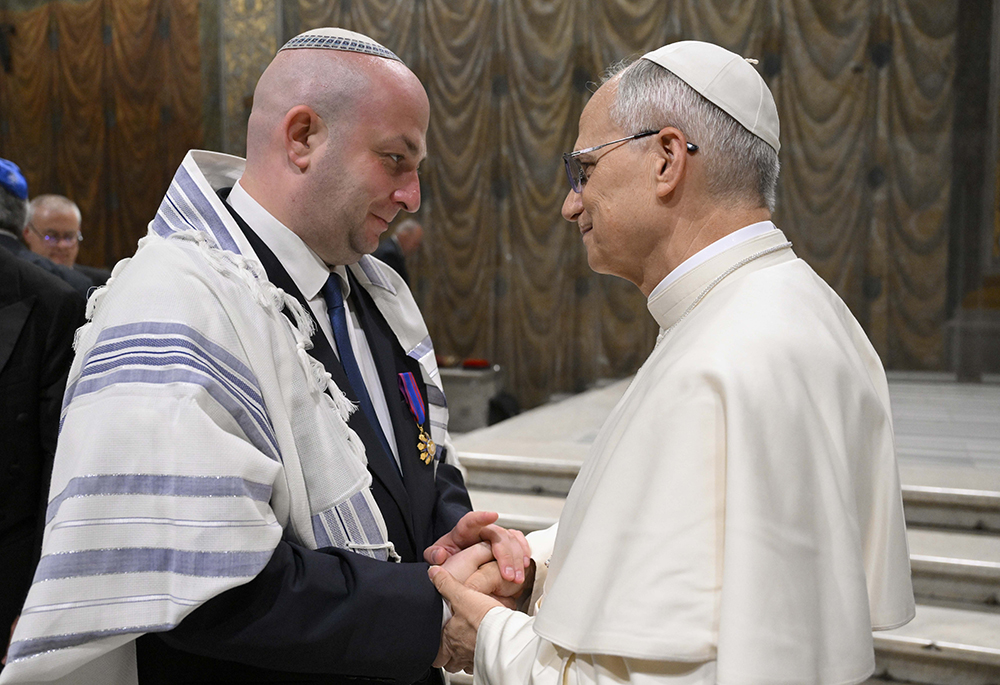
Pope Leo XIV greets Silviu Vexler, president of the Federation of Jewish Communities in Romania, during a ceremony honoring Blessed Iuliu Hossu in the Sistine Chapel at the Vatican June 2, 2025. (CNS photo/Vatican Media)
“Hamas’s attack on October 7, 2023, triggered a tsunami of antisemitic incidents in Europe (and other places such as the US, Canada, and Australia). These incident – including physical attacks, harassment and demonstrations outside Jewish schools, synagogues and community centres – have continued after the ceasefire agreement in Octobet 2025. This rise in antisemitism throughout Europe and elsewhere, and in such a short time, has come in many shapes and forms – online as well as physical – and shows how widespread and ingrained this particular form of racism is.”
The above is the opening for the “Background” section of a report entitled “The Rise of Antisemitism in Europe after October 7, 2023,” written by Dr. Magnus Norell for the Wilfred Martens Center for European Studies and published earlier this year. Dr. Norell is Associate Director of Studies in Terorism, Organised Crime and Middle East Politics at Infosphere in Stockholm, Sweden. He writes as a specialist on issues such as terrorism, political violence, democracy and security in the Middle East and Central Asia.
The statistics are sobering, and disconcerting considering the history of antisemitism in Europe and the extreme actions taken by the Nazi regime in Germany to eliminate the “Jewish problem” not even a century ago. Yet, here we are again. It seems the lesson of the Holocaust – the inherent injustice of attempting to eliminate by genocide an entire race of people – is lost on the people of Europe. And those most inclined to participate in these antisemitic attacks, according to Norell, are young people on the political left.
Of course, any alarm raised about the rise or decline of anything must include basic stats. So, here are some statistics on antisemitism in the J7 countries, from “J7 – The Large Communities’ Task Force Against Antisemitism”: Argentina, Australia, Canada, France, Germany, UK, and US. The J7 nations represent those nations (outside of Israel) that have the largest Jewish populations:
Rates of Antisemitic Incidents in J7 countries, 2021 – 2024 (in terms of number of antisemitic incidents per 1,000 Jews):
Argentina from 2.79 antisemitic incidents per every 1,000 Jew in 2021 to 3.5 such incidents in 2023 (Some of these countries don’t have 2024 numbers, yet)
Australia 3.79 incidents in 2021 to 17.6 such incidents in 2024
Canada 1.25 such incidents in 2021 to 2.26 in 2023
France, from 1.32 incidents in 2021 to 3.6 incidents per 1,000 in 2024
Germany went from 23.5 incidents in 2021 to 38.26 incidents in 2023
United Kingdom went from 7.74 incidents to 11.13 in 2024
United States 0.45 incidents in 2021 to 1.48 in 2024.
The Task Force’s report includes the number of violent antisemitic attacks in the year 2025 for each of the J7 countries:
Argentina 673
Australia 1,750
Canada 6,800 – WHAT?!?! What’s going on in Canada?
France 1,320
Germany 5,729
UK 3,700
United States 398
What do these incidents and attacks look like? What types of incidents and attacks are we talking about? There is a great variety, anything from calling a Jewish child a derogatory name in school, to murder. Online attacks included 124 million antisemitic posts on X. There are antisemitic examples in the curriculum of schools; Holocaust denials; banning Israeali fans from a soccer game; anti-Israel demonstrations in Jewish neighborhoods, where participants are throwing insults, but also rocks and sticks; mob rule on college campuses, where anti-Israel students join forces to disrupt classes, threaten Jewish students, occassionally even assuming the privilege of deciding who may and who may not enter a particular area of the college campus, or a particular building. So, to be clear, Jewish students at some of the most expensive and elite universities in our country or being refused the opportunity to attend class in a building that has been designated a “No Jews Zone.”
Norell points to Middle East influence in Europe as one of the factors contributing to the surge of antisemitism on the continent. This influence is rooted in mass migration from Middle Eastern/Muslim-dominated countries. In 1960, there were approximately 6 million Muslims in what is today the European Union plus the UK. In 2025, that number was 42 million. There is no reason to think that the migration will stop. Muslims have traditionally had a difficult time assimilating to the West. Rather, many, especially younger, more radicalized Muslims, tend to keep their country of origin values and try to live them in the West. This is at the root of many difficulties for Muslims in Europe. They fail or refuse to assimilate, so succeeding in school, getting a well-paying job, finding adequate housing – all of these become more difficult for Muslims in the West. The truth is, Muslims often have to make the choice between acclimating to the values of Western society and living a life consistent with the teachings found in the Quran.
Another factor of Middle Eastern influence on the treatment of Jews in the West is that radical Muslim organizations are allowed to be present, organize, and be active in European countries. Even with warnings regarding their extremist philosophies and a history of supporting terror, organizations such as Hezbollah are allowed to continue working and organizing in the European Union, recruiting students, radicalizing believers, and planning and carrying out terror attacks. Finally, there is the money. Middle Eastern countries that produce oil often take some of their profits and invest in Western colleges and universities. It is a rule of every education system in the world, and ours is no exception: Money talks. Investments in these universities gives the Middle Eastern billionaire an advantage. If he wants a certain message taught, or a certain play performed, or an article in the college newspaper, the college or university may well feel obliged to acquiesce, unless they want to lose a substantial percentage of their annual budget.
I think another factor is at play here, however, though it may not be as obvious and, I confess, may not be as strong as the fear of losing significant amounts of endowments. In the second half of the twentieth century, Europe has experienced a significant loss of Christian faith. The continent once identified with Christendom, the continent that was essentially synonomous with Christianity has, in the last half-century, become a bastion of secularism and, to not a small degree, even anti-Christian or, to borrow a phrase, Christophobic sympathies. While 67% of Europeans still identify as Christian, for most it is a nominal identity, for only between 5-15% of Christians attend church services weekly. The situation is much worse among younger Europeans, those between 16 and 29, among whom 55% identify with no religion whatsoever. So, in Europe, there are a lot of people who say they are Christians who likely know very little about the faith and likely don’t practice the faith. As such, it is also likely the faith will have little influence on the decisions they make, including political and cultural decisions made for the benefit of all citizens.
Why is this a big deal in a post about antisemitism? Because the truth is, while Christians certainly have a history of relations with Jews that represents, at times, a horrors of animosity and persecution toward the Jews, secularists and radical Muslims are worse. This, in my mind, likely contributes to a situation in modern Europe where Jews are treated as social pariahs. Much of the physical violence against Jews during the middle and later medieval periods was inspired, not by a pastor or bishop, but by lay folk who hated Jews. The priests and bishops and, in some cases, even popes, often actively sought to protect Jews from attacks by lay mobs and rulers. Rabbi and historian David Dalin, in his 2001 review of the anti-papal book The Popes Against the Jews by David Kertzer, writes: “Beginning during the fourteenth century, a tradition of papal support for the Jews of Europe began to emerge. Kertzer and other recent papal critics have largely missed this ‘philo-Semitic’ tradition. By portraying Catholic-Jewish relations as a history of the popes against the Jews, alleging that the papacy has played a disproportionate role in the rise of modern anti-Semitism, Kertzer ignores the fact that during periods of intensified anti-Semitic persecutions several popes served as protectors of Jewry–especially of the Jews of Rome–upholding the Jewish right to worship freely in their synagogues and publicly defending Jews against a host of anti-Semitic allegations.” So, the popes and bishops were often put in the position of protecting the Jews from persecution, and they accepted and acted on that reponsibility, instructing the lay faithful in the proper respect and treatment of the Jews. But without faith there is no respect for the opinions or directives of pastors and bishops. They have no more influence over a mob of antismites than an entertainment or sports celebrity telling people how they should treat Jews, and perhaps even less. Bishops in the United States and across Europe have condemned antisemitism. Every pope from St. Pius X to Leo XIV has condemned antisemitism in no uncertain terms. The bottom line is, Jews are probably safer from antisemitism in a Christian society than they are in a secular society, and certainly moreso than in a Muslim society. The Jewish scholar, Yosef Yerushalmi, in response to Rosemary Reuther’s claim that the Holocaust was the result of Christian medieval anti-Jewish laws, wrote: The slaughter of Jews by the state was not part of the medieval Christian world order. It became possible with the breakdown of that order.” The fact that Europe is a more secular society, and that a large influx of Muslim immigrants entering Europe has resulted in some parts of European cities becoming Muslim enclaves, does not bode well for Jews, and I believe explains, at least partly, the rise of antisemitism in the J7 countries.
Christians must stand up against antisemitism and in defense of the Jewish people and of Israel. It is no good to simply express out disgust for antisemitism. We must be willing to stand alongside our Jewish neighbors and friends for their right to be safe and for Israel’s right to exist. We must be willing to take action against the surge of antisemitism. Most of the antisemitism today comes from the political left. This is also partly explained by the fact that the political left is much more secular, much less religious, than the political right or the political middle. This is evident in the churches, as well. Support for Israel is weakest among the liberal churches. That makes no sense, of course, but it is what it is. We Christians must educate ourselves on the Jewish-Arab conflict, on the truth of the Jewish presence in the Middle East (and, incidentally, on the large number of countries Jews have been run out of), and on the state of near constant war the Arab nations have exercised against Israel, many of whom still include the destruction of Israel as a goal.
Catholics, in particular, ought to be champions of the safety of Jews. It’s true that many of our Church leaders over the centuries failed in their responsibility to protect the Jews, and too many failed miserably, horribly. Still, many of our Church leaders across the centuries took up the mantle of protector of the Jews, even during some of the darkest periods of antisemitic pograms and riots, often carried out by Catholics. We need to look to the legacy of those popes, archbishops, bishops, priests, sisters, and laypersons who took responsibility for protecting the Jews seriously, even saving them from certain death during the years of Nazi oppression. Our current Holy Father, Pope Leo XIV, has called for an end to antisemitism. We ought to listen to him, and join him in the effort to stop this madness that is taking over the continent of Europe and too many areas in the United States, especially on our college and university campuses and, now, ever moreso in New York City, the city with the second largest population of Jews in the world (Tel Aviv is first).
What can Christians do? I recommend that one start by reading Nostra aetate, the Second Vatican Council’s “Declaration on the Relation of the Church to Non-Christian Religions.” This is where modern Catholic-Jewish relations began. It was a breakthrough document and has stood the test of time. There are a number of websites with ideas on how Christians can be more active in fighting antisemitism. The USCCB website includes an antisemitic dictionary to help Christians learn the language of antisemitism. At the end of the “Translate Hate” booklet is a resource on “How to Report Hate.” You may find it helpful. Word on Fire, Bishop Robert Barron’s evangelization ministry, has an article on its website entitled, “Christians Have an Obligation – and a Way – to Stop Antisemitism.” The website for Catholic Social Teaching in Action has ideas on what Christians can do concretely to fight antisemitism. Finally, Philos Catholic is an organization that seeks to promote honesty in the history of Catholics towards Jews and in creating friendship between Catholics and Jews in the modern era. My only caution re: Philos Catholic is their recommendation of two books, one by James Carroll and another by David Kertzer, both of which have come under some intense criticism from historians for being selectively anti-Catholic in their histories.
On September 6, 1938 Pope Pius XI received a group of pilgrims from Belgium. The conversation turned toward the question of relations between Christians and Jews. National Socialism was in power in Germany by then and had adopted laws restricting the activity and movements of Jews. The Holy Father spoke spontaneously on the question:
“At the most solemn moment of the Mass we recite the prayer which contains the expression ‘sacrifice of Abel, sacrifice of Abraham, sacrifice of Melchisedek’ in three strokes, three times, three steps, the entire religious history of mankind—a magnificent passage. Every time we read it we are seized by an irresistible emotion. The sacrifice of our patriarch Abraham. Note that Abraham is called our patriarch, our ancestor. Antisemitism is incompatible with the thought and the sublime reality expressed in this text. It is alien to us, a movement in which we Christians can have no part. The promise was made to Abraham and to his descendants. It is realized in Christ, and through Christ in us who are members of his mystical body. Through Christ and in Christ we are the spiritual descendants of Abraham. No, it is not possible for Christians to take part in antisemitism. We acknowledge for all the right to defend themselves, to adopt measures of protection against what threatens their legitimate interests. But antisemitism is inadmissible. Spiritually, we are Semites.”
While Vatican policy at the time was not to publish the unscripted statements of popes, the statement was recorded and published in Belgium papers, as well as many others. We ought to remember the sentiment of Pius XI and take it to heart. We ought to use it as inspiration for our defense of our Jewish brothers and sisters, heirs of the covenant that gave birth to our Lord and Savior. We cannot afford to stand idly by, silent witnesses to an ideology that has already taken too many lives.
Be Christ for all. Bring Christ to all. See Christ in all.

