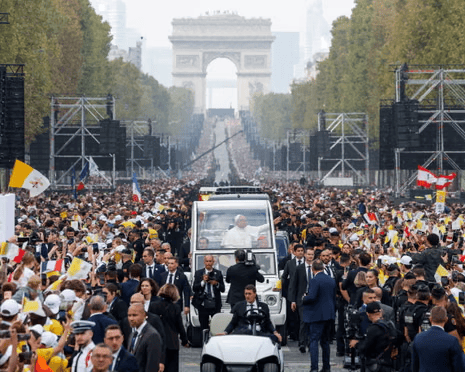
Pope Leo XIV greeted by hundreds of thousands in Parish, Sunday, September 27, 2026
In seems that the faith is not entirely dead in la République. Pope Leo XIV arrived in France to large and thunderous crowds on Friday, September 25. The evening of Saturday, September 26, Leo celebrated Mass in the Stade de France, the rugby and soccer stadium, with 80,000 youth in attendance. They cheered, waved, and generally gave the Holy Father a welcome usually reserved for rock stars. The next day, Sunday, an estimated 800,000 attended an open-air Mass in Paris. When Leo went to Lourdes, the famous site of St. Bernadette Soubirous’ visions of Our Lady as the Immaculate Conception and where healing waters flow, another 150,000 attended Leo’s Mass.
Does this signal a revival of Catholic faith in “the eldest daughter of the Church”? As with many questions, the answer is “yes” and “no” and “it depends.”
The answer is “yes” in the sense that there are certainly more people turning to the Church today than even only a decade ago. The Catholic bishops report 21,386 adult and adolescent baptism at Easter 2026, including 13,234 adults, representing an increase of 28% from the previous year and three times the number from ten years ago.
The answer is “no” or, at least, “not much of one,” when you consider that France has a population of 70 million. Against that number 21,000 doesn’t sound nearly as impressive. Fully 51% of France’s population identifies as non-religious, and only 26% identify as Catholic. Now, in any other country, 26% might be an impressive number. But this is France. In the year 1960, well over 80% of the population identified as Catholic. So, the Church has lost huge numbers over the course of the last sixty-plus years, most of that to secularism. France is a secular state, and a reminder of that were the recent actions of the government, which made abortion a constitutional right and passed a law allowing for assisted suicide. Pope Leo blasted France’s adoption of both of these new laws during his visit, insisting in a speech in front of President Emmanuel Macron that the right to life was the “indispensable foundation of every other human right.” There is not greater power a government can assume than to decide who may live and who may die. France has presumed to claim that power, and Pope Leo was not going to let that slide. Good.
So, the answer is “it depends” on how one defines a revival of Catholic faith. Certainly more people have been drawn to the Church in recent years, especially young people. But their numbers remain small in relation to total populations, and the fact remains that, at least in the West, for every person who enters into full communion with the Catholic Church as adults, many more who were raised Catholic are abandoning the faith of their childhood.
This is cause for serious concern. The Church’s responsibility is to preach the gospel of Jesus Christ, to baptize and to teach all to follow Jesus’ commands. The desire of the Church is that every soul come to know Jesus Christ and develop a deep, passionate love for Him and His Church. It is God’s desire, and the Church’s desire, that all be saved. At the same time, when well over 80% of the population of France identified as Catholic in 1960, only 25% were attending Sunday Mass. What good does it do to “identify” as Catholic when one fails to participate in the very action that defines what it means to be Catholic? Being Catholic is not like being White or Black, or male or female, or other immutable characteristics. A Black African cannot suddenly decide that he is White Balkan, any more than a White Balkan can decide that he is a Black African. And, despite what our contemporary culture demands, males are males and females are females, and there’s no deciding to be one or the other. You are what you are. Also, there are no degrees of Blackness or Whiteness, or male or female. One male is not “more male” than another, based on the choices he makes. One Black man is not more Black than another based on the choices he makes. Yes, I know that some political or social activists, or some “man’s man” types will disagree, but that’s ideology, not biology. When Joe Biden had the audacity to tell Black Americans that, if they didn’t vote for him, they weren’t Black, he ought to have lost every Black vote in the country. Who is he to judge that a Black person is not Black on any grounds whatsoever, much less based on whether or not they vote for him? Outrageous!
But this obviously isn’t the case when it comes to being Catholic. While Baptism makes a person Catholic, infusing an indelible seal on his or her soul, being Catholic involves a lot more than being Baptized for anyone much older than twelve or thirteen. There certainly are degress of being Catholic, because being Catholic involves choices, choices that potentially make one a better Catholic. Participation in the holy sacrifice of the Mass is rather the basic, foundational choice for being Catholic. If you don’t go to Mass, you are not Catholic. If you are Catholic, you go to Mass. I think it rather goes without saying, again, at least in the West, that no one goes to Mass because they “have” to anymore. There are no social pressures to go to Mass. The neighbors aren’t going to talk about you. The parish priest isn’t going to call you up and challenge your absence from Mass. Whether he ought to is another post. In that case, the Church can have fairly high confidence that those who do go to Mass have embraced the faith at a foundational level, if not deeper.
The Church in every country ought to dedicate itself consciously to keeping those she already has under her wing. What is it that keeps people Catholic? How does a child who goes to Mass regularly become an adult who goes to Mass regularly? There has been research on the question, and the key seems to be whether or not that child comes from an intact family where the father attends Mass. Communio is an organization that supports the efforts of churches to build strong families. In 2023 they published “A Nationwide Survey on Faith & Relationships.” They surveyed 19,000 Catholic, Protestant, and Orthodox young adults. Their conclusion? Eighty percent of young adults who attend church regularly come from intact homes, where the mother and father are married to each other and are the biological parents of the children. Only 1 in 5 children being raised in homes where, for whatever reason, the parents are not together or are not the biological parents of the child, can be expected to attend church regularly as adults, even if they were brought to church by their parent growing up. Full disclosure: I am part of that 20%. I was nine-years-old when my family stopped going to Mass. I don’t know why. I was nine and it wasn’t my call. Before that, we went to Mass regularly, every Sunday. Then, we stopped. My father died when I was ten, and my mother did not have the energy to get five kids up (the oldest was married and moved out) up for Sunday Mass. So, we languished in this “no man’s land” of not practicing any religion. My mother wasn’t hostile to the Catholic faith – and, in fact, I had the joy of arranging for her to go to Confession and receive the Blessed Sacrament only days before she died – she just didn’t have the energy.
It seems obvious to me, then, that the Church needs to support families. We need to be a resource for people to build and maintain strong families, to assist those who are struggling, and to keep reaching out to those we are in danger of losing. The family has always been the most important element in the life of the Church, as it is for the life of a healthy society. That’s why I have very little confidence in “renewal” movements that don’t put the family at the center of its efforts. Even with the most aggressive renewal efforts, however, the Church must accept that, again, at least in the West, it will be a smaller Church. But that smaller Church ought to prove more faithful, more evangelical, more committed to the life of the gospel. Why? Because, as I said above, no one goes to Church because they have to, anymore. Those who are there are there because they want to be. And that is what makes all the difference.
Josef Cardinal Ratzinger, in part of a radio lecture in 1969, decades before he became Pope Benedict XVI, said of the future Church: “It seems certain to me that the Church is facing very hard times. The real crisis has scarcely begun. We will have to count on terrific upheavals. But I am equally certain about what will remain at the end: not the Church of the political cult, which is dead already, but the Church of faith. She may well no longer be the dominant social power to the extent that she was until recently; but she will enjoy a fresh blossoming and be seen as man’s home, where he will find life and hope beyond death.”
The image of the Church enjoying a “fresh blossoming” and be experienced as “a man’s home, where he will find life and hope beyond death,” strikes me as a much more positive, gospel-oriented, and Christocentric Church than the one we too often find in areas where the Church has been reduced to a political or cultural body. I pray that Cardinal Ratzinger’s vision comes true. No, rather, is coming true. I hope so. I pray so. Perhaps the reception Pope Leo received in France is a small indication that it is.
Be Christ for all. Bring Christ to all. See Christ in all.

