Blessed Fulton Sheen
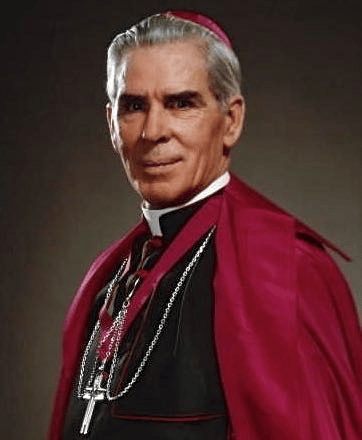
Bishop Fulton Sheen was the most famous Catholic in the United States in the decades of the 1950s and 1960s, with the possible exception of President John F. Kennedy, the first Catholic president. At the height of his television popularity, Sheen spoke weekly to an audience of 30 million. Billy Graham called him, “The Great Communicator.” Sheen’s deep-set, hypnotic eyes, his baritone voice, and his flare for the dramatic gesture, as well as his sense of humor and common sense take on important matters of the day, were perfect for the new medium of television, and he won over millions. Those millions represented viewers the executives at Sheen’s station never thought would materialize. What was the attraction to an elderly priest wearing a cape and a skullcap and talking about life matters in the context of Catholic faith? No one thought Sheen’s program could survive, yet the numbers don’t lie. He was, and likely remains still, the most popular media preacher to have ever graced the airwaves. cles, nevertheless, Bl. Fulton Sheen will be remembered especially for his television programs, many of which are still available on YouTube and still run regularly on Eternal Word Television Network (EWTN). It was through his TV programs that Sheen became the face of the Catholic Church in the U.S. Many Americans who had previously had little exposure to Catholicism, and many who had a hostile view of it, came to see the pleasant, wise, and attractive bishop as a good man, a man of common sense reflections, and someone whose insights on life and faith might easily apply to their own situations. As such, Sheen contributed greatly to a more positive perspective on Catholicism for Americans, and some have even speculated that his ability to connect with so many millions who were not Catholic contributed significantly to the election of John Kennedy, because it made Kennedy’s own Catholicism seem less strange and more in line with the American experience.
Peter John Sheen was born in El Paso, Illinois on May 8, 1895, the oldest of four sons born to Newton and Delia Sheen. Though baptized “Peter John,” he was called “Fulton” after his mother’s maiden name. Sheen’s family soon moved to Peoria, and he graduated as valedictorian from Spalding Institute in 1913, attended St. Viator College in Bourbonnaise, Illinois and Saint Paul Seminary in Minnesota. On September 20, 1919, Fulton Sheen was ordained a priest of the Diocese of Peoria. He continued his studies at Catholic University of America, and graduated in 1923 with a Doctorate in Philosophy from the Catholic University Leuven in Belgium. He was the first American to win the Cardinal Mercier award for best philosophical treatise. In 1924, Fr. Sheen continued his studies in Rome and earned a Sacred Theology Doctorate from the Pontificium Collegium Internationale Angelicum.
After brief service in parish ministry, Fr. Sheen taught philosophy at Catholic University until from around 1926 to 1950. In 1951, Sheen was named Auxiliary Bishop of the Archdiocese of New York and consecrated on June 11, 1951. He served in this capacity until he was named Bishop of Rochester, New York in 1966. He served as Bishop of Rochester to only 1969, when he resigned at the age of 74.
Fr. Sheen began his media career with a weekly radio program, The Catholic Hour, which at its height in the mid-1940s attracted four million listeners. Sheen received between 3,000 and 6,000 letters each week. In 1951, now Bishop Sheen began his famous television show, Life Is Worth Living. The show was slotted for 8pm on Tuesday nights, competing with Milton Berle’s comedy show. No one thought it would offer Berle much competition, however. Even still, Bishop Sheen did well in the ratings, so much so that he caught Berle’s attention. Berle, affectionately referred to by his viewers as “Uncle Miltie,” joked that Bishop Sheen shouldn’t be doing so well because, “he used old material,” but that, “[i]f I’m going to be eased off the top by anyone, it’s better that I lose to the One for whom Bishop Sheen is speaking.” Bishop Sheen joked back, suggesting that his viewers call him, “Uncle Fultie.” The number of television stations carrying Life Is Worth Living jumped from three to fifteen in two months and Bishop Sheen received 8,500 fan letters each week. 30 million viewers watched weekly until the program ended in 1957. In 1952, Bishop Sheen won an Emmy for Most Outstanding Television Personality, and quipped at the ceremony, “I think it is time I acknowledged my four writers — Matthew, Mark, Luke and John.” One of Bishop Sheen’s best remembered programs was in 1953, when he denounced the Soviet Union. Bishop Sheen said, “Stalin must one day meet his judgment.” Stalin suffered a stroke and was dead within the week.
Bishop Sheen is credited with converting a number of prominent people to the Catholic faith, including journalist and agnostic Heywood Broun just months before Broun’s death, Republican politician and ambassador Clare Boothe Luce, automaker Henry Ford II, Communist organizer turned anti-Communist Bella Dodd, violinist and composer Fritz Kreisler and actress Virginia Mayo. One estimate claims that Bl. Fulton Sheen was personally responsible or played a significant role in the conversion to Catholicism of 42,000 people.
In 1958, Bishop Sheen became director for the Society for the Propagation of the Faith, where he served for eight years, until he was named Bishop of Rochester in 1966. Bishop Sheen also starred in another television series, The Fulton Sheen Program, which ran from 1961 to 1968. In 1969, Bishop Sheen resigned from his appointment in Rochester and was named titular archbishop of Newport, Wales, a ceremonial position. This allowed him more time to write his books and articles. In his life, Archbishop Sheen wrote 73 books and innumerable articles. Two months prior to Sheen’s death, Pope St. John Paul II visited New York. There he met Archbishop Sheen, embraced him and told him, “You have written and spoken well of the Lord Jesus Christ. You are a loyal son of the Church.”
Shortly after open-heart surgery, Archbishop Fulton Sheen died in his personal chapel, before the Blessed Sacrament, on December 9, 1979. He is buried in St. Patrick’s Cathedral in New York City.
Archbishop Sheen’s cause for canonization was formally opened by the Diocese of Peoria in 2002 and he was given the title Servant of God. On June 28, 2012, the Vatican announced that Archbishop Sheen had lived a life of “heroic virtue,” and he was given the title Venerable. In 2014, the miraculous revival and survival without physical or mental problems of a newborn baby whose heart had not been beating for the first hour of his life, and who was about to be declared stillborn, was recognized as attributable to the intercession of Ven. Fulton Sheen. After delays caused by a dispute between members of Sheen’s family and the Archdiocese of New York, Sheen was beatified at the cathedral in St. Louis, Missouri on September 25, Luis Cardinal Tagle presiding. The evening before, at the vigil prayer service, Bishop Robert Barron, often compared to Fulton Sheen for his use of various forms of media to proclaim the gospel, preached a marvelous homily that I’ve linked to here.
Prayer for the Canonization of Archbishop Fulton J. Sheen:
Heavenly Father, source of all holiness, You raise up within the Church in every age men and women who serve with heroic love and dedication. You have blessed Your Church through the life and ministry of Your faithful servant, Archbishop Fulton J Sheen. He has written and spoken well of Your Divine Son, Jesus Christ, and was a true instrument of the Holy Spirit in touching the hearts of countless people. If it be according to Your Will, for the honor and glory of the Most Holy Trinity and for the salvation of souls, we ask You to move the Church to proclaim him a saint. We ask this prayer through Jesus Christ, our Lord. Amen.
Be Christ for all. Bring Christ to all. See Christ in all.

