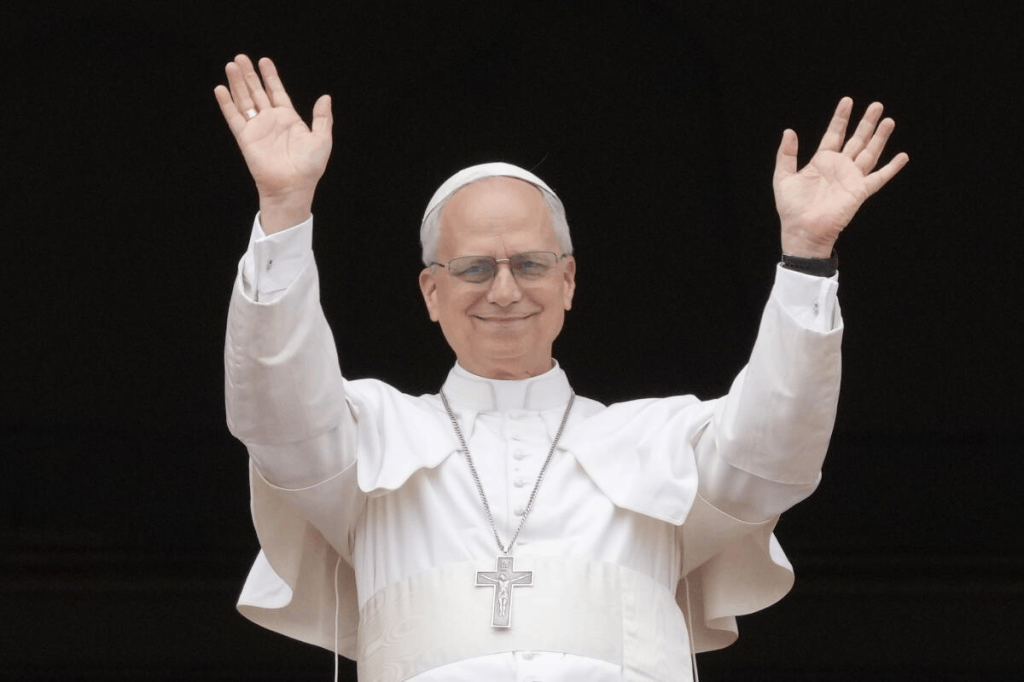
A statement from Pope Leo XIV’s medical team at Agostino Gemelli University Policlinic, where the Holy Father underwent surgery to excise a nodule from his lung, requiring the removal of the lower lobe of his right lung, has confirmed that the adenocarcinoma in his right lung was localized, successfully removed, and that “no further treatment” for the cancer “is necessary.” Pope Leo is cancer free. Thanks be to God!
The full statement, as released by the Holy See Press Office reads: “The final histopathology and molecular testing reports on the tissue removed during the Holy Father’s surgery were issued today. The results confirmed that the tumor was a lung adenocarcinoma and that the disease was localized. A subsequent oncological assessment has confirmed that no further treatment is necessary,”
Speculation was rife when tests confirmed that the nodule in Leo’s lung was an adenocarcinoma. Journalists were writing as if Leo was on his last leg, already speculating how this might diappoint the many who had hoped for a long pontificate. All of that can be laid to rest (pun intended!). Of course, few have any idea of when the Lord will call them home. But there’s no reason to think that Leo’s demise is imminent, or that it will be related to the nodule found in his lung. The cancer was completely removed.
In a conversation I engaged in on the Fox News combox (I know! I know! Why do I bother?), there was a comment from someone who, apparently, is an atheist, asking why God didn’t just heal Leo, or why He didn’t prevent the pope from getting the nodule in the first place? I responded saying that that is not the promise God has made. And, it’s true. No where in the Scriptures does God promise that He will spare believers all the ravages of disease and death. The logical conclusion of such would be that everyone who has ever been a disciple of Christ over the course of history would still be walking the earth. Clearly, that’s not the case. This is not to say that God cannot heal people of diseases and infirmities of every kind. He certainly can, and He does. But the idea that, if I as a Christian, get a disease of some kind, then God either doesn’t exist or has betrayed me is ridiculous and contrary what He has revealed to us about Himself and His promises. We cannot oblige God. God heals whom He wills to heal. If I’m not on that list, it’s not because God has somehow cheated me out of a promise He made. He never made that promise. The promise He made was to enter into my suffering, to empower me to unite my sufferings with His and, in doing so, participate in His redemptive mission.
But what about Psalm 103:3, where it says, “Bless the LORD, O my soul, and forget not all his benefits, who forgives all your iniquity, who heals all your diseases …” (Emphasis added)? Are we forced to conclude that the person who wrote this psalm, under the inspiration of the Holy Spirit, either didn’t know what he was talking about or was engaging in wishful thinking? No one much past the age of five or six believes that there is no disease for those who believe in God, or even that all who believe in God are cured of their diseases. People die. People who believe in God die. What could the verse mean? Clearly, it’s not talking about never suffering disease, for then a person wouldn’t need to be healed of it, right? But it’s not talking about every believer who gets a disease being healed, at least in this temporal order. Why do we know this? Because we regularly experience people getting diseases and not being cured. Either the disease is chronic, or the disease is fatal. So, the Holy Spirit must have inspired the composer of the psalm to write about the life of the believer in the kingdom, after we leave this temporal order. And, of course, he’s right! For those who believe, every disease will eventually be healed, when we come to share in the divine nature after the Final Judgement.
Brief tangent: It has always impressed me that, while atheists employ childhood cancer as one of what they regard as the strongest arguments against God’s existence, I am amazed, having met children who have cancer and their families that, if anything, their struggle with this horrid disease is a source of greater faith in God and His good graces. Hmmm …
Another person then asked, if such were the case, what’s the point of “all this God/Jesus stuff?” Apparently, this person’s understanding of God is as one who either spares us all suffering or isn’t worth the time of day. I responded that eternal life, sharing in the very nature of God, was a pretty good reason for “all this God/Jesus stuff.” Again, Jesus doesn’t remove all suffering. (I mean, think about it, all but one Apostle died a martyr’s death!). Rather, He empowers us to unite our sufferings with His for the salvation of the world. Well, another person didn’t like that idea! He or she insisted that such a theology was “absurd,” and that Jesus would not want us sharing in His suffering. I pointed out that Jesus informed His disciples that He would have to suffer and die, and encouraged His disciples to “take up their cross” and follow Him.
All of this is indicative of our culture’s attitude toward suffering. Many insist that suffering be prevented because all suffering is bad and only bad, and thus suffering is to be avoided and it is genuinely possible for people to avoid suffering entirely. The idea, or even the expectation, that all suffering is to be avoided and can be avoided is a new development. In ages past, there was no expectation that all suffering could be avoided. In centuries where the Black Plague, constant warfare, and regular famine took the lives of so many at such young ages, the idea of avoiding suffering entirely would have been considered unthinkable. In point of fact, it would not have been thought of at all. To be human is to suffer.
Doctors, nurses, and others in the medical profession are aware of this attitude, this expectation that suffering is be avoided. People get downright angry if they are hurting and the medications you administer are inadequate to manage the pain entirely. People call the triage service after hours and demand that you diagnose their child over the phone, and that the medication required to fight the infection, or whatever it is, be prescribed now. I get it. We certainly don’t want children to suffer unnecessarily. But the expectation that a diagnosis can be made over the phone and that meds to make it all better be prescribed immediately is simply unrealistic. But there it is.
One of the heresies of Unitarian Universalism is the idea that it is possible for humans to build a better world here on Earth using only human ingenuity and will. God is not needed for this project. I am not saying it’s not possible to build a better world, at least in terms of justice, economic stability and success, improvements in medicine, transporation, communications, respect for human rights, etc. After all, free market capitalism has been responsible for lifting more people up and out of poverty over the last century or more than have ever been lifted up and out of poverty in the history of the world. Abject poverty is being reduced to only a handful of desperate areas of the world, where intransigent forces combine to fight progress of any sort. There are still far too many in the world who are illiterate and suffer the burden of ignorance and lack of economic mobility. But there has been great progress, to be sure. Any hope for a world without poverty, however, or entirely free of conflict, struggle, toil, disease, and death is a pipe dream. That will come only with the kingdom. It isn’t to say that we shouldn’t be working to improve our own lot and that of others. We should. We have an obligation to do so, in fact. But we need not get lost in wishful thinking of goals not possible in this broken, temporal order.
Let’s work to make the world a better place, including making it a place, in the words of the esteemable Peter Maurin, co-founder of the Catholic Worker, where it is easier to be good. But let’s not waste our time on unrealistic goals of perfect peace and harmony in this realm. The poor we will always have with us. With poverty will come struggle and conflict. With struggle and conflict will come death, desolation, and isolation. Along with these, though, there will be efforts toward reconciliation and peace, and heroes to make those efforts. We cannot oblige God to free us from all suffering. But we can work with His grace to do what we can with what we have. And that’s a lot!
Be Christ for all. Bring Christ to all. See Christ in all.

