
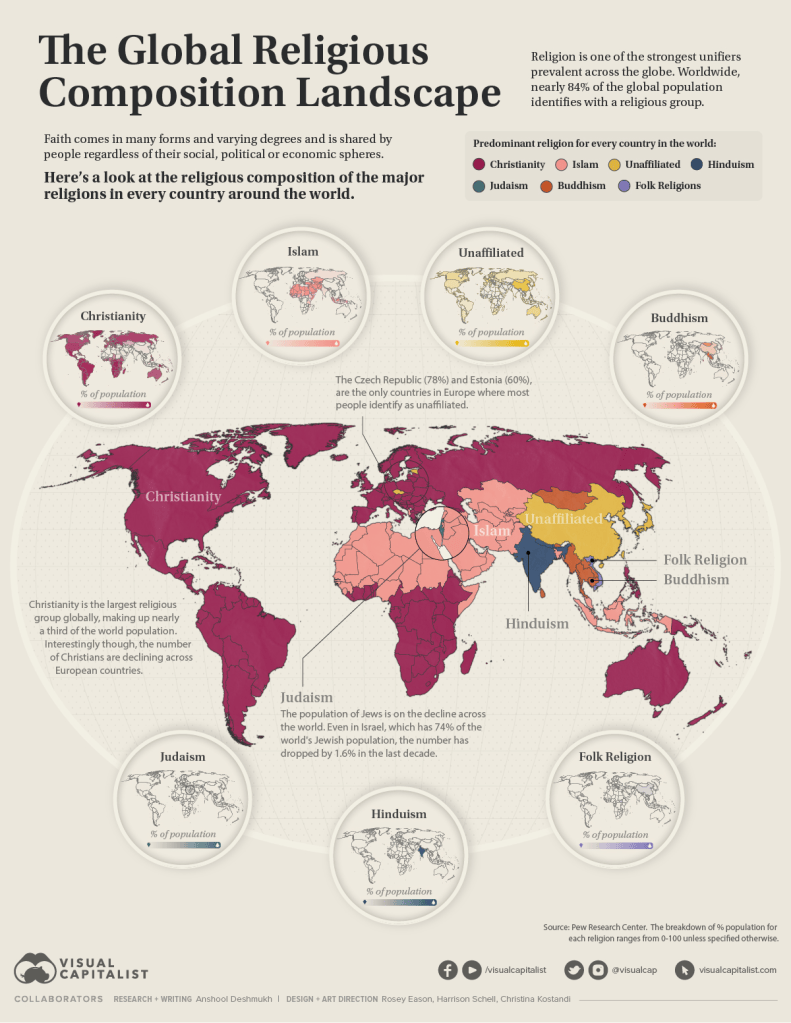
The Pew Research Center, one of the more highly respected research organizations when it comes to identifying populations of whatever group they’re investigation, projects that, by 2035, Islam will be the largest world religion, overtaking Christianity for the first time in history.
What accounts for this? According to Pew, it comes down to one factor: babies! The simple fact is that, while Christianity will keep pace with projected world population growth, Islam will far exceed the pace. The average number of children a Muslim woman has is 3.1, while the average number of children a Christian woman has is 2.5. Both religions exceed the world average, which is 1.6 children per woman. As such, Pew projects that, by 2070, the world population will grow by 29% (which strikes me as astronomical!), the number of Muslims in the world will increase by 80%, and the number of Christians in the world, of all denominations, will increase by 30%. Only a small percentage of the shift in Christian or Muslim populations will be related to conversions from Islam to Christianity or vice verse, given that expectations are that such conversions will balance each other out. However, Christians in the West (North America and Europe) are projected to lose a significant number of adherents over those years. Interestingly, the religiously unaffiliated are projected by Pew to increase fairly significantly their percentage of the populations in Europe, North American, and even Latin America, but worldwide are projected to fall well behind the world population growth rate, falling from 24% of the world population to only 17%. In no region of the world are the unaffiliated projected to be a majority by 2070.
According to World Population Review and most other resources I was able to find, there are about two billion Muslims in the world today. Pew says they will increase by another 1.6 billion by 2070. According to World Christian Database, there are 2.67 billion Christians in the world who, according to Pew, will add 792 million to their numbers by 2070. So, doing the math, there will be about 3.6 billion Muslims in the world and around 3.4 billion Christians in the world. The year Muslims will overtake Christians in numbers, Pew projects, will be 2035. The World Population Review projects the year Muslims will overtake Christians to be by 2050.
What will this mean for Christians? For some, likely a lot. For others, likely not much at all.
Why likely a lot for some? Because those Muslims who are having the most babies – and, again, it’s the babies that make the lion’s share of growth for Muslims and Christians – are in countries notorious for persecuting Christians. According to the apologetics organization Catholic Answers, the Muslim majority countries that have the worst reputations for persecuting Christians are (in no particular order): Sudan, Afghanistan, Brunei, Mauritania, Qatar, Saudi Arabia, the United Arab Emerites, Yemen, Pakistan, Somalia, Iran, Syria, Algeria, Morocco, and Indonesia. Ten of these fifteen countries have a birth rate higher than that of Christians and the rest of the West, anywhere from 3.6 children per woman (Pakistan) to 6.2 children per woman (Niger), and every conceivable (pun intended!) rate in between. And nearly all of these rates represent a significant decline in the births per woman rate in these Muslim countries. Christian are not keeping up with these numbers in their own levels of fertility and, honestly, who can blame them? But the bottom line is, it is or ought to be a grave concern among Christians that many of the highest rates of birth per woman or, in other words, the countries where Islam is growing fastest, are present in the Muslim-majority countries that are among the worst in persecuting Christians. These countries score little better or, in some cases, much worse on scales measuring personal freedoms, religious liberty, and freedom for women.
Why likely not much at all for others? Because, having said all of the above, the great majority of growth in Islam around the world is projected to be in those countries where Islam is already the majority, has been the majority for centuries, and will remain the majority by several orders of magnitude. Fully 80% of Muslims in the world live in countries that are majority Muslim, and this will remain true by all projections. Pew divides the world into six regions: Asia-Pacific, Europe, Latin America-Caribbean, Middle East-North Africa, North America, and Sub-Saharan Africa. Christians are the majority in four of those six regions: Europe, Latin America-Caribbean, North America, and Sub-Saharan Africa. Muslims are the majority religion in one of those regions currently, the Middle East-North Africa. In spite of Islam’s projected growth and Christianity’s projected loss of millions of adherents over the next four or more decades, Islam is expected to gain the majority in Asia-Pacific, where the unaffliated currently are the majority, but are not projected to become the majority in any region of the world where Christians are currently the majority. Any concerns, then, that America or Europe will become Muslim majority in the near future are baseless. Also, in terms of reach, or world wide presence, no other religion comes close to Catholicism. As I’ve reported in other posts, there are 198 sovereign states in the world today, and the Catholic Church has a presence in 196 of them.
The bottom line is, though Muslims will outnumber Christians by about 0.2 billion in 2070, Christianity will remain the dominant religion in the West, and Islam will remain the dominant religion in the Middle East and North Africa, at least into the forseeable future. The great challenge in the West is not Islam, but secularism, as the unaffiliated, though losing a significant percentage of their share in the world population, will continue to grow in the West. They will not be the majority in North America by 2070, but they will not be far off, if Pew is correct, and if Christians remain satisfied that current rates of growth and decline, in particular by disaffiliation, are acceptable. Christians, I propose, ought not be satisfied with current rates of growth, and certainly not with current rates of decline. There’s been much written about the apparent wave of young people, in particular young men, who have been drawn to Catholicism and have joined the Church in recent years. I’ve contributed my own thoughts to the subject. But it’s still true that, for every one person who enters the Church in any given year, 8.4 leave, according to a survey by the Catholic University of America as reported to the United States Conference of Catholic Bishops earlier this month.
Be Christ for all. Bring Christ to all. See Christ in all.

