St. Justin Martyr
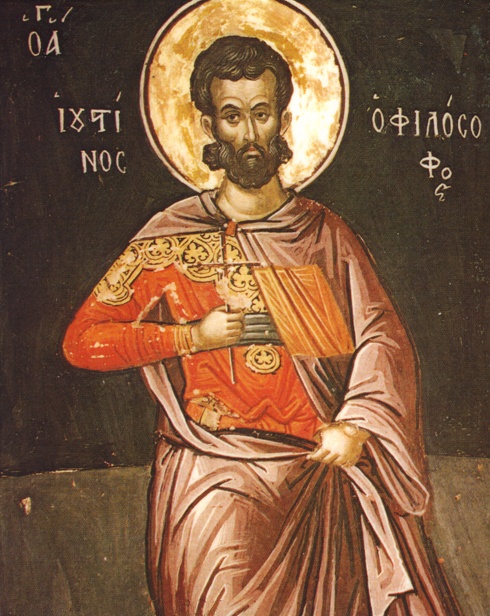
Today, June 1, is the Memorial of St. Justin Martyr, patron saint of Christian apologists and patron of philosophers.
Justin was born into a pagan family around the year 100, near Shechem in Samaria. He received an excellent education in the fields that dominated the academy in the second century, especially rhetoric and philosophy. Rhetoric was not then what we think of it today. Rather than a showy display of words meant as much to confuse as to enlighten, rhetoric was considered a crucial skill to have for public speakers and others. It is the art of persuasion: how to make an argument and win it.
Justin studied many different philosophies, but he became enamored of the philosophical school of Socrates and Plato. Even still, in his continued search for the truth, he learned that Platonism did not have the answers he was looking for. During a walk on the beach, a chance encounter with an elderly man would change Justin’s life, for the man introduced him to the glories of Catholic faith and the challenges of living that faith. Justin never looked back. He was Baptized shortly after, probably in Ephesus. Thus was the career of the first Christian philosopher born!
Justin lived in the middle of the second century, a time of persecution of Christians because of wild rumors Romans had heard (and spread) about the Church. Minucius Felix, an attorney and Christian, wrote of how Romans believed that, during a Christian worship service, “An infant covered over with meal, that it might deceive the unwary, is placed before him who is to be stained with their rites: this infant is slain…. Thirstily—O horror!—they lick up its blood; eagerly they divide its limbs.” As well, because they refused to worship the pagan gods and make sacrifices to the emperor they were charged with atheism.
Justin hoped to stamp out these rumors with clear intellectual/philosophical thought and with writings that explained Christian worship and rituals. Those writings come down to us as the First and Second Apologies of St. Justin Martyr. The Apologies are addressed to the Emperor Antoninus Pius and to the Roman Senate. The hope was that the Emperor and Senators would read his Apologies and realize that none of the charges against Christians in the Roman Empire were true. It’s not likely that St. Justin’s Apologies had much of an effect on the Roman authorities, but they do represent the first extant attempts of a Christian to make a detailed defense of the faith, which is why St. Justin is the patron saint of apologetics, which is the organized effort to explain and defend the faith against those who attack her. In the year 165, Justin was arrested as a Christian with six companions and ordered to make acrifices to the emperor, Marcus Aurelius. Justin responded by making a profession of his faith in Christ, which emboldened the others to follow suit. All seven were beheaded.
St. Justin Martyr is likely and rightly best known for his description of the Catholic Mass in the middle of the second century and his explanation of the doctrine of the Real Presence of Christ in the Eucharist. These sections of his First Apology are often cited when discussions or debates come up between Catholics and Protestants, for it is impossible to deny that Justin’s description of the Mass is so similar to how Catholics worship today. It is also impossibe, to the Catholic mind, to deny his clear and detailed description of what Catholics believe about the Eucharist being the Body and Blood of Christ. Protestants, nevertheless, find a way to interpret Justin’s explanation of the Eucharist as a spiritual presence and not a Real Presence. Of course, Justin’s contributions to the testimony of the early Church do not constitute doctrine-defining documents. But they certainly do testify to the witness and faith of the early Church. Mid-second century is quite early in the life of the Church. And if Justin was describing the faith and worship of the Church around 150, we can have confidence that his description applies to what had been going on for some time prior, likely decades, when one considers the writings of St. Ignatius of Loyola and link the two Church Fathers.
St. Justin’s description of the Mass can be found in chapter 65 of the First Apology:
But we, after we have thus washed him who has been convinced and has assented to our teaching, bring him to the place where those who are called brethren are assembled, in order that we may offer hearty prayers in common for ourselves and for the baptized [illuminated] person, and for all others in every place, that we may be counted worthy, now that we have learned the truth, by our works also to be found good citizens and keepers of the commandments, so that we may be saved with an everlasting salvation. Having ended the prayers, we salute one another with a kiss. There is then brought to the president of the brethren bread and a cup of wine mixed with water; and he taking them, gives praise and glory to the Father of the universe, through the name of the Son and of the Holy Ghost, and offers thanks at considerable length for our being counted worthy to receive these things at His hands. And when he has concluded the prayers and thanksgivings, all the people present express their assent by saying Amen. This word Amen answers in the Hebrew language to ge’noito [so be it]. And when the president has given thanks, and all the people have expressed their assent, those who are called by us deacons give to each of those present to partake of the bread and wine mixed with water over which the thanksgiving was pronounced, and to those who are absent they carry away a portion.
St. Justin’s description of the doctrine of the Real Presence of Christ in the Eucharist can be found in chapter 66 of the First Apology:
And this food is called among us Eucharistia [the Eucharist], of which no one is allowed to partake but the man who believes that the things which we teach are true, and who has been washed with the washing that is for the remission of sins, and unto regeneration, and who is so living as Christ has enjoined. For not as common bread and common drink do we receive these; but in like manner as Jesus Christ our Saviour, having been made flesh by the Word of God, had both flesh and blood for our salvation, so likewise have we been taught that the food which is blessed by the prayer of His word, and from which our blood and flesh by transmutation are nourished, is the flesh and blood of that Jesus who was made flesh.
For an analysis of Justin’s writings on these matters, I recommend this article by Joe Heschmeyer on the Word on Fire website.
St. Justin Martyr might also be considered a patron of religious liberty. He argued, in his Apologies, for an end to the anti-Christian laws in the Roman Empire. And, again, while his efforts failed to bear the hoped for results, even still Justin’s writings and actions stand as testimony to the fact that Christians are not necessarily called to put up with injustices against us, but have legitimate grounds for taking action to improve our temporal lot. It seems that Jesus’ command to turn the other cheek, even from as early as the second century, was not interpreted by the Church as a call to lay down all efforts to stop the persecutions, much less the martyrdoms, of the faithful. As such, St. Justin can prove a faithful intercessor for those Catholics and other Christians around the world who face ridicule, fines, imprisonment, exile, torture, and even death rather than surrender their faith in Jesus. This is not a rare occurance. Christians in countries like Nicaragua, Nigeria, China, and the Muslim-dominated countries of the Middle East often face violent persecution. Now even in Western democracies like the UK, Finland, Canada, and Northern Ireland the free speech rights and other societal privileges are being challenged or denied.
Christians have a responsibility to live the life of the gospel and to share the gospel with others. That does not translate into forced Baptisms, shoving the Bible down anyone’s throat, or turning democracies into theocracies. It does translate into working to protect our religious freedoms from attempts by the State or by the culture to muzzle or limit the activity of the Christian faithful. In the effort to do so, may we rely on the prayers of St. Justin Martyr and all others who worked for the respect Christianity merits and the freedom of all to practice their faith openly.
Be Christ for all. Bring Christ to all. See Christ in all.
 Thoughts and Prayers for the Faithful