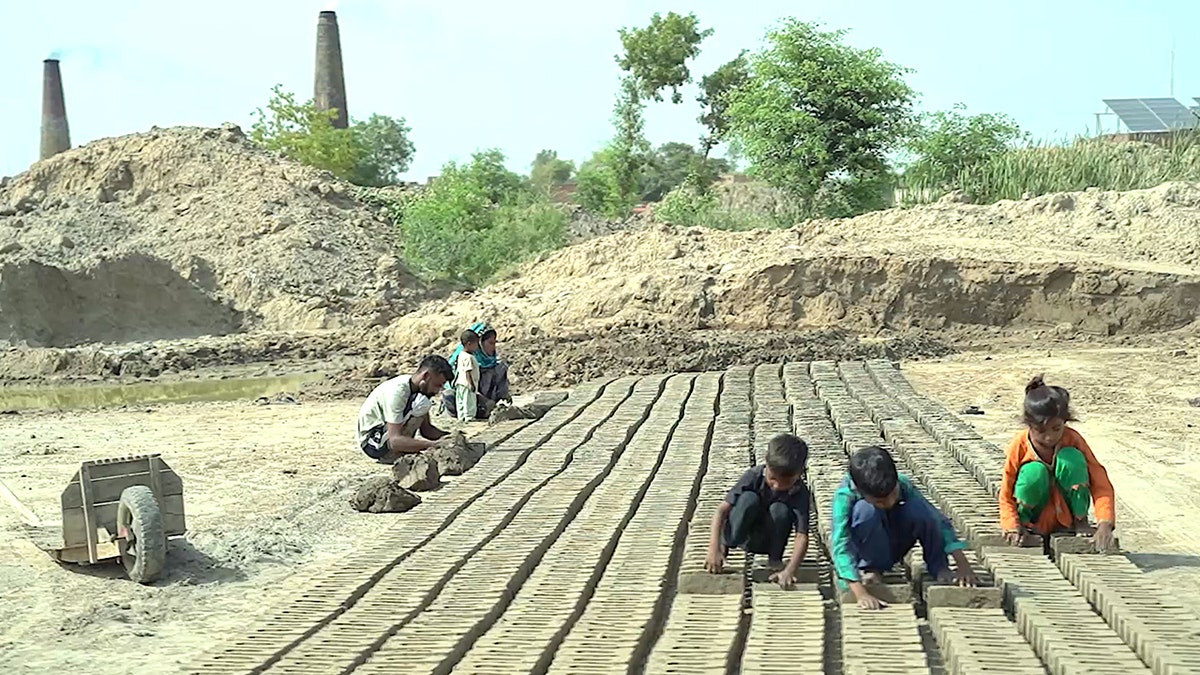
Child slaves work in a brick kiln in Pakistan
Here’s a horror I bet you weren’t aware of. In Pakistan, there are approximately 3.5 million people trapped in bonded labor or, a less polite way of putting it would be: debt slavery. The great majority of those people are minority Christians.
This is how it works: Because of religious discrimination, Christians lack access to adequate education and well-paying jobs in Pakistan. As such, whenever a family emergency arises, such as a medical or legal issue or even a funeral, and sometimes just for basic human needs, the Christian Pakistani family will go to a brick kiln order and request a loan. The loan is extended, but at such exorbitant rates that it’s virtually impossible for the Christian family to pay off the loan. In order to pay off the loan, then, these families are forced into bonded labor. In other words, they work off the loan with manual labor at the brick kiln. The problem is, the interest keeps growing, and the book keeping is dishonest, and there are no regulations on the practice, so the family is trapped in a cycle of poverty and slavery, in some cases over multiple generations, because when a parent who is in debt to the brick kiln owner dies, his or her children inherit the debt. While the practice of bonded labor was outlawed in Pakistan in 1992, the law is not enforced because of corruption and the political and economic power of the kiln owners.
Efforts to rescue Christian families from slave labor in Pakistan include a ministry called Project Jubilee, founded by Emmanuel Hernandez in January 2025. When he traveled to Pakistan to meet the woman who would become his wife, Hernandez was shocked by the depth of poverty and the slavery of his fellow Christians in the Muslim-dominated nation. “Never in my life have I seen such hopelessness,” Hernandez said. “At that moment, I committed myself to rescuing one family a year for the rest of my life.” Project Jubilee has raised enough money from donations to free 300 people from slavery. It isn’t always easy, however, purchasing the freedom of these families. Some brick kiln owners don’t like to part with their slaves. They need them to keep their factories turning out bricks. Some have put a cap on how many individuals or families can be “purchased” at any given time. Project Jubilee doesn’t limit its efforts to Christians, of course, but the nature of the beast means that the vast majority of those rescued from slavery are Christians.
Another effort to help Christians, especially those who have been freed from slavery to manage their lives in their new-found freedom is called PaX. PaX was founded by Fr. Rico (his last name is not given because of security risks), a Catholic priest of the Order of St. Elias (the prophet Elijah to us Westerners). Fr. Rico works with others to “purchase” Christians out of slavery. Basically, he learns how much debt they owe, an amount that could be entirely created from the imagination of the kiln owner on the spot, and he pays it, thus releasing them from the bondage of slave labor. Fr. Rico has secured the freedom of hundreds of slaves in Pakistan. PaX will be a community where former slaves can live together and build a new life working in construction, farming, livestock, and other trades. The first planned PaX community is being built to hold 300 to 400 residents. Other communities are already being planned as the first is being built.
According to the Walk Free, an International Labor Organization, and the International Organization for Migration, there are approximately 50 million slaves in the world today. Slavery comes in many forms: human trafficking, forced labor, debt bondage, child slavery, forced marriages, and domestic servitude. Approximately 25% of the slaves in the world today are children, including 40% of those entrapped in forced marriages. Slaves are obtained by kidnapping, allurement (promised a new life in a wonderful country, only to learn too late that they have become slaves), bonded labor or debt slavery, via online slave markets, the abuse of migrants and refugees, and some are sold into slavery by their families or born into slavery. The countries with the largest number of slaves include: India (11 million), China (5.8 million), North Korea (2.7 million), Pakistan (2.3 million), Russia (1.9 million), and the United States (1.1 million). Are you surprised to see the United States among the top six countries for number of slaves? You can bet a fair number of those who crossed into the U.S. illegally in past years found themselves in slavery, either as sex workers, domestic workers, farm workers, victims of forced marriages, or just used as gofers by the families that purchased them, paid for their travel, sponsored them, or just took them.
Here is a map showing the prevelance of slavery by country in the world today (Source: Wikipedia):

Slavery has been a scourge to humankind probably since the first humans walked the earth and some realized they were bigger and stronger than others and could overpower them for their purposes. Even Catholic popes gave their permission for kings and conquerers to enslave the people of Africa and the Americas as late as the 16th century, when finally the realization that the people being enslaved were, indeed, people deserving of the respect afforded every other person. Somehow, even men of the Church missed that obvious reality. Catholic bishops, priests, and religious orders of men and women bought, owned, and sold slaves Conversely, while this was going on, individual Catholics, Catholic orders, and popes were both condemning slavery and actively working to free slaves from at least the 6th century. Pope Leo XIV acknowledged the role of Catholics in the slave trade and in keeping slaves, and apologized for such in his encyclical Magnifica humanitas. The Holy Father wrote: “It is impossible not to feel deep sorrow when contemplating the immense suffering and humiliation endured by so many in stark contrast to their immeasurable dignity as persons infinitely loved by the Lord. For this, in the name of the Church, I sincerely ask for pardon.” There have been many famous former slaves in the history of the Church, including St. Onesimus (the subject of St. Paul’s Letter to Philemon in the New Testament), St. Felicity of Carthage, Pope St. Callixtus I, St. Patrick of Ireland, St. Raymond Nonnatus (who purchased slaves to free them, and who, when he ran out of money, offered himself in exchange for the freedom of another), Ven. Pierre Toussaint, Ven. Augustus Tolton (the first Black Catholic priest in the U.S.) and St. Josephine Bakhita.
Slavery will likely not cease to be a reality in this world until our Lord returns. Happily, civilized society has come around fully to the condemnation and outlawing of slavery. While there is no country today where slavery is legal, incredibly it was only in 2007 that Mauritania became the last country to outlaw slavery. Even still, there are more slaves in the world today than ever in the history of the world, even though slaves represent a smaller portion of the world population than ever before. Why does slavery linger? Man’s inhumanity to man? The desire to control another, to have complete power over another? Perhaps the better question is, why has slavery become recognized as the curse that it is? After millennia of acceptance by virtually every country, ethnic group, tribe, culture, and religion in the world barely 200 years ago, slavery is now universally recognized by the civilized world to be a great horror and nowhere and never justified. But this remains a relatively new phenomenon. In the West, Great Britain banned all slavery finally in 1833, France in 1848, the United States in 1865, Spain in 1886. So, it hasn’t yet been even 200 years since the earliest of the Western democracies legally abolished slavery. I don’t have the time now to investigate how such a tremendous turnaround took place over such a relatively short period of time. Again, an institution that was nearly universally accepted became universally abhored in less than 200 years. That is a story worth investigating.
In the meantime, we must remember that slavery still exists, and slaves number in the millions. While the work of minitries such as Project Jubilee and PaX manage to touch the lives of only a few of those millions, their work is to be commended and supported. I could not find a website for Project Jubilee, but Global Christian Relief is a well-respected organization that does similar work. You can find the link here if you would like to support the PaX ministry. No one can do everything, but everyone can do something.
Be Christ for all. Bring Christ to all. See Christ in all.

