John 6:51-58
Jesus said to the Jewish crowds: “I am the living bread that came down from heaven; whoever eats this bread will live forever; and the bread that I will give is my flesh for the life of the world.” The Jews quarreled among themselves, saying, “How can this man give us his flesh to eat?” Jesus said to them, “Amen, amen, I say to you, unless you eat the flesh of the Son of Man and drink his blood, you do not have life within you. Whoever eats my flesh and drinks my blood has eternal life, and I will raise him on the last day. For my flesh is true food, and my blood is true drink. Whoever eats my flesh and drinks my blood remains in me and I in him. Just as the living Father sent me and I have life because of the Father, so also the one who feeds on me will have life because of me. This is the bread that came down from heaven. Unlike your ancestors who ate and still died, whoever eats this bread will live forever.”
Today, June 7, is the Solemnity of Corpus Christi.
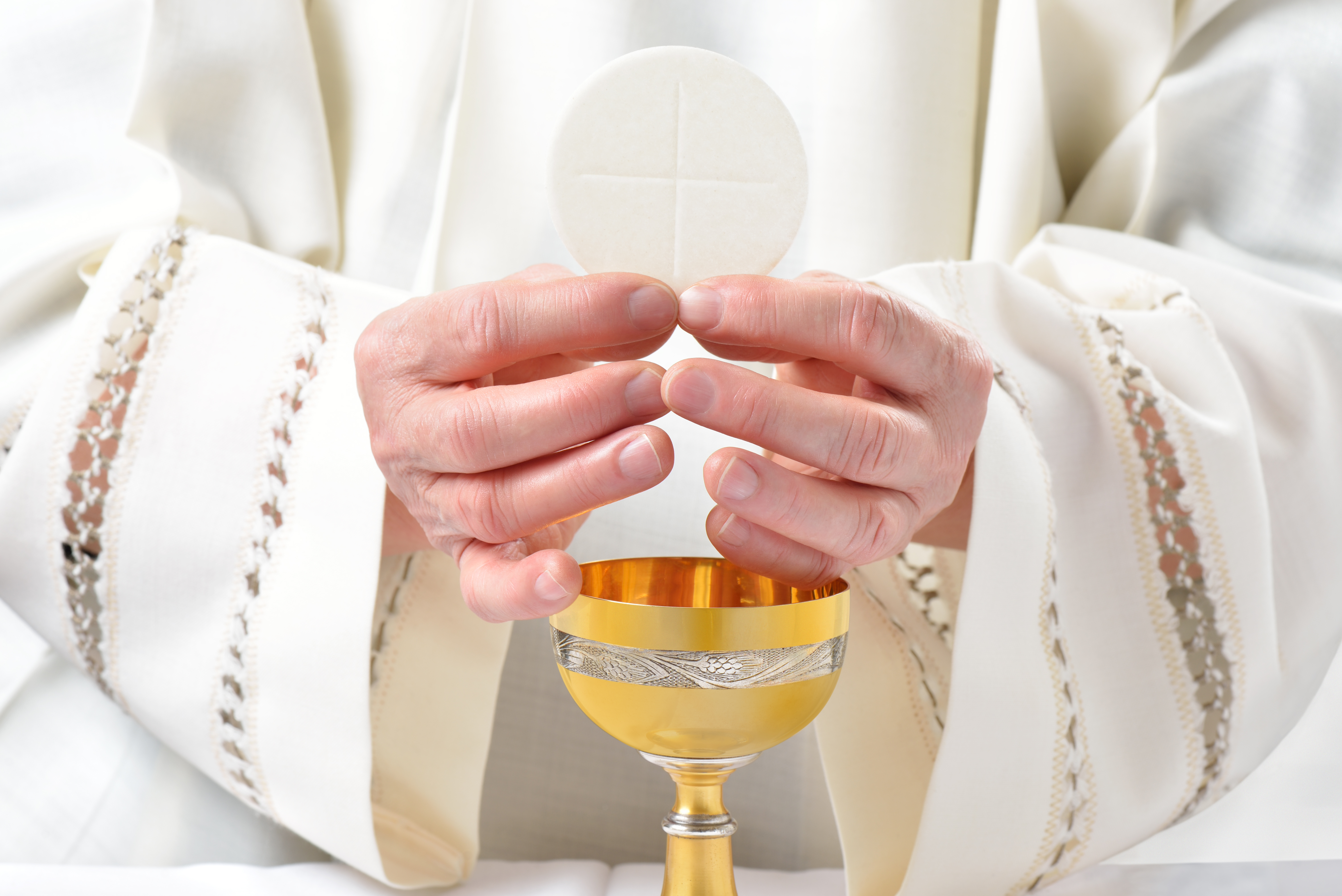
The Catholic Church has, from her beginnings, taught that the Eucharist is the Body and Blood of Jesus Christ. The Gospel for today comes from what is called the “Bread of Life Discourse,” in which Jesus reveals Himself as the true bread come down from heaven. All who eat this true bread will have eternal life. But here’s the key, and the controversy: this true bread is His own Body and Blood!
The Jews of Jesus’ day believed that when the Messiah came, his arrival would be anticipated by a repeat of the miracle of the manna, the bread from heaven that fed the Hebrews on their forty years through the desert. Every morning, except on the Sabbath, the manna would appear among them to be collected by them for their nourishment. Manna, incidentally, does not mean “bread.” It means, “what is it?” because when they first saw it, the Hebrews had no idea what it was. Nevertheless, the bread from heaven appeared each day to keep them fed during the desert years. It tasted like honey! Once they passed into the Promised Land, the land of milk and honey, the manna stopped appearing every morning. Their journey through the desert was over. What lay before them was the conquering of Palestine. You can read about that in the Books of Joshua and Judges.
Earlier in the discourse, not included in this Sunday’s Gospel reading, those who had followed Jesus to His present location asked Him what they could do to accomplish the work of God. Jesus told them to believe in Him. They replied, “What sign can you do, that we may see and believe in you?” This is a bit ironic, since Jesus had just performed the miracle of feeding thousand with just a few loaves of bread and some fish. But they wanted more. They suggest, perhaps, the miracle of the manna. They tell Jesus, “Our ancestors ate manna in the desert, as it is written: ‘He gave them bread from heaven to eat.'” As I said above, many Jews at the time of Jesus believed that the arrival of the Messiah would be accompanied by a repeat of the miracle of the manna, the bread from heaven. God would once again send His bread to nourish His people and announce that the Messiah had come to rescue them from the chains of whatever nation was enslaving or oppressing them this time. To suggest that Jesus give them bread from heaven, then, was a test to see if He was claiming to be the Messiah and, if so, to prove it.
But Jesus has a different bread from heaven in mind. First, He reminds them that it was not Moses who gave them the bread from heaven, but “my Father gives you the true bread from heaven.” The bread of heaven gives life to the world. The Jews, still thinking in terms of bread like the manna their ancestors received, beg Jesus, “Sir, give us this bread always.” It is then that Jesus makes the great reveal: “I am the bread of life; whoever comes to me will never hunger, and whoever believes in me will never thirst.” Then we soon arrive at where today’s Gospel begins. Over and over, the promise of eternal life is connected to eating His Body and drinking His Blood: “whoever eats this bread will live forever”; “… unless you eat the flesh of the Son of Man and drink his blood you do not have life within you”; “Whoever eats my flesh and drinks my blood has eternal life…”; Whoever eats my flesh and drinks my blood remains in me and I in him”; “whoever eats this bread will live forever.” I mean, how many times can He say it?
The Gospel records that many of His disciples found this to be too much for them. Jesus had dozens of followers. “Disciple” simply means “student.” These disciples were those who hoped to learn from Jesus how to live a godly life, or that maybe He was the Messiah and He would lead them in overthrowing the Roman occupation. Most of these disciples didn’t follow Jesus in His travels. Jesus limited most of His travels and activities to Galilee, which isn’t a very big region. So, the disciples would get word that “Jesus is teaching at so-and-so today,” and they would show up to learn from Him. Other disciples did follow Jesus in His travels, and these disciples were invested in providing for Jesus and the apostles the type of support that people with money could provide: food and lodging mostly. Tradition has it that St. Mary Magdalene was well-off from what her husband left her when he died, and she used her considerable wealth to support the material needs of Jesus and the disciples. After all, Jesus was hardly working as a full-time carpenter at the time of His mission. Neither were the apostles supporting themselves by fishing. Then there were the twelve, who represented Jesus’ inner circle. Finally, even within the twelve there was Peter, James, and John, the three who were the inner circle within the inner circle. So, when the Gospel speaks of the disciples finding Jesus’ teaching too much and walking away, this is the group John means, the larger group of disciples described earlier in this paragraph.
Notice, too, that Jesus doesn’t stop them. He doesn’t say, “No, you’ve misunderstood me! I didn’t mean eating and drinking my actual Body and Blood. How absurd would that be! I meant is symbolically, in a spiritual sense.” Jesus did not stop them. He did not attempt to correct their misunderstanding. Why? Because they hadn’t misunderstood. They knew exactly what Jesus meant. That’s why they walked away and stopped learning from Him, stopped listening to His teaching. He had gone too far. They knew it. Jesus knew it. That’s why He let them walk away.
That is why the writings of the early Church reveal that the Church, from her earliest days, also knew what Jesus meant. Paul, in his First Letter to the Corinthians, our second reading today, asks the Christians in Corinth: “The cup of blessing that we bless, is it not a participation in the blood of Christ? The bread that we break, is it not a participation in the body of Christ?” That is why the writings of the earliest Church Fathers, Clement of Rome, Ignatius of Antioch, and Justin Martyr, affirm the Church’s faith in the Eucharist as the Body and Blood of Jesus. They knew what Jesus meant, just as the disciples who walked away knew what Jesus meant.
Just as He asked the apostles, Jesus asks us: Will you also leave me? Jesus desires a deep, intimate relationship with each of us, and you don’t get more intimate than “Eat my Body; drink my Blood.” Perhaps, for some, this is too close. They want Jesus, but not so close that He actually transforms them into Himself. It’s a big responsibility being Jesus in this world. To be the presence of Jesus in this world takes a lot of courage and fortitude and a willingness to be seen as strange, as odd. Flannery O’Connor supposedly once said, paraphrasing another passage from the Gospel According to John: “You shall know the truth, and the truth shall make you odd.” I don’t know if she really said it, but it sounds like her. Perhaps we don’t want to be odd, to stick out, to be so identified with Jesus that, when people have questions or comments about Him, they come to us for our take. Do we want to be so associated with Jesus that people start expecting things of us in terms of our behavior, our values, our perceptions and worldview? Who wants that responsibility?
But people want Jesus. They want to be close to Him. They want to think that He might be on their side or, if they know He cannot be, to know at least that He will be there if they ever decide to get things straight in their lives, to turn things around, to be motivated by something more than money, sex, pleasure, success, whatever. People want Jesus and, sometimes, if we claim Him and we are known for genuinely trying to follow Him, they may see Him in us and come to us when they want to know about Him. That’s how it ought to be. We need to be prepared for when that might happen.
We also need to be prepared when others see Jesus in us and are not happy about it. The ridicule, the insults, the smart remarks, the accusations of failing to live up to the ideal, even the possible lost job or demands to compromise if we intend to keep our jobs. Few here in the U.S. are faced with life or death decisions regarding our faith in Jesus. But we need to be prepared for those who would attempt to knock us down because they see Jesus in us, and we need to pray for our confreres around the world who do face life and death decisions regarding their faith in Jesus.
Today is a day to be strengthened by the Eucharist, by Jesus whose Body and Blood we receive. When we receive Him in Holy Communion, we are transformed into Him. Take the Christ that you now are and go into the world outside of Church and transform that world, by God’s grace, into one that better reflects His sacrificial, unconditional, and redemptive love.
Be Christ for all. Bring Christ to all. See Christ in all.

