
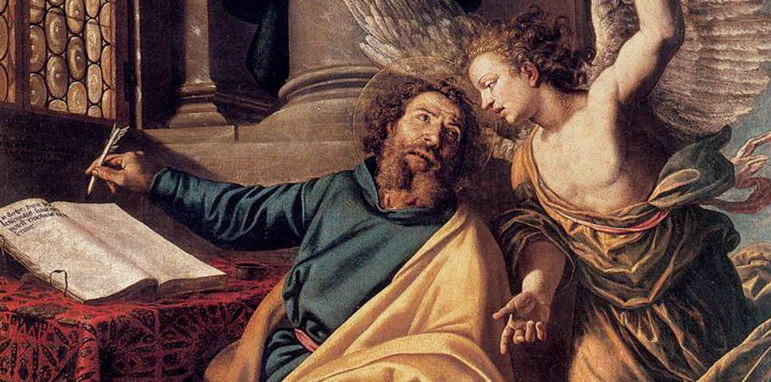
St. Matthew composing his Gospel
For the first three parts of this series, I considered those New Testament texts 1) that seem to imply that Jesus was not God, 2) where the use of the title “God” for Jesus is questionable, including those texts where it is unlikely that the title “God” is given to Jesus and those texts where it is more than likely that the title “God” is given to Jesus, and 3) those texts where Jesus is clearly called God. For this assessment, I relied heavily on Fr. Raymond E. Brown, SS’s book Jesus God and Man: Modern Biblical Reflections. Today, I am going to consider those texts from the Gospel According to Matthew where Jesus claims to be God by claiming the authority to do what only God can do. In succeeding posts, I will consider where Jesus claims to be God in the other Gospels. NOTE: Some Gospels tell the same accounts of Jesus claiming to be God.
I have a bank account. I have a home. I have a wife, children, and grandchildren. I have a career and I am a deacon for the local Catholic diocese. Let’s consider that, if someone went to the bank with an ID that showed that he was Bob Hunt for the purpose of emptying out my bank account. Or if he entered my home and presumed to make himself home there, as if he lived there. Or if he related to my wife, children, and grandchildren as if he were her husband, their father, and their grandfather or “Papa.” What if someone clocked in to my work space, using my username and password, answered calls by introducting himself as “Nurse Bob,” and offered advice as if he were a licensed RN and expected to get paid for his services? Finally, what if someone wrote a “Deacon’s Corner” column for my parish bulletin, putting my name on it? Or if he wrote a column for the “East Tennessee Catholic” newspaper and submitted it in my name? What if he hacked in to my blog and began writing posts under my name? What if he arrived at various parishes, giving retreats, all while claiming my name? Every reasonable person would conclude that this fraudster is claiming to be me – Bob Hunt. Identity theft is one of the fastest growing crimes in the U.S. When someone “steals” your identity, they are claiming to be you. And they are claiming to be you by claiming to do those things that only you have the authority to do, such as empty your bank account, make a purchase with your credit card, or enter into some aspect of your life claiming the privilege of being you. You may never say the words, “I am Bob Hunt.” But by claiming to do those things only Bob Hunt as authority to do, you are claiming to be Bob Hunt.
Just so, throughout the New Testament, Jesus of Nazareth claims to do those things that only God has the authority to do. I will consider some of those things in the post. Let’s be clear: these texts do not prove that Jesus of Nazareth was God. But they should put to rest the false claim that Jesus never claimed to be God. When you claim to do what only some other person has the authority to do, you are claiming to be that person, whether that person is Bob Hunt, or God.
Matthean texts where Jesus claims to be God by doing what only God has the authority to do:
Matthew 5:21-45: The first example is from the Sermon on the Mount, a sermon of Jesus’ with which many are already familiar. In the fifth chapter of Matthew’s Gospel, Jesus begins a series of moral teachings along the pattern of: “You have heard that it was said, … But I say to you.” In other words, Jesus is contrasting His own teaching with the teaching that the Jews have received over the centuries. And from where did these teachings orginate? In the law of God given to Moses on Mt. Sinai. During the first half of His teaching, Jesus begins with “You have heard that it was said” … and then Jesus quotes from the Law of Moses, given to Moses by God Himself on Mt. Sinai. This is followed by Jesus saying, “But I say to you” … then quickly followed by a moral teaching of Jesus that raises the bar even higher than did the Law of Moses. But even if Jesus hadn’t raised the bar, if he had, rather, pushed for a more lenient version of man’s living in relationship with God – the truth would still be out there. There would still be God’s law as given to Moses. But here Jesus presumes to take the law of God given to Moses and revise it. Whether He revised it in such a way to make it more lenient or more strict does not matter. What matters is Jesus presuming the authority to change God’s law. Who can do that save God alone? No one. By claiming the authority to do what only God can do, namely, change God’s law, Jesus is claiming to be God.
Matthew 12:1-8: In this pericope, Jesus claims authority over the Sabbath. After witnessing Jesus’ disciples picking grain on the Sabbath because they are hungry, the Pharisees accuse them of doing what is not lawful on the Sabbath. Jesus responds by giving a couple of examples of those who worked on the Sabbath and yet remained innocent because of the circumstances or because of their status as priests of the temple. Then Jesus says, “Something greater than the temple is here.” The temple was God’s residence among His people. What could possibly be greater than the temple? God Himself incarnate in ther Person of Jesus of Nazareth. Jesus ends by telling the Pharisees, “The Son of man is lord of the Sabbath.” The Sabbath law was given to humankind by God Himself at the Creation. To rest on the Sabbath was a divine command, given at least partially, I think, to communicate to humankind that we are not the ones on which the world turns. We can stop our work, and the world still turns, still continues. So, the world and all life is not dependent on us and our incessant need to keep working. No, rather it depends on God. Now, if God should stop working, then we’re all in trouble! Jesus’ claim to be “lord of the Sabbath” is to claim authority over God’s commands, to claim that He is above God’s Law. To claim that He is God.
Matthew 14:27: Jesus is walking on the water. The disciples are afraid when they see Him, thinking He may be a ghost. Jesus says to them, “Take heart, it is I; have no fear.” Scholars conclude that the Greek literally translates Ego eimi, which means, “I AM.” I AM, of course, is the Name God gives to Himself when Moses, before the burning bush, asks His Name, in case the Hebrews ask who it was that sent him (Exodus 3:14). This is only one occasion where Jesus claims the divine Name for Himself, thus claiming to be God.
Matthew 14:33; 28:9: After Jesus catches Peter before he descends into the waters, and then calms the storm, the Scripture says, “And those in the boat worshiped him, saying, ‘Truly you are the Son of God.'” Jesus does not rebuke them for worshiping Him. Instead, He accepts their worship. Also, when the women flee the empty tomb to follow the angel’s instructions to tell Jesus’ disciples that He had risen from the dead, the women meet Jesus on the way. Immediately, “they came up and took hold of his feet and worshiped him. Then Jesus said to them, ‘Do not be afraid; go and tell my brethren to go to Galilee, and there they will see me.'” The women, upon recognizing Jesus, worship Him. He does not rebuke them for doing so, but accepts their worship. In first-century, strict monotheistic Judaism, worship is given to God alone. By worshiping Jesus, His disciples and the women at the empty tomb, acknowledge Jesus as God. By accepting their worship, Jesus acknowledges that He is God.
Matthew 26:63-65: During His trial before the Sanhedrin, Jesus is commanded by the high priest, “I adjure you by the living God, tell us if you are the Christ, the Son of God.” Jesus replied, “You have said so. But I tell you, hereafter you will see the Son of man seated at the right hand of Power, and coming on the clouds of heaven.” Here Jesus quotes Psalm 110:1, “The LORD says to my lord: ‘Sit at my right hand, till I make your enemies your footstool.'” To sit at the right hand of God is to take one’s place as sovereign Lord over all creation. It is, in effect, to be God, because the one who sits at God’s right hand has been enthroned as King of an eternal kingdom. It is to claim authority over all of Creation. As well, to come with the clouds of heaven is how God manifests Himself in the Old Testament (Jer 4:13). Jesus references here the prophecy of Daniel 7:13-14: “I saw in the night visions, and behold, with the clouds of heaven there came one like a son of man, and he came to the Ancient of Days and was presented before him. And to him was given dominion and glory and kingdom, that all peoples, nations, and languages should serve him; his dominion is an everlasting dominion, which shall not pass away, and his kingdom one that shall not be destroyed.” Jesus is claiming to be the one who fulfill the coming of God’s kingdom. He is claiming to be God. We know this, partly at least, because of the reaction of the high priest, who immediately tears his garments and declares that Jesus has blasphemed and deserves death. How has Jesus blasphemed? By declaring Himself the long-awaiting Messiah, and by making Himself equal with God.
In the next part of this series, I will consider those places in the Gospel According to Mark where Jesus claims to be God.
Be Christ for all. Bring Christ to all. See Christ in all.

