
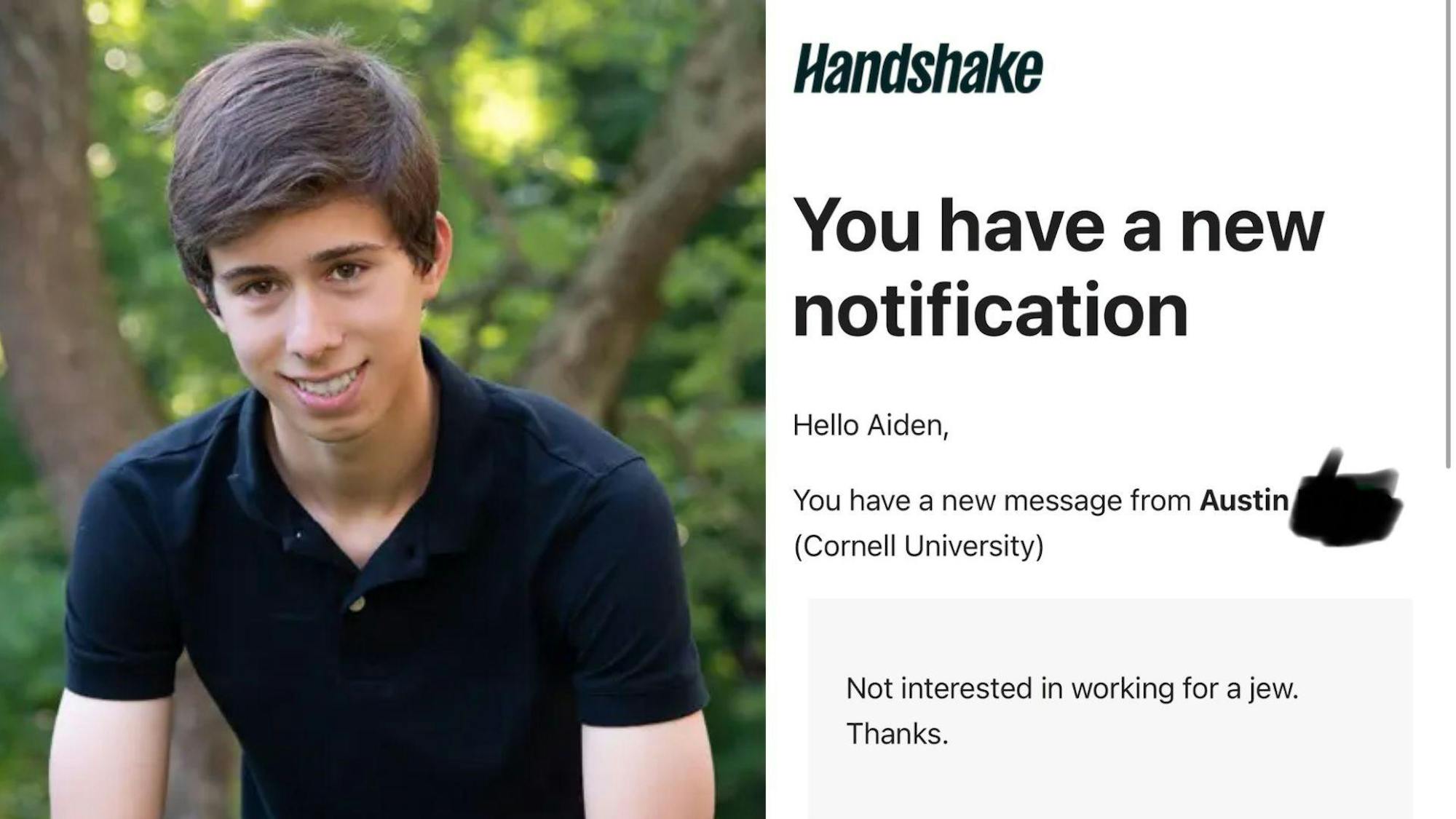
Austin Franco and the message he sent to Aiden Einhorn
Something quite disturbing happened this week. I know for years now anti-semitism has been on the rise in the U.S. I know that college campuses have been especially egregious in their tolerance of anti-semitism and, perhaps, even their encouragement of anti-semitism. There have been attacks on synagogues, nearly always resulting in property damage and, horribly, sometimes even resulting in deaths.
But the event that took place this week recommended to me that there are sane people, well-educated people, people who have every expectation of success in this country and, by the way, are born and bred in this country, who have adopted anti-semitism as their “go-to” position regarding Jews. These people are not part of some lunatic fringe, or even a part of organized efforts on college campuses to limit access to certain parts of campus to non-Jews, or dedicated to intimidating Jews on their campus. No, these people are, for lack of a better word, normal guys, the types you would more likely see at a Starbuck’s than at a pro-Palestinian rally. Looks can be deceiving, of course and, in this case, they certainly are. But this event indicates a breadth and width and acceptance of anti-semitism that was not realized before. After all, it’s easy to dismiss the anti-semitic ravings of a foreign exchange student from Lebonon or Syria as part and parcel of the culture of that part of the world. Sadly, the Middle East has been ravaged by war for millennia, or at least decades. And, in recent decades, much of that warring has been founded on or inspired by a deep anti-semitism that is committed to wiping the nation of Israel off the map.
But how to explain this? Austin Franco, a student at Cornell University in Ithaca, New York, class of 2028, applied for a growth/sales position at VrfyID, a real estate startup, on May 26. Through a digital hiring platform called Handshake, he arranged a meeting with the two founders of the company, Aiden and Gabe Einhorn (who are also brothers and are practicing Jews). When Franco didn’t show for the meeting, Aiden Einhorn contacted him about his being a no-show. Franco then responded, “Not interested in working for a jew. Thanks.”
I’m not going to get into the response from Cornell and others. Suffice it to say that Cornell’s Office of Civil Rights is investigating that matter and that, when Franco’s response was posted on X, receiving over two million views, many of the comments toward Franco were less than charitable.
I want to focus on this: Why would a college kid of Franco’s obvious social status and high expectations of a successful future not want to work with a Jew? And why did he think he could respond in such an abrasive and openly anti-semitic way and expect no pushback? It’s clear he didn’t expect any pushback because of the almost nonchalant attitude of his respone. Here is Franco’s explanation, also posted on X, of why he is not interested in working for a Jew: “My experiences with Jews have not been pleasant … this is not to say I havent had positive experiences, but on the aggregate that is not the case. Given that I have been doxed and intim[id]ated by your community including having my personal life investigated for no other reason than a single comment I cant imagine any reasonable person not coming to a similar conclusion.” This is the standard formula that serves as the foundation of bigotry: I’ve had some bad experiences with persons of a particular racial, ethnic, religious or other community, or I’ve heard or been taught bad stuff about them, so I’m going to assume that all or most of them are that way. Rather than recognizing that there are jerks in all communities, the bigot assumes, based on his or her limited experience, that all members of said community are jerks. Rather than concluding that this guy is a jerk who happens to be a Jew, bigots conclude that this guy is a jerk because he is a Jew. The same is true for bigotry against any particular racial, ethnic, religious or other community.
Only someone with his head in the sand is unaware of the rise of anti-semitism in the U.S. and the even more pernicious, widespread and, in some cases, deadly rise of anti-semitism in Europe. But the fact that a highly educated young man with every expectation of having a successful future, attending a highly prestigous and respected university, thinks that he can simply point out that he’s not interested in working for a Jew, and that it’s perfectly within the boundaries of appropriate communication with a professional businessman, and do so with no concerns that he might be targeted as a racist, a bigot, an anti-semite, or as someone whose personal prejudices might make him unsuitable for employment in other places – in other words, a smart, normal kid with dreams of a bright future, the fact that he could make such a statement implies that anti-semitism is now the norm in our culture. Or, at least, young people like Austin Franco think it is. And if they think it is, then we know in the heart and mind of many of his peers it is the thinking.
Do the majority of young people think this way about Jews, and of society’s expectations for Jews? I don’t know. I don’t know as many young people as I used to, for obvious reasons. It’s one thing for a hostile Arab exchange student to be shouting anti-semitic slogans. It’s quite another when a born and bred American thinks he can make such an anti-semitic statement with no repercussions. But this incident suggests that anti-semitism’s roots are much deeper than we thought.
How to fight back? First and foremost, I think the responsibility lies on parents, especially Christian parents, to protect the Jews when we can. That means teaching our children well about the historical relationship between Christans and Jews, and the discordant part radical Islam plays in how we look at and treat others. It means taking people as they are, because of how they are, how they act, and not thinking we understand another perfectly when we discover what they are. There are a lot of “influencers” out there on the internet who are never so happy as when they are bashing others, and Jews have suffered the worst of this bashing.
Prejudice and bigotry is rooted in fear of the unknown. When we get to know another person, we usually don’t fear them so much. I’m not advocating going out and recruiting friends because they are Jewish, or Christian, or Muslim, or Black, or Hispanic, or Asian, or White. But I am advocating introducing yourself to others who seem different from you, getting to know them, and allowing yourself to get known be them. Listen to their story, and share your story with them. Will all others respond in a reciprocal way? No. But that shouldn’t dissuade us from giving a good effort to expanding our understanding of others. I suspect after all, that most of us, including Franco and the Einhorn brothers, share the same aspirations: the opportunity to succeed, the chance to meet someone, get married, and raise a family, and the desire to be respected by others regardless of our differences.
Jesus taught us to respond with love when others come at us with hate. What does it mean to love? It means, at least at the most basic level, to hope for them what is best for them. Now, what they think is best for them may not be what God thinks is best for them. So, we pray that God’s will be done in their lives. Ultimately, what else is there?
Be Christ for all. Bring Christ to all. See Christ in all.

