St. Augustine of Hippo
Today, August 28, is the Memorial of St. Augustine of Hippo
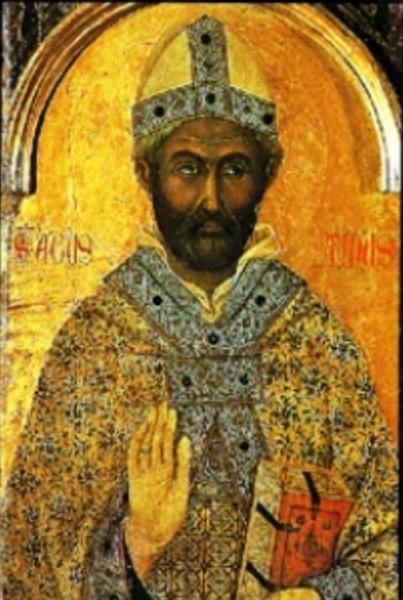
St. Augustine of Hippo is one of the greatest theologians of the Church. Born in 354 in Tagaste, north Africa (present-day Algeria), he was of Berger ethnicity. His father, Patricius, was a pagan and his mother, Monica, a Catholic. In his youth, Augustine rejected both his father’s paganism and his mother’s Catholicism in favor of a faith/philosophy called Manicheaism. He became a professor of rhetoric and moved, first to Rome and then to Milan, living a dissolute life and fathering a son out of wedlock. Augustine provided for his son, Adeodatus, whom he loved very much.
Monica, now a widow who had accomplished with her prayers and witness the conversion of her husband and his mother, moved to Italy with Augustine, continuing to pray for his conversion also. Augustine had read the Bible and was not impressed until he met St. Ambrose, bishop of Milan. Ambrose was Augustine’s intellectual equal and taught him how to read the Scriptures in the Catholic tradition.
One day, Augustine was weeping in a garden, lost over the direction of his life. He heard a child’s voice repeating, “Take up and read!” He opened the Scriptures and found where St. Paul wrote in his Letter to the Romans 13:13-14: “Not in rioting and drunkenness, not in chambering and wantonness, not in strife and envying, but put on the Lord Jesus Christ, and make no provision for the flesh to fulfill the lusts thereof.” Augustine was struck hard, and immediately saw the light of Catholic faith, renouncing his wayward life. He was baptized, along with his son, by St. Ambrose in Milan at the Easter Vigil in 387. Augustine originally desired to live the monastic life, but he was called to the priesthood and then as bishop of Hippo after returning to north Africa.
Augustine took up the challenge of defending the Catholic faith against the heresies of Donatism and Pelagianism and shared the journey of his soul in his book, Confessions. He also wrote The City of God in defense of the faith against accusations that the Roman Empire had fallen after it became weak because of its conversion to Christianity. His other works include treatises on grace and the Holy Trinity. Augustine is regarded as essential to the theology of the Church. His writings had a tremendous impact on the Church’s teaching and understanding of herself and, since the Church came to dominate the West, the same could be said of Augustine’s impact on Western Civilization.
St. Augustine of Hippo died on August 28, 430.
Source: https://www.catholic.org/saints/saint.php?saint_id=418
Here is a selection from the Confessions of Saint Augustine:
Urged to reflect upon myself, I entered under your guidance into the inmost depth of my soul. I was able to do so because you were my helper. On entering into myself I saw, as it were with the eye of the soul, what was beyond the eye of the soul, beyond my spirit: your immutable light. It was not the ordinary light perceptible to all flesh, nor was it merely something of greater magnitude but still essentially akin, shining more clearly and diffusing itself everywhere by its intensity. No, it was something entirely distinct, something altogether different from all these things; and it did not rest above my mind as oil on the surface of water, nor was it above me as heaven is above the earth. This light was above me because it had made me; I was below it because I was created by it. He who has come to know the truth knows this light.
O Eternal truth, true love and beloved eternity. You are my God. To you do I sigh day and night. When I first came to know you, you drew me to yourself so that I might see that there were things for me to see, but that I myself was not yet ready to see them. Meanwhile you overcame the weakness of my vision, sending forth most strongly the beams of your light, and I trembled at once with love and dread. I learned that I was in a region unlike yours and far distant from you, and I thought I heard your voice from on high: “I am the food of grown men; grow then, and you will feed on me. Nor will you change me into yourself like bodily food, but you will be changed into me.”
I sought a way to gain the strength which I needed to enjoy you.
But I did not find it until I embraced the mediator between God and men, the man Christ Jesus, who is above all, God blessed for ever. He was calling me and saying: I am the way of truth, I am the life. He was offering the food which I lacked the strength to take, the food he had mingled with our flesh. For the Word became flesh, that your wisdom, by which you created all things, might provide milk for us children.
Late have I loved you, O Beauty ever ancient, ever new, late have I loved you! You were within me, but I was outside, and it was there that I searched for you. In my unloveliness I plunged into the lovely things which you created. You were with me, but I was not with you. Created things kept me from you; yet if they had not been in you they would not have been at all. You called, you shouted, and you broke through my deafness. You flashed, you shone, and you dispelled my blindness. You breathed your fragrance on me; I drew in breath and now I pant for you. I have tasted you, now I hunger and thirst for more. You touched me, and I burned for your peace.
The Liturgy of the Hours, Office of Readings, August 28.
Be Christ for all. Bring Christ to all. See Christ in all.

