
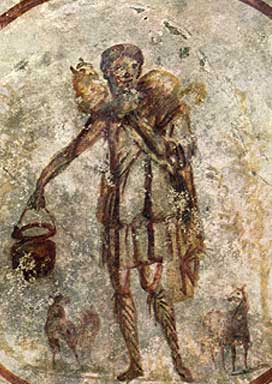
Ancient image of Jesus the Good Shepherd
Raymond E. Brown, SS was a priest of the Order of St. Sulpicius recognized as the pre-eminent Catholic biblical scholar of his time. He was the first Catholic professor to be given tenure at Union Theological Seminary, where he taught for almost thirty years. He was twice appointed to the Pontifical Biblical Commission. He was president of the Catholic Biblical Association, the Society of Biblical Literature, and the Society of New Testament Studies. An expert on the Gospel of John who developed the, now often rejected, theory of the existence of a “Johannine School” that communicated the testimony and teaching of the Apostle and Evangelist, Fr. Brown was, though he had his critics, easily one of the most influential Catholic biblical scholars of the second half of the twentieth century.
I point all of this out because this post will rely heavily on the scholarship of Fr. Brown in his book Jesus God and Man: Modern Biblical Reflections. Fr. Brown’s book was first published in 1967, when I was six years old. Can we really still call it “modern.” Yes, for the simple reason that opinions on this particular topic have not changed much since Brown wrote his book. And what is that particular topic? Does the New Testament specifically refer to Jesus as God? I will look to more contemporary sources, as well. But Fr. Brown’s research still serves as a good introduction to the question.
The critical chapter for our purposes from Fr. Brown’s book is Chapter One: Does the New Testament Call Jesus God? Fr. Brown divides the chapter into several sections. I will consider each section seperately. It’s important to know that, in this book, Fr. Brown’s concern is not what Jesus thought of Himself, but what the authors of the New Testament thought of Jesus. All translations are from the Revised Standard Version, Catholic Edition.
I. Texts That Seem to Imply That the Title “God” Was Not Used for Jesus.
For Fr. Brown, intellectual and scholarly integrity requires that all sides of a question be considered. As such, Fr. Brown begins his book with a section on those verses that seem to imply that the title “God” was not used for Jesus. How these verses were interpreted by the early Church and the Church Fathers was critical to the development of the Church’s faith in the divinity of Jesus. Even still, an honest account of the question demands that these verses be addressed.
Mark 10:17-18: “And as he was setting out on his journey, a man ran up and knelt before him, and asked him, ‘Good Teacher, what must I do to inherit eternal life?’ Jesus said to him, ‘Why do you call me good? No one is good but God alone.” Many of the Church Fathers would interpret this verse as Jesus trying to lead the man into an understanding of His divinity. Fr. Brown rejects that, insisting that there’s no way around it: Jesus here makes a distinction between Himself and God.
Mark 15:34; Matthew 27:46: “And at the ninth hour Jesus cried with a loud voice, ‘Eloi, Eloi, lama sabachthani?’ which means, ‘My God, my God, why hast thou forsaken me?” Certainly Jesus is quoting from Psalm 22:1. My understanding is that, when the Evangelist puts a verse from a psalm or prophet on the lips of Jesus, it represents shorthand for Jesus reciting the entire text. So, it’s my take that Jesus recited the entirety of Psalm 22, and not just the first verse. Given the text of Psalm 22, I think that makes most sense. Jesus addressing the Father as “God” does not preclude His being God, given our faith in the Holy Trinity.
John 20:17: “Jesus said to her, ‘Do not hold me, for I have not yet ascended to the Father; but go to my brethren and say to them, I am ascending to my Father and your Father, to my God and your God.'” Here Jesus makes a clear distinction between Himself and the Father, calling the Father, “my God and your God.” If Jesus is God, why does He have a God? If Jesus is God, why do the apostles have a God other than Jesus. Obviously, the Church will interpret this verse in the context of the Holy Trinity.
Ephesians 1:17: “I do not cease to give thanks for you, remembering you in my prayers, that the God of our Lord Jesus Christ, the Father of glory, may give you a spirit of wisdom and of revelation in the knowledge of him…” See also, Eph. 1:3; 2 Cor 1:3; 1 Pt 1:3. Fr. Brown writes, “Just as in the preceding Gospel examples wherein Jesus speaks of ‘my God,’ these examples from the Epistles make it difficult to think that the author designated Jesus as God.” Again, though, the Church would come to interpret these verses according to Catholic faith in the Holy Trinity. The Father is God, and the Father is Jesus’ God. But this does not preclude that Jesus is also God.
Fr. Brown lists several Scriptures that, he writes, “by means of immediate juxtaposition seem to distinguish between the one God and Jesus Christ. We give a sampling.” Fr. Brown includes Jn 17:3; 1 Cor 8:6; 1 Cor 12:4-6; 2 Cor 13:14; Eph 4:4-6; 1 Tim 2:5. Fr. Brown recognizes that these verses make a close association between Jesus the Lord and God the Father, so they are valuable to a discussion of the Holy Trinity. Even still, these verses reveal what Fr. Brown called a “strong tendency to reserve the title ‘God’ to the Father,” while referring to Jesus as “Lord.” While Fr. Brown doesn’t mention it, let’s not forget that “LORD” was the title used in the Hebrew Scriptures to substitute for the name of God because the name of God was too sacred even to be written out. All of the authors of the New Testament books, with the exception of Luke, were Jews. So the idea that referring to Jesus with the title “Lord” means that He is not God doesn’t work.
Also, regarding the title of “Lord” for Jesus and “God” for the Father, J. P. Nunez, writing for The Catholic Stand website in 2018, makes an argument from Romans 10:8-13: “But what does it say? The word is near you, on your lips and in your heart (that is, the word of faith which we preach); because, if you confess with your lips that Jesus is Lord and believe in your heart that God raised him from the dead, you will be saved. For man believes with his heart and so is justified, and he confesses with his lips and so is saved. The scripture says, ‘No one who believes in him will be put to shame.’ For there is no distinction between Jew and Greek; the same Lord is Lord of all and bestows his riches upon all who call upon him. For, ‘every one who calls upon the name of the Lord will be saved.'” Here is another example where Jesus is given the title “Lord” and the Father is given the title “God.” But, as Nunez points out, the key is the quote at the end of this verse. This is from Joel 2:32: “And it shall come to pass that all who call upon the name of the Lord shall be delivered.” The prophet Joel, of course, is talking about God. Paul, in his Letter to the Romans, uses the title “Lord” in referring to Jesus, then quotes from Joel where the prophet uses the title “Lord” referring to God. It only makes sense that Paul is quoting Joel to refer to Jesus as God.
Finally, for this section, Fr. Brown lists texts that seem to indicate that Jesus is less than God the Father, including Jn 14:28; Mk 13:32; Phil 2:5-10; 1 Cor 15:24, 28. The Philippians verse, a hymn to Christian soteriology, is often used to demonstrate that Jesus was believed to be God by the early Church, in particular verses 6-7: “who, though he was in the form of God, did not count equality with God a thing to be grasped, but emptied himself, taking the form of a servant being born in the likeness of men.” Jesus, being in the “form” of God, Jesus was equal with God, because the form of a thing is the truly true part of the thing (think Plato). But Fr. Brown points out at the end of the hymn Jesus is given the title “Lord,” while the title “God” is reserved for the Father. Arius, a priest of the Diocese of Alexandria in Egypt in the early fourth century, used such verses to support his theology that Jesus was not God, but was a creation of God the Father. Arius believed that Jesus attained divinity because of His obedience to the Father but, of course, the idea of “attaining” divinity is contrary to Christian faith in the nature of God and the oneness of God and also in reason that demonstrates that there can be only one God. The Church would condemn Arius’ teaching as heretical and confirm her faith in the hypostatic union (Jesus is fully divine and fully human) at the First Council of Nicaea in 325. Even still, Arianism continued to be highly influential, especially in the East where, at one time, fully eighty percent of bishops were Arians. The Church finally defeated Arianism only in the seventh century. Today, groups such as the Jehovah Witnesses and the Unitarian Church hold to Christologies similar to that of Arius. Semi-Arian Subordinationism, the belief that the Son is subordinate to the Father, is still held among some groups who reject the dogma of the Holy Trinity. Again, we’re talking about Jehovah Witnesses and Unitarians, but it’s also held by some Trinitarian Evangelical Christians. The belief is that, while Father and Son are ontologically equal, there is a functional inequality related to the different roles the Father and Son assume, the Son voluntarily submitting Himself to the authority of the Father. This theology is rejected by Catholics, Orthodox, and mainline Protestants.
So, we’ve considered the negative evidence on the question: those verses that seem to say that Jesus is not God. These verses caused considerable confusion, and even the development of a couple of heresies, in the early centuries of the Church. But the faith of the Church Fathers and their commentary on these verses helps put them in perspective with our Catholic faith in the divinity of Jesus and also in the Holy Trinity.
Next, I will consider verses that may refer to Jesus as God, but with which there is still debate on the question.
Be Christ for all. Bring Christ to all. See Christ in all.

